Regime Change: The Book That Exposes How Trump Rewired the American Presidency
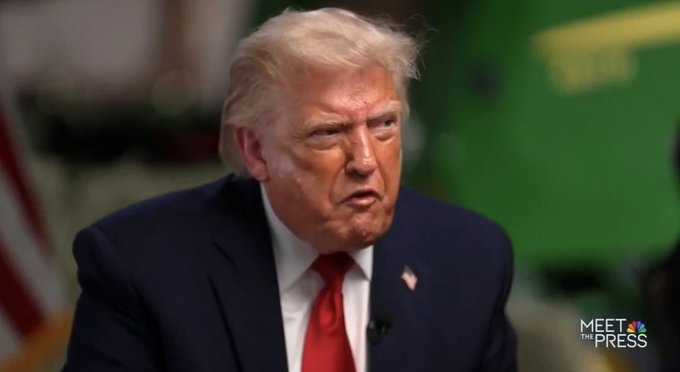
Trump Walks Out of NBC Interview and Inside His War on the American Press (2026) (Image video grab NBC)
Maggie Haberman and Jonathan Swan deliver a deeply reported account of Donald Trump’s second presidency, revealing a White House driven by personal authority, loyalty tests, tariff battles, immigration crackdowns and an unprecedented concentration of executive power.
Book Desk
Authors: Maggie Haberman & Jonathan Swan. Publisher: Simon & Schuster. Published: June 23, 2026. Pages: 496. ISBN: 978-1-668-06724-6. Price: $34.00
There is a particular kind of book that arrives at precisely the right moment — not because its publishers planned it that way, but because reality has conspired to make it inevitable. Regime Change: Inside the Imperial Presidency of Donald Trump, by New York Times White House correspondents Maggie Haberman and Jonathan Swan, is that book. Published on June 23, 2026, just over a year into Donald Trump’s second term, it lands not as a post-mortem but as a dispatch from the inside of a presidency still in motion — and, by the authors’ account, still accelerating.
The title is the thesis. As Haberman and Swan explain in their framing, American journalists have long parachuted into foreign capitals to chronicle the phenomenon of regime change. They came to believe they were witnessing one at home. That is not a rhetorical flourish. It is a structural claim about what Trump’s second term has done — and is doing — to the American presidency as an institution.
The result is 496 pages of densely reported, intimately sourced, and often jaw-dropping contemporary history. Based on more than a thousand interviews conducted over three years, Regime Change does what the best political journalism does: it makes vivid what was previously only rumoured, names what was only implied, and forces readers to confront a reality that, however relentlessly covered, has never been quite this granular, this close, or this alarming.
Who Are the Authors?
Understanding the book requires understanding its authors, because their credibility is the book’s primary asset — and the primary target of White House attacks.
Maggie Haberman joined The New York Times in 2015, having previously worked at the New York Post, the New York Daily News, and Politico. She was part of the Times team that won the Pulitzer Prize in 2018 for reporting on Donald Trump’s advisers and their connections to Russia.
She has covered six US presidential elections. Her 2022 biography of Trump, Confidence Man: The Making of Donald Trump and the Breaking of America, was widely praised as the most psychologically acute portrait of the 45th (and now 47th) president available. She is, by most accounts, the journalist Trump has simultaneously needed and despised more than any other — a person whose access to him is matched only by her willingness to publish what she learns.
Jonathan Swan is a White House correspondent for The New York Times and a former Axios political reporter. He won an Emmy for his legendary 2020 interview with Trump — a face-to-face exchange in which Trump’s responses frequently left viewers stunned. Swan’s skill is a particular kind of forensic patience: the ability to sit across from a subject, present them with their own words and actions, and observe what happens next.
Together, they form one of the most formidable reporting partnerships in American political journalism. Haberman brings intimacy with Trump’s psychology; Swan brings fluency with the mechanics of executive power. The combination, on this subject, is potent.
The Central Argument: An Unconstrained Presidency
The spine of Regime Change is a single, sustained argument: Trump’s second term is categorically different from his first — not merely in policy but in kind. The institutional, personal, and legal constraints that defined and sometimes hobbled the first term have been systematically dismantled.
As Haberman and Swan write, the generals who once told Trump “no” are gone. The lawyers who remain have learned to pick their battles carefully. The aides who once saw his behaviour as dangerous and privately worked to slow or redirect it have been replaced by loyalists who believe, as Haberman put it in a television interview, that there is “something almost mystical about him, that he can hear frequencies that maybe they can’t.”
The new acid test for anyone seeking a place near the center of power was, the authors report, January 6. Anyone with ambitions inside this White House had to demonstrate the right posture toward that day.
The result, as MSNBC’s review of the book captured it, is “a vicious cycle of incompetence and moral corruption. The president has finally created an administration that works exactly how he wants it to, and the result is” a White House where aides “enable him to be the worst version of himself, and in turn he makes them the worst version of themselves.”
This is not a new observation, but what Haberman and Swan bring to it is evidence — specific, named, sourced, and often extraordinary.
The Reporting: What the Book Reveals
The Iran War Decision
The most consequential reporting in Regime Change concerns Trump’s decision to take the United States into war with Iran. Haberman and Swan construct, from their reporting, a detailed account of the Situation Room deliberations — meetings so tightly held, the authors reveal, that the Treasury Secretary and the Energy Secretary were not informed until one day before the launch of operations.
As Swan explained in a television interview: “The treasury secretary of the United States, the energy secretary — the two people who would have to handle the biggest oil shock in world history — they weren’t in the room. They weren’t in the meetings.” Tulsi Gabbard, then-director of national intelligence, was also excluded. The closure of the Strait of Hormuz that followed sent global oil costs upward and triggered supply disruptions worldwide — consequences the key officials responsible for managing them had been given almost no time to prepare for.
Vice President JD Vance, whose opposition to the war was known, is described as having reminded the president of his reservations in the final conversation before the decision — and then supporting it anyway.
The Epstein Files
Haberman and Swan report in detail on the internal crisis triggered by the Jeffrey Epstein files scandal. Vice President Vance and Chief of Staff Susie Wiles gathered in the Situation Room to manage the fallout. Vance reportedly argued for full release of the files. Trump, according to the authors, wanted the matter buried entirely and was “snapping at anyone who raised it.” The authors write that “relationships at the top of the Justice Department were by now beyond dysfunctional.”
The irony embedded in this reporting — that classified Situation Room facilities were being used for damage-control meetings about a domestic political scandal — did not go unnoticed by reviewers or, apparently, by the White House. The administration’s alarm about Haberman and Swan’s sourcing in the Situation Room became itself a story in the weeks before publication.
Trump’s Self-Comparisons
One of the book’s most discussed revelations is a scene in which Trump, during a March 2026 interview with the authors, produced and proudly shared a two-page document arguing that he was more powerful than Attila the Hun, Genghis Khan, Napoleon, Stalin, Mao, and Hitler — each of whom, the document contended, had only local or regional power, while Trump’s was global. The document was presented as the work of “a historian.” Haberman and Swan report that the author was, in fact, a golf caddy and personal associate of Gary Player. Trump later shared the document on Truth Social, describing the author as a “presidential historian.”
CNN, which obtained an advance copy of the book, reported this scene as emblematic of something deeper: Trump’s psychological investment in grandiosity had, in the second term, moved from rhetorical habit to something more structurally significant. There was no one left to tell him the document was absurd.
The Oval Office Aesthetic
For those who believe that personal details illuminate character, Regime Change provides several. White House press secretary Karoline Leavitt once walked into the Oval Office to find Trump, according to the authors, clutching a tube of superglue and attempting to affix gold decorations to the marble fireplace mantel himself — unwilling to delegate even the gilding of his own office. His bedroom, the authors report, was often littered with empty potato chip bags, Starbucks wrappers, and ice cream cartons. He was also, for reasons the authors diplomatically do not attempt to fully explain, “sometimes throwing out White House sterling silver utensils.”
The Federal Reserve Vendetta
The book documents Trump’s fixation on Federal Reserve Chair Jerome Powell with characteristic specificity. During a July staff meeting, Trump directed aides to find a way to stop a renovation project at the Federal Reserve building — deploying an obscure planning commission mechanism. His private language about Powell, as quoted by the authors, left little ambiguity about his motivations.
The Justice Department as Instrument
The book chronicles how Trump’s desire for retribution shaped Justice Department decisions. In one episode, Trump vaguely recalled a “lawyer” from his administration who had said the 2020 election was fair, and ordered aides to identify the person. Staffers googled the name and matched it to Chris Krebs, the former head of DHS’s cybersecurity agency who had been fired in November 2020 after declaring that election “the most secure in American history.” Trump ordered an investigation.
Trump Demanded ‘Real Numbers’ on India Tariffs, New Book Reveals Turbulent White House Trade Debate
Strengths of the Book
- Unmatched Access and Sourcing
The most obvious and most significant strength of Regime Change is its sourcing. More than a thousand interviews over three years, covering the first fourteen months of a second term in real time, yield a level of granularity that no amount of analytical intelligence can substitute for. The New York Times review by Fintan O’Toole called the book “riveting and richly textured,” adding that what the authors supply is “the vivid detail that makes these events feel actual.”
- The Structural Argument Holds
Unlike many Washington insider books, which deliver anecdotes without architecture, Regime Change makes and sustains a coherent structural argument: that the second term represents a qualitative shift in how American presidential power is exercised, and that this shift is not accidental but deliberate. Axios, summarizing the book’s themes, noted that the authors identified two overarching forces — Trump’s greater willingness to use power without constraint, and how four years out of office transformed his determination to project that power globally.
- The Reporting Is Cinematic Without Being Sensationalized
One of Haberman’s signature gifts, evident in Confidence Man and again here, is the ability to write scenes that feel inhabited — as if the reader were present. The Situation Room meetings on Epstein; the night before the Iran decision; Trump alone in his bedroom surrounded by chip wrappers and ice cream cartons; Leavitt finding the president with a superglue tube in his hand. These are not cheap anecdotes. They are diagnostic portraits.
- The Authors Demonstrate Self-Awareness About Their Role
Both Haberman and Swan have been accused, at various points in their careers, of being too close to their subject — of providing Trump with a platform that amplifies rather than scrutinizes. Regime Change reads as a deliberate, sustained rebuttal of that critique. The framing — that they are covering a domestic regime change — is a significant statement about the authors’ own judgment of what they have been witnessing. It is a statement that carries professional risk, and that Haberman in particular makes with evident care.
Weaknesses and Caveats
- The Sourcing Question
The book’s greatest strength is also its most contested feature. The revelation that some of Haberman and Swan’s Situation Room reporting appeared to be based on secretly recorded meetings set off a firestorm before publication. When Jon Stewart pressed the authors on The Daily Show about their Situation Room source, both declined to answer. “We’re not going to comment on the tapes,” Swan told MSNBC’s Lawrence O’Donnell. This is editorially defensible — protecting sources is foundational to journalism — but it leaves readers unable to independently assess the reliability of some of the book’s most dramatic scenes.
- The Real-Time History Problem
Any book written about events still unfolding faces a structural problem: it will be incomplete the moment it goes to print. Regime Change covers the first fourteen months of Trump’s second term. By publication date, that term was already further along. Some of the dynamics the authors describe as current may have already shifted. This is not a criticism of the book’s journalism; it is an inherent limitation of the genre that readers should keep in mind.
- Limited on Policy Depth
Regime Change is, above all, a portrait of character, culture, and decision-making process. It is not an economic or foreign-policy analysis. Readers seeking a systematic accounting of the second term’s policy consequences — the full economic impact of the Iran war, the structural changes to the Justice Department, the downstream effects of immigration enforcement — will need to supplement this book with other sources.
The White House Response
No review of Regime Change would be complete without noting that the book’s pre-publication history was itself a story. Trump attacked Haberman publicly before the book appeared, suggesting she and her “associates” could face a lawsuit. Senior administration officials were privately alarmed by the depth of the authors’ Situation Room sourcing. Vice President Vance reportedly expressed concern that the authors might possess audio recordings of classified meetings.
The administration’s anxiety was, in some ways, the book’s most important pre-publication blurb. When a sitting president threatens to sue the journalists writing about him, and when senior officials worry openly about what recordings may exist, it is a reasonable inference that what those journalists have found is significant.
Context: Haberman’s Prior Trump Reporting
Regime Change cannot be read in isolation from Haberman’s prior work. Her 2022 Confidence Man was the most comprehensive psychological portrait of Trump available — a book that traced the origins of his operating style from the New York real-estate world through his first presidency. Regime Change, co-authored with Swan, is in some ways its sequel: where Confidence Man explained how Trump became who he is, Regime Change documents what happens when that person holds power without the guardrails that once, imperfectly, existed.
Together, the two books constitute something approaching a definitive journalistic record of the Trump era. That the second volume was written in real time, while the subject was still in office, makes it rarer and more valuable — and more perishable.
Critical Reception
The New York Times published a review by Fintan O’Toole, who described the book as “riveting and richly textured” and argued that what makes it essential is the authors’ ability to “wrest reality itself back from the distorted world of entertainment, illusion, fantasy and denial that Trump has generated around himself.”
MSNBC’s review called it a book that offers “a genuinely sinister picture” of the Trump White House — one less interested in gossip than in the systemic portrait that emerges when you understand the dynamic between the president and those around him: an administration that “works exactly how he wants it to.”
Axios, reporting on the book’s themes directly from the authors, noted the emphasis on Trump’s transformation — the argument that four years out of office made him “not weaker but far more powerful, more vengeful, and more willing to gamble than any President in modern history.”
Deadline called it “the blockbuster book of the first 14 months of Trump 2.0.”
Verdict
Regime Change: Inside the Imperial Presidency of Donald Trump is essential reading — and it is essential in a way that transcends the usual promotion of political books. Haberman and Swan have written a work of real-time history with genuine consequences. Its reporting on the Iran war decision alone, documenting that the Treasury Secretary and the Energy Secretary were excluded from war-planning meetings with one day’s notice before the launch of operations, is the kind of detail that belongs not just in a book but in a congressional record.
The book is not flawless. Its sourcing, however impressive in aggregate, includes elements that readers cannot independently verify. Its scope, by design, is the first fourteen months of a term that continues. And its focus on character and process, while the book’s greatest strength, means that policy analysis must be sought elsewhere.
But as a portrait of power — of what it looks like when a president has systematically eliminated every check on his instincts and replaced sceptics with believers —Regime Change is authoritative, disturbing, and necessary. The title is not hyperbole. The authors mean it. And the reporting, scene by devastating scene, makes the case.
Rating: 4.5 out of 5 stars
(The most important political book of 2026 — a real-time history of an American presidency like no other.)
Regime Change: The Trump Book That Even Trump Was Waiting For — With Dread
Follow The Raisina Hills on WhatsApp, Instagram, YouTube, Facebook, and LinkedIn




About The Author