Restoring Faith in Ram Mandir is Yogi’s Biggest Test Beyond Politics
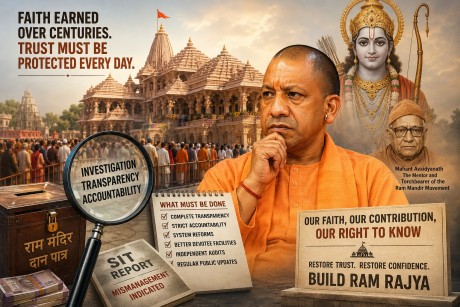
Yogi Adityanath’s Biggest Challenge Yet? The Ram Mandir Donation Controversy (Image representative image_
By SIDHARTH MISHRA
The controversy over alleged financial irregularities at the Ram Mandir has become a defining challenge for Yogi Adityanath. Can transparency and accountability restore devotees’ confidence?
New Delhi, June 24, 2026 — The controversy surrounding the alleged mishandling of donations at the Ram Mandir in Ayodhya presents one of the most significant challenges in the political life of Uttar Pradesh Chief Minister Yogi Adityanath. More importantly, it is a test not merely of governance but of faith, trust and accountability. The Ram Mandir movement was never just about constructing a grand temple. It was about restoring civilizational confidence, fulfilling a centuries-old aspiration and creating a symbol of national unity rooted in faith. Any controversy involving the management of the temple therefore strikes at the heart of that emotional investment made by millions of devotees.
For Yogi Adityanath, the issue carries an added personal dimension. Long before he became Chief Minister, he inherited the ideological and spiritual legacy of Mahant Avaidyanath, one of the prominent leaders associated with the Ram Janmabhoomi movement. Countless saints, social workers, political activists and ordinary devotees sustained the movement itself over decades. Therefore, safeguarding the credibility of the Ram Mandir is not just a governmental responsibility for Yogi; it is also a moral obligation linked to the very tradition from which he emerged.
The allegations of embezzlement and financial irregularities have understandably disturbed devotees. Prima facie evidence suggests that there may have been serious lapses in financial management. Whether these amount to outright corruption, negligence or procedural shortcomings will be established only after a thorough investigation. Yet public perception often moves faster than official inquiries. In matters of faith, even a small doubt can have disproportionately large consequences.
The Bharatiya Janata Party and the wider Sangh Parivar have invested decades of political and social capital in the Ram temple movement. For millions of supporters, the temple represents the culmination of a struggle spanning generations. If questions begin to emerge regarding the integrity of its management, the damage will not remain confined to Ayodhya. It could potentially affect public trust in institutions associated with the movement itself.
To his credit, Yogi Adityanath responded quickly after the allegations surfaced. He publicly reminded people that those who had struggled for nearly 500 years for the reconstruction of the temple should be given a few days to investigate the charges. He constituted a Special Investigation Team and sought a detailed inquiry into the matter. The preliminary findings reportedly point towards mismanagement and procedural lapses that require correction.
However, the challenge before the Chief Minister extends beyond conducting an investigation. Investigations determine facts; confidence is restored through transparency and reform. At present, many devotees are willing to trust Yogi Adityanath personally, but they are uncertain about the systems operating within the temple administration. This distinction is important. The issue is not whether people trust the Chief Minister. The issue is whether they trust the mechanisms responsible for protecting their donations and ensuring proper management of the shrine.
The first step Yogi should take is to ensure complete transparency. The findings of the SIT should be made public to the greatest extent possible without compromising legal proceedings. Any attempt to shield individuals or institutions from scrutiny will only deepen suspicion. Devotees have contributed generously to the temple and have every right to know how their contributions are being managed.
Second, accountability must be visible and swift. If wrongdoing is established, those responsible should face consequences irrespective of their status or connections. The Ram Mandir cannot become a place where accountability is diluted because of prestige or influence. On the contrary, the standards of integrity applied there must be higher than those applied elsewhere. A temple dedicated to Lord Ram, who symbolizes righteousness and justice, must reflect those values in its administration.
Third, the temple trust requires structural reforms. Independent financial audits should become a regular feature of temple management. Annual audit reports should be placed in the public domain. Modern accounting systems, digital donation tracking and transparent procurement mechanisms should be introduced wherever required. Technology can significantly reduce opportunities for misuse while increasing public confidence.
Fourth, there is a need to improve the overall experience of devotees. While the Uttar Pradesh government has transformed Ayodhya’s infrastructure and created world-class facilities around the temple complex, complaints regarding arrangements inside the temple continue to surface. Many pilgrims appreciate the city’s redevelopment but express dissatisfaction with crowd management, information systems and basic facilities within the temple premises. Addressing these concerns would send a powerful message that the focus remains on devotees rather than administrators.
Fifth, Yogi Adityanath should consider creating an advisory council comprising respected saints, financial experts, retired administrators and representatives of devotees. Such a body could periodically review temple management practices and recommend improvements. Institutional oversight would help ensure that future controversies are detected and addressed before they escalate.
Most importantly, the Chief Minister must communicate directly with devotees. The emotional nature of the issue requires more than bureaucratic responses. People need reassurance that their faith has not been betrayed and that corrective action is being taken. Regular updates regarding the investigation and reform measures would help bridge the gap between official action and public perception.
The Ram Mandir is not merely a religious structure. It is a symbol carrying the hopes, sacrifices and emotions of millions. Its sanctity depends not only on its magnificent architecture but also on the integrity of those entrusted with its management. Yogi Adityanath’s response to the present controversy will therefore be remembered as much as the temple’s construction itself.
The challenge before him is clear. He must demonstrate that devotion and accountability can coexist, that faith does not require secrecy and that transparency strengthens rather than weakens sacred institutions. If he succeeds, the current controversy may ultimately become an opportunity to establish a model of temple governance worthy of the ideals associated with Lord Ram and the Ram Rajya envisioned by generations of devotees.
(This is an opinion piece. Views expressed are the author’s own.)
FAQs
1. What is the Ram Mandir donation controversy?
The controversy revolves around allegations of financial irregularities and possible mismanagement of donations received by the Ram Mandir in Ayodhya. Investigations are currently underway to determine the extent of any wrongdoing.
2. Why is the issue politically significant for Yogi Adityanath?
Yogi Adityanath is closely associated with the ideological legacy of the Ram Janmabhoomi movement. Any controversy involving the temple’s management directly impacts a project that carries deep emotional and political significance for millions of devotees.
3. What action has the Uttar Pradesh government taken?
The Uttar Pradesh government has constituted a Special Investigation Team (SIT) to examine the allegations and identify any procedural lapses, negligence or financial misconduct.
4. Why is transparency considered crucial in this case?
Devotees have contributed substantial donations to the temple and expect accountability. Public disclosure of investigation findings, independent audits and stronger oversight mechanisms are seen as essential to restoring confidence.
5. What reforms could improve Ram Mandir governance?
Experts have suggested regular independent audits, digital donation tracking, public disclosure of financial reports, improved administrative oversight and the creation of an advisory council comprising saints, financial experts and retired administrators.
Follow The Raisina Hills on WhatsApp, Instagram, YouTube, Facebook, and LinkedIn




About The Author