Rajasthan Civic Polls: BJP Stalwarts Face Setbacks in Their Home Turf
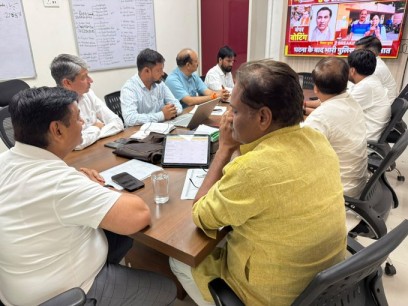
Rajasthan Pradesh Congress Committee President Govind Singh Dotasra holds a meeting during local body elections (Image INC Rajasthan)
By KUMAR VIKRAM
From Bikaner and Jodhpur to Pali and Jhalawar, municipal results expose pressure points for the BJP’s established leadership despite retaining a strong position in Jaipur.
Jaipur, September 15, 2026 — Rajasthan’s municipal election results have thrown up an uncomfortable pattern for the BJP: several of the party’s established political strongholds produced closely fought contests, with Congress and Independents making significant gains in areas associated with senior BJP leaders.
The results do not amount to a uniform rejection of the BJP. The party retained a commanding position in Jaipur, winning 78 of 150 wards. But its performance elsewhere points to pressure at the local level, particularly in the home districts and political bases of several prominent BJP leaders.
Bikaner delivers one of the clearest reverses: The sharpest result came from Bikaner, the political stronghold of Union Minister Arjun Ram Meghwal.
Congress won 42 of 80 wards, crossing the majority mark on its own. The BJP managed 27 seats, while Independents won 10.
The result is particularly significant because Congress’s majority came in one of the BJP’s prominent organisational bases. The incumbent BJP mayor also lost the election, according to the results.
Jodhpur turns into a dead heat: In Jodhpur, the home turf of Union Minister Gajendra Singh Shekhawat, neither major party could establish dominance.
Congress and the BJP won 44 seats each in the 100-member corporation, while Independents secured 10.
Congress nevertheless recorded the higher vote share, at 42.7% against 39.8% for the BJP.
The arithmetic leaves Independents holding considerable importance in determining the eventual composition of the municipal board and underlines the limits of translating a major party’s political influence into an outright municipal majority.
Pali puts BJP’s state organisation under pressure: The result in Pali, associated with BJP state president Madan Rathore, was another setback for the ruling party’s local dominance.
Congress emerged as the largest party with 29 of 65 wards, compared with 21 for the BJP. Independents won 15.
Congress therefore held an eight-seat advantage over the BJP and, together with Independents, commanded 44 of the 65 wards.
The contest is notable because the BJP’s state-level organisational leadership is closely associated with the region.
Jhalawar shows another vote-share challenge: In Jhalawar, the political base associated with former Chief Minister Vasundhara Raje, the supplied figures show Congress with 45.4% of the vote, compared with 40.5% for the BJP.
The five-percentage-point gap is among the more significant vote-share differences in the results presented.
While municipal outcomes cannot automatically be read as judgments on individual leaders, results in established political bastions are often closely watched for signs of changing local electoral dynamics.
Bharatpur exposes another weak point: Bharatpur, the home district of Chief Minister Bhajan Lal Sharma, produced an unusual result.
Independents emerged as the largest bloc, winning 36 of 65 wards. The BJP won 20, while Congress secured seven.
The combined tally of Independents and Congress reached 43, well above the majority mark.
The result highlights the importance of local candidates and independent political networks in Rajasthan’s municipal elections, where party labels do not always translate directly into control of urban bodies.
Jaipur remains BJP’s strongest counterpoint: The BJP’s performance in Jaipur provides an important qualification to the narrative of setbacks.
The party won 78 of 150 wards, substantially ahead of Congress at 53 and Independents at 15.
Yet the vote-share figures are strikingly close: Congress is listed at 38.1% and the BJP at 37.7%.
That gap between vote share and seat conversion demonstrates how municipal ward-level arithmetic can produce very different outcomes from the overall popular vote.
Smaller contests add to the pressure
The pattern extends beyond the major corporations.
In Dudu and Phagi, Congress won 20 seats compared with 17 for the BJP.
In Sirohi, Congress won 37 seats against 28 for the BJP, while the figures for Shivganj show Congress ahead of the BJP as well.
In Badi Sadri, Congress won 13 seats against 12 for the BJP, while in Kuchaman City the corresponding figures were 17 and 15.
The widest gap among the smaller contests came in Jayal, where Congress won 14 seats against just three for the BJP.
The bigger political signal
Taken together, the results suggest that the BJP’s challenge is less about a statewide collapse and more about local electoral vulnerability in several established strongholds.
Bikaner produced a clear Congress majority. Jodhpur ended in a 44-44 tie. Pali gave Congress the largest bloc. Bharatpur saw Independents dominate. Jhalawar recorded a sizeable Congress vote-share lead.
At the same time, Jaipur demonstrated that the BJP continues to possess substantial organisational strength and can convert its support into a large seat tally.
The central political takeaway, therefore, is the uneven performance of the BJP across the very territories where the influence of senior leaders and the party organisation might normally be expected to provide an advantage.
For the BJP’s Rajasthan leadership, the municipal results are consequently less a statewide verdict than a warning signal from several political home grounds: established influence did not consistently translate into municipal dominance.
Follow The Raisina Hills on WhatsApp, Instagram, YouTube, Facebook, and LinkedIn




About The Author