When Political Satire Becomes Political Theatre: The Rahul Gandhi–Modi Mimicry Row

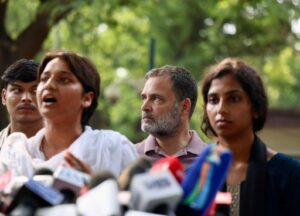
Rahul Gandhi with comedian Pulkit Mani during the Chhatron Ki Goonj event in Indore, where a Modi mimicry performance triggered a political debate. (Image INC Video grab)
By SIDHARTH MISHRA
The Pulkit Mani episode at Indore’s Chhatron Ki Goonj raises a larger question: when satire enters the political stage, where does humour end and political messaging begin?
New Delhi, September 22, 2026 — The episode at Rahul Gandhi’s recent Chhatron Ki Goonj programme in Indore raises a question larger than the immediate controversy over a comedian mimicking Prime Minister Narendra Modi. It is a question about the changing grammar of Indian political communication. Is humour becoming a new political weapon, or are politicians merely rediscovering an old one?
At the Indore event, stand-up comedian Pulkit Mani appeared on stage with Rahul Gandhi and mimicked Prime Minister Narendra Modi’s mannerisms, speech and gestures. The Congress shared a video of the performance. The BJP subsequently accused Gandhi and the Congress of providing a political platform for mockery of the Prime Minister, while the Congress and some opposition voices defended the performance as satire and argued that there should be space for humour in politics.
Traditionally, a comedian at a political gathering might provide entertainment before or after the speeches. The comedian’s performance was separate from the political argument. The Indore episode blurs that boundary. Mani did not merely perform for the audience, he appeared alongside Gandhi and his act was subsequently circulated through the Congress’s own social-media ecosystem. That makes the comedian part of the political communication strategy rather than merely an entertainer.
Political satire works best when the joke exposes a contradiction, hypocrisy, policy failure or gap between rhetoric and reality. It becomes less consequential when the target is reduced simply to a caricature. The difficulty begins when humour ceases to illuminate politics and becomes merely another vehicle for personal attack. This is where the Indore episode becomes complicated.
The BJP has argued that the performance crossed the boundary of political criticism and became insulting, particularly because references involving Modi’s late mother were perceived by BJP leaders as offensive. Union ministers publicly condemned the episode, describing the event in terms such as a “party of comedians” and “cheap political theatre.”
Congress, on the other hand, has maintained that the performance was mimicry and satire rather than a serious statement and that Gandhi was standing with students at the event. Both interpretations are politically significant.
However, the problem with using a comedian as an extension of political messaging is that the politician cannot completely outsource responsibility for the joke. Once the comedian shares the stage with a political leader, the distinction between independent satire and political messaging becomes blurred. If the comedian succeeds, the politician receives the benefits of the viral moment. If the joke crosses a line, the politician can no longer convincingly argue that it had nothing to do with him.
There is another problem for Rahul Gandhi. Narendra Modi has spent years building a highly recognisable political persona. His voice, gestures, clothing, rhetorical style and public mannerisms are familiar even to people who do not closely follow politics. That makes him an unusually easy target for mimicry.
However, attacking such a political leader through caricature can sometimes strengthen the very personality one wants to diminish. The more one imitates Modi, the more one reinforces his recognisability. Every successful imitation therefore carries two messages. One says, how ridiculous this person is, whereas the other says, how recognisable and dominant this person has become. This is the paradox of political mockery.
There is also a larger danger for Indian politics. If every political disagreement becomes a joke, the public eventually loses the distinction between criticism and entertainment. A serious argument about examination reform, unemployment, federalism or institutional accountability can be displaced by a viral punchline. Political communication then becomes a contest over who can produce the more entertaining clip.
The BJP itself has frequently used humour, wordplay, ridicule and personalised political attacks against opponents. This is therefore not a problem confined to one party. The larger phenomenon is the gradual transformation of political communication from argument to performance. The comedian is merely the most visible participant in that transformation.
There could be a lesson here from our classical theatre for the modern day spin doctors. The Vidushak existed alongside the central narrative, he did not replace it. Shakespeare’s clown could illuminate the tragedy, but he did not become the tragedy itself. This distinction is worth remembering.
There is nothing undemocratic about laughing at politicians. Indeed, a democracy in which leaders cannot be mocked becomes an uncomfortable democracy. Satire can puncture arrogance, expose contradictions and make political power less intimidating. But satire is most effective when it makes citizens think after they have laughed.
If the laughter is all that remains, the comedian has not strengthened political discourse. He has merely supplied another piece of political theatre. The Indore episode may therefore represent neither a revolution nor an aberration. It is better understood as the latest stage in an old Indian political tradition adapting itself to the age of social media.
(This is an opinion piece. Views expressed are the author’s own.)
Follow The Raisina Hills on WhatsApp, Instagram, YouTube, Facebook, and LinkedIn




About The Author