Rahul Gandhi Warns 850-Seat Lok Sabha Could ‘Finish Democracy’; DMK Holds Its Ground on Delimitation
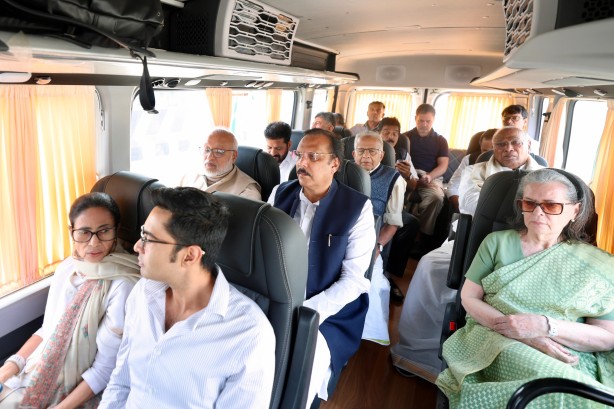
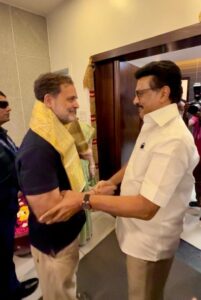
Rahul Gandhi appealed to M.K. Stalin to oppose the proposed delimitation exercise during his visit to Chennai. (Image INC India)
By KUMAR VIKRAM
After meeting M.K. Stalin in Chennai, Rahul Gandhi alleged that the proposed expansion of the Lok Sabha would give the BJP an opportunity to redraw constituencies to its advantage. The Left parties have separately demanded that the Women’s Reservation Act be implemented without linking it to delimitation, exposing differences within the opposition over the legislation.
New Delhi, November 29, 2026 — The proposed expansion of the Lok Sabha to 850 seats has triggered a fresh political confrontation, with Rahul Gandhi warning that the delimitation exercise could fundamentally alter India’s electoral map and threaten the interests of southern states, particularly Tamil Nadu.
But the opposition’s attempt to build a united front has encountered a complication: the DMK, which Rahul Gandhi approached in Chennai, has maintained its support for the Centre’s revised delimitation proposal, saying safeguards for Tamil Nadu have been secured.
The Leader of the Opposition in the Lok Sabha met DMK president M.K. Stalin along with other INDIA bloc leaders on Sunday. Describing the meeting as cordial, Gandhi said the opposition had explained its concerns about the proposed expansion and the possibility of the BJP reshaping all 850 constituencies.
“Our view is that an 850-seat Lok Sabha with delimitation and allowing the BJP to completely shape those 850 seats, change the nature of the constituencies in India, is not only damaging to the Indian nation, it is damaging to South India, and particularly to Tamil Nadu,” Gandhi told the media.
He alleged that the BJP had already tested its approach to delimitation in Assam and Jammu and Kashmir and wanted to extend it across the country.
Gandhi also brought the issue into the realm of cultural and linguistic identity, alleging that the RSS was hostile to Tamil civilisation, language and culture. He warned that once the BJP reshaped the constituencies in an expanded Lok Sabha, democracy in India would be finished.
DMK’s position complicates opposition unity
Rahul Gandhi’s Chennai visit was aimed at persuading Stalin to oppose the proposed legislation. The DMK, however, has maintained that rejecting the revised proposal could leave Tamil Nadu without adequate safeguards when the delimitation process takes place.
Stalin has argued that his party secured assurances protecting Tamil Nadu’s share of Lok Sabha seats and retaining the existing proportional representation among states, based on the 1971 Census, for another 25 years.
The DMK’s position reflects a different political calculation: rather than reject the legislation outright, it wants to use its parliamentary strength to secure safeguards for the state. The disagreement highlights a significant difference within the INDIA bloc over the strategy to be adopted on delimitation.
Gandhi also acknowledged that he was not aware of what the DMK had formally said or done on the issue. He said his appeal to Stalin was based on the concerns he had conveyed about Tamil Nadu, Tamil culture, the Indian Union and the Constitution.
Left parties oppose linking women’s quota to delimitation
The Left parties have raised a separate but connected objection. In a joint statement dated November 29, CPI(M), CPI, CPI(ML) Liberation, RSP and All India Forward Bloc condemned the Union government’s decision to reconvene Parliament after it had remained in abeyance for 104 days.
The parties alleged that the government was attempting to introduce the Delimitation Bill by linking it to the Women’s Reservation Bill after what they described as “Operation Lotus” to split and weaken opposition parties.
The statement said the Left had consistently fought for 33 per cent reservation for women in legislatures and accused the government of delaying implementation of the legislation passed by Parliament in 2023.
The Left parties also questioned the proposed delimitation process, arguing that the government had not adequately consulted political parties or state governments. They demanded clarity on the composition of the Delimitation Commission and the principles it would follow.
Their central demand is that women’s reservation should be implemented immediately and delinked from delimitation. They also called for opposition parties and impartial jurists to be represented in the Commission, and warned against carrying out an exercise with long-term consequences in haste.
A wider constitutional and political contest
The competing positions reveal that the delimitation debate is no longer confined to the number of Lok Sabha seats. It has become a contest over federal representation, the balance between states, the design of constituencies and the implementation of women’s reservation.
For the Congress, the proposed 850-seat structure raises concerns about the BJP’s potential influence over the electoral map. For the DMK, the priority is securing Tamil Nadu’s representation through negotiated safeguards. The Left parties are questioning the process itself and insisting that women’s reservation should not remain dependent on the delimitation exercise.
The government now faces questions about the details of the proposed framework, the safeguards for states and the composition and functioning of the Delimitation Commission.
With the special parliamentary sitting approaching, the opposition’s challenge is twofold: to scrutinise the proposed legislation and to reconcile differences within its own ranks.
The political significance of the debate will therefore depend not only on the government’s proposals but also on whether the opposition can arrive at a common position on the future of parliamentary representation in India.
Modi’s Delimitation Plan Faces an Equality Test: Who Really Benefits?
Follow The Raisina Hills on WhatsApp, Instagram, YouTube, Facebook, and LinkedIn




About The Author