How a 109-Vote Recount Exposed Failure of Electoral Justice
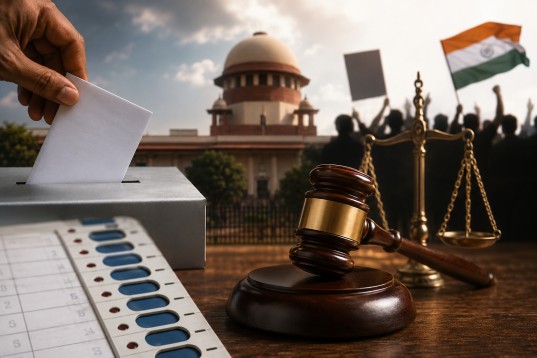
Wrong MLA Served Full Term Before Court Corrected Election Result (A representative image)
By R. NARAYANAN
A recount of wrongly rejected postal ballots revealed that DMK leader Appavu had actually won the 2016 Radhapuram Assembly election, prompting sharp judicial criticism of delays that left the wrong representative in office for an entire legislative term.
New Delhi, June 11, 2026 — The Radhapuram Assembly election of 2016 has emerged as one of the most extraordinary election disputes in India, raising serious questions about judicial delay and its impact on democratic representation.
In the 2016 Tamil Nadu Assembly elections, AIADMK candidate I. S. Inbadurai was initially declared elected from the Radhapuram constituency by a margin of 49 votes over DMK candidate Appavu. The result was challenged by Appavu before the Madras High Court on the ground that 203 postal ballots had been improperly rejected during the counting process.
The Returning Officer had rejected these postal ballots on the ground that they were attested by Government Middle School Headmasters, who, according to the Returning Officer, were not Gazetted Officers.
In October 2016, Appavu filed an election petition before the Madras High Court alleging wrongful rejection of valid postal ballots and other counting irregularities. Inbadurai sought dismissal of the election petition through a preliminary application.
The High Court rejected the application. Aggrieved by this decision, Inbadurai approached the Supreme Court. The matter remained pending there for nearly fourteen months before the appeal was eventually withdrawn.
On 1 October 2019, Madras High Court held that Government Middle School Headmasters were Gazetted Officers for election purposes and that their attestations were valid. The Court ordered an immediate physical recount of the 203 postal ballots and the votes recorded in 39 Electronic Voting Machines (EVMs) within the High Court premises.
However, on 4 October 2019, while the recount was in progress, Inbadurai obtained an interim stay from the Supreme Court. The Supreme Court permitted the recount to continue but directed that the result should not be officially declared. Consequently, the recounted votes were placed in a sealed cover and kept in the custody of the Madras High Court.
Meanwhile, the term of the Tamil Nadu Legislative Assembly expired in 2021. In the subsequent elections, Appavu won the constituency and later became Speaker of the Tamil Nadu Legislative Assembly for the 2021–2026 term, while the 2016 election dispute remained unresolved in the sealed cover.
Is President, per se, Accountable for Delays in State Bills Disposal?
After almost seven years, on 26 May 2026, the Supreme Court disposed of the matter without deciding the central legal question: whether Government Middle School Headmasters are Gazetted Officers and legally authorised to attest postal ballot papers under the Election Rules. Observing that no useful purpose would be served by adjudicating the issue after such a long lapse of time, the Supreme Court left the question of law open for determination in a future case and remitted the matter to the Madras High Court for passing final orders.
On 3 June 2026, the Madras High Court opened the sealed cover. The recount revealed that valid votes cast in favour of Appavu had been wrongly discarded during the original counting process. The recount established that Appavu had actually won the election by 109 votes, contrary to the original declaration that Inbadurai had won by 49 votes.
The Court accordingly declared Inbadurai’s election void and formally declared Appavu as the duly elected Member of the Legislative Assembly for the 2016–2021 term. The Assembly Secretariat was directed to make the necessary corrections in the official records.
In a rare expression of judicial disquiet, the High Court strongly criticised the extraordinary delay that had occurred in the case. Justice Jeyachandran observed that the word “unfortunate” was insufficient to describe what had transpired. He characterised the situation as a grave mockery of justice that had deprived the voters of their right to proper representation for an entire legislative term. The Court further cautioned that the country could drift towards autocracy if courts themselves failed to act upon their own observations regarding timely justice.
Although the Supreme Court left the central question of law unanswered, the Madras High Court examined State administrative clarifications and related materials and concluded that Government Middle School Headmasters were indeed competent to attest postal ballot papers. The Court affirmed their status in order to protect the electoral rights of voters.
The legal consequences of the judgment are significant. Appavu, having been declared the lawful winner of the 2016 election, becomes entitled to all monetary benefits and emoluments associated with the office for that legislative term. At the same time, under the well-established doctrine of de facto authority, all legislative acts, proceedings, discussions and votes in which Inbadurai participated during his tenure remain valid and enforceable. No recovery can be made of any salary, allowances or other benefits paid to him during the period he functioned as an MLA.
However, since Inbadurai’s election has been declared void, his tenure cannot be treated as lawful service for the purpose of pensionary benefits or other privileges available to former legislators. At the same time, since the invalidation of his election arose from counting irregularities and not from any wrongdoing on his part, no disqualification attaches to him. He remains eligible to contest future elections.
Similarly, where an election is set aside for technical reasons such as nomination defects or counting errors, the election may be declared void without attracting any disqualification.
In contrast, where an election is invalidated on grounds such as bribery, voter intimidation, corrupt practices or suppression of criminal antecedents, the candidate may face both invalidation of the election and disqualification from contesting future elections for a prescribed period.
The case also exposes a deeper institutional problem. The Representation of the People Act, 1951, provides that courts should endeavour to conclude election petitions within six months.
However, the provision is directory rather than mandatory. Consequently, there are no legal consequences when election disputes remain pending for years. When an election petition is decided only after the entire legislative term has expired, the very purpose of the democratic process stands defeated.
Election petitions are governed by procedures that permit interim applications, interlocutory proceedings, cross-examinations and technical objections. Litigants often utilise these procedural avenues, contributing to prolonged delays. At the same time, the judiciary itself faces severe structural constraints, including substantial vacancies in many High Courts, where vacancy rates frequently approach 30 per cent.
The Election Commission of India also has an important stake in such disputes. As the custodian of the electoral rights of citizens, it bears responsibility not only for conducting elections but also for ensuring that elected representatives genuinely reflect the will of the electorate.
One may therefore question whether the Election Commission and the Union Government should have played a more active role in the proceedings before the High Court and the Supreme Court instead of remaining passive observers.
The State Legislature should have been proactive to expedite the decision by the High Court and SC because it is in its own interest to ensure that each constituency is represented by a duly elected Person.
The irony of an election petition being finally decided nearly eight years after the election itself underscores the vulnerability of the justice delivery system.
Yet, under the constitutional principle of separation of powers and the doctrine of the basic structure, judicial independence remains a protected feature of the Constitution. Neither the Executive nor the Legislature can interfere with the judicial process. Equally, judges and court registries cannot be subjected to legal proceedings merely because a case has taken an unusually long time to conclude.
The most striking feature of this case is not merely that the wrong candidate occupied the seat for five years. What is far-more troubling is that the institutional mechanism meant to correct that error moved so slowly that the correction itself became largely symbolic.
The real remedy therefore lies within the judiciary itself. An effective internal mechanism must be evolved to ensure that election petitions are disposed of within a maximum period of six months.
Delayed justice in election disputes is not merely an administrative problem; it strikes at the heart of representative democracy. The hopes of the common citizen ultimately rest upon the judiciary’s ability to deliver timely and meaningful justice.
(This is an opinion piece. Views expressed are the author’s own.)
His Highness, the Vice President of India: A Superfluous Office?
Follow The Raisina Hills on WhatsApp, Instagram, YouTube, Facebook, and LinkedIn




About The Author