Pickaxe Mountain: Inside Iran’s Deepest Nuclear Site
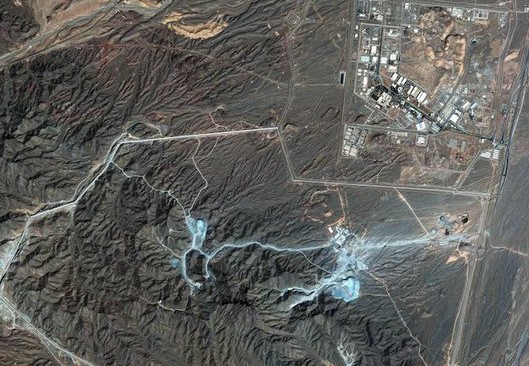
Satellite image of Pickaxe Mountain in Iran (Image X.com)
By TRH World Desk
Trump says the U.S. will “take out” Pickaxe Mountain, Iran’s most fortified nuclear site. Here’s what it is, why it’s harder to hit than Fordow, and what’s at stake.
New Delhi, July 14, 2026 — US President Donald Trump said Monday the United States would “take out” Pickaxe Mountain, Iran’s most deeply buried and hardened nuclear-linked facility, escalating a military campaign that has already struck Iran’s nuclear program repeatedly since June 2025. Speaking with conservative radio host Hugh Hewitt, Trump framed the site as the next major target in the ongoing conflict, saying, “we’re going to take out Pickaxe Mountain,” and warning Tehran to “be ready.”
The comments mark the most direct threat yet against a facility that U.S. and Israeli forces notably avoided striking during their 2025 and 2026 campaigns against Iran’s nuclear infrastructure — largely because of doubts that any existing weapon can reach it.
What Is Pickaxe Mountain?
Pickaxe Mountain — known in Persian as Kuh-e Kolang Gaz La — sits roughly a mile from Iran’s Natanz enrichment complex in the Zagros Mountains. Construction began in 2020, with Iran initially describing it publicly as a centrifuge assembly plant. International Atomic Energy Agency inspectors have never been granted access to the site, and Iran has never formally declared it as an enrichment facility, which has stoked long-standing suspicion that it could house covert enrichment cascades or serve as a repository for Iran’s stockpile of highly enriched uranium.
That secrecy, combined with the site’s extraordinary depth, is why analysts increasingly describe it as the single most consequential unresolved piece of Iran’s nuclear puzzle.
Why Pickaxe Mountain Is Different From Fordow
Fordow, the underground enrichment site the U.S. bombed with a dozen 30,000-pound GBU-57 Massive Ordnance Penetrators in June 2025, was long considered the hardest target in Iran’s nuclear network. Pickaxe Mountain appears to surpass it.
According to reporting from the Eastern Herald, the mountain housing the Pickaxe complex rises to roughly 1,608 meters above sea level, compared with about 960 meters at Fordow — a difference of nearly 650 meters that translates into significantly greater depth for any tunnels bored beneath it.
Estimates of the facility’s actual depth vary by outlet, ranging from roughly 260–330 feet in some assessments to over 100 meters (about 330 feet) beneath solid granite in others. By comparison, the GBU-57 — the largest conventional bunker-buster in the U.S. arsenal — is rated to penetrate only about 200 feet of reinforced concrete before detonating. Granite is also considerably denser and harder than the rock and soil the bomb was designed against, compounding the challenge.
Western intelligence assessments cited by multiple outlets conclude the site is likely beyond the effective reach of the existing U.S. bomb inventory — including the GBU-57. That assessment is reportedly part of why Pickaxe Mountain was left out of the strike packages used against Natanz, Fordow, and Isfahan in 2025, and again during Operation Epic Fury, the U.S.-Israeli campaign that began in late February 2026.
What’s Actually Inside
U.S. officials and independent researchers believe Pickaxe Mountain may serve one or both of two purposes: housing a hardened enrichment cascade hall, and/or storing part of Iran’s remaining stockpile of uranium enriched to nearly 60% — a short technical step from weapons-grade.
The IAEA said Iran had roughly 441 kilograms of 60%-enriched uranium as of June 2025, and agency director general Rafael Grossi has said a portion of that material is believed stored in deep tunnels near Isfahan, with additional quantities potentially at the fortified Natanz-area site.
Trump has directly linked the facility to Iran’s nuclear ambitions before. Speaking in March, he described Iran as pursuing a nuclear weapon “even after we obliterated their key nuclear sites,” referring to a site “protected by granite” where Tehran “wanted to go a lot deeper.”
Andrea Stricker, deputy director of the Nonproliferation Program at the Foundation for Defense of Democracies, has identified that as a reference to Pickaxe Mountain.
Satellite Evidence of Ongoing Construction
Despite the war, satellite monitoring by the Washington-based Institute for Science and International Security (ISIS) indicates Iran has kept building. The group reported on July 2 that recent imagery showed continued vehicle activity and tunnel-entrance hardening at the site — an assessment at odds with Trump’s own claim on Monday that the U.S. sees “no activity” there.
Earlier ISIS reporting from February described concrete being poured over one tunnel entrance and rock and soil being pushed over another, along with construction of a reinforced headworks structure at a third entrance.
ISIS senior fellow Spencer Faragasso has argued the pattern suggests Iran is hedging against failed diplomacy, writing that the facility appears to function as insurance in case negotiations collapse. He has urged Iran to halt construction and allow inspections as a test of its sincerity.
The Military Options — and Their Limits
Analysts broadly agree that conventional airpower alone may not be able to destroy Pickaxe Mountain outright, given its depth and the strength of granite relative to the penetration capability of even the heaviest bunker-buster bombs.
Some reporting has noted the Pentagon recently ordered a new batch of GBU-57 Massive Ordnance Penetrators on an expedited basis — though those munitions aren’t expected to be delivered until 2028, well after any near-term strike decision.
Because of these limitations, some analysts have floated options beyond standard airstrikes, including the possibility of ground operations by special forces to disable the site or secure any uranium stockpile inside it, rather than attempting to collapse the facility from the air alone.
Others have suggested more extreme or unconventional measures. None of this reporting indicates that a nuclear weapon is an option under active U.S. consideration, and no U.S. official has publicly discussed one; claims that a nuclear strike would be required to destroy the site are not corroborated by the sourcing reviewed for this piece and should be treated as speculation rather than established analyst consensus.
What is more consistently reported is uncertainty itself: multiple assessments conclude that even a successful strike campaign might only partially damage the facility — echoing the debate over Fordow, which was hit directly in June 2025 but which analysts believe was only marginally damaged given its depth.
Eventual Conflict Off-Ramp
Trump’s Pickaxe Mountain threat comes amid a fresh escalation. U.S. forces launched new strikes against Iran at 4:45 p.m. Monday, marking a third consecutive day of American attacks — part of a broader campaign officials describe as retaliation for Iranian strikes on commercial shipping.
CENTCOM figures released this month put the total number of targets struck since Operation Epic Fury began in late February at more than 7,800, as the conflict entered its 18th day at that point.
Whether or not Pickaxe Mountain is actually struck in the near term, its unresolved status has become a central sticking point in any eventual off-ramp from the conflict. Analysts including Stricker have argued that neutralizing the site and accounting for Iran’s remaining highly enriched uranium stockpile are the two prerequisites for the U.S. and Israel to credibly claim their military campaign achieved its goals.
Until then, Pickaxe Mountain is likely to remain both a military target and a diplomatic flashpoint — the one piece of Iran’s nuclear program neither side has yet found a way to resolve.
US Intel Wings Face Scrutiny Over Iran Nuclear Strikes Narrative
Follow The Raisina Hills on WhatsApp, Instagram, YouTube, Facebook, and LinkedIn




About The Author