National Geospatial Policy 2022: Gaps & the Case for CAG Audit
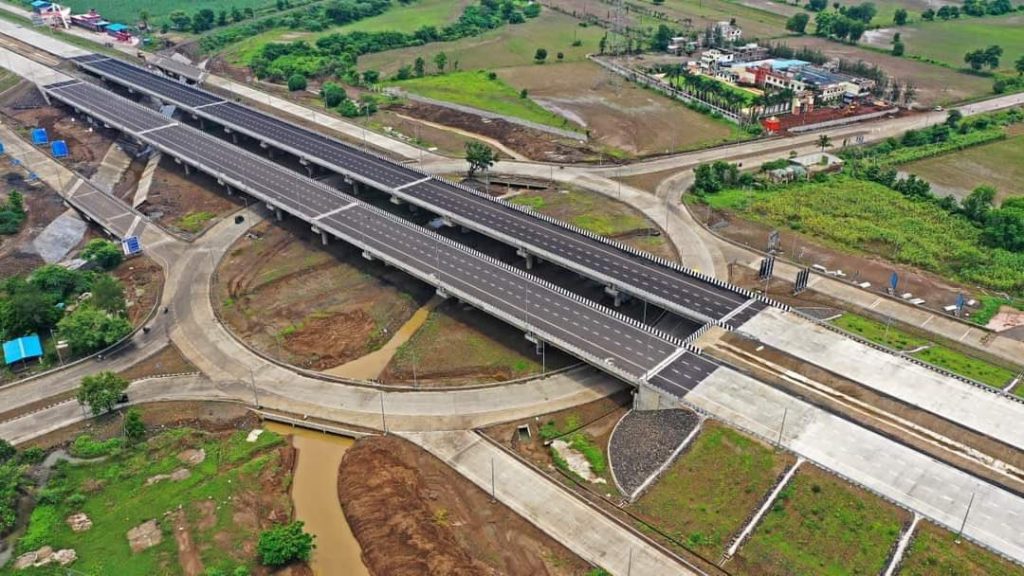
Samruddhi Mahamarg being built as part of PM GatiShakti
India’s 2022 geospatial policy promises to turn maps into governance infrastructure — but the real test lies in State execution, data custodianship, and independent outcome measurement. Here’s what needs to change.
By P. SESH KUMAR
New Delhi, March 28, 2026 — India’s National Geospatial Policy, 2022 is not “a mapping document.” It is a governance redesign that tries to turn location data into public infrastructure-so roads, forests, land records, welfare assets and disaster response stop living in separate departmental silos and start speaking a common language called “place.” The catch is that the policy’s promise lives or dies in the trenches: in States that hold most on-ground assets and approvals, and in Union systems that set standards, build shared platforms, and remove the old fear-factor around maps.
The real architecture: the Union sets the rails, the States run the trains
The National Geospatial Policy, 2022 is structured like a national “operating system” rather than a single project. It creates apex governance through the Geospatial Data Promotion and Development Committee (GDPDC), explicitly positioning it as the top body to drive strategies, programmes and guidelines for the sector. That immediately tells us the Union’s first role: rule-setting, standard-setting, and ecosystem-building-so that every ministry, State, PSU, and private player doesn’t reinvent the same basemap, the same formats, the same metadata and the same procurement.
But the policy also reveals a second Union role that is more operational than people admit: building and running the “national pipes” through which geospatial data is meant to flow. The policy describes a National Geospatial Data Repository (NGDR) and a Unified Geospatial Interface (UGI) that are supposed to be operationalised through data supply chains coming from Central and State-level partnering agency data nodes. In other words, the Union is expected to provide the common exchange and discovery layer, while States and sector custodians feed authoritative datasets into it. When this works, departments stop fighting over whose map is “correct”, because the custodian model becomes visible and enforceable: who owns which dataset, how often it is updated, what quality it meets, and who can reuse it.
Now comes the blunt truth: States are not “partners” here in a ceremonial sense; they are the primary theatre of execution. Land records, local roads, urban drainage, rural assets, encroachments, forest fringes, building permissions, property taxation, mining footprints-these are overwhelmingly State-domain realities. Even national programmes succeed only when States build and maintain reliable spatial layers and then actually use them in approvals, monitoring, inspections, and grievance redress. The policy anticipates this by talking of Central and State-level partnering agencies, and by envisioning lead agencies at Central or State level for identified fundamental or sectoral data themes. So the clean division is this: the Union must standardise, integrate and de-risk; the States must institutionalise, update, and enforce geospatial use in day-to-day governance.
“Liberalisation” was the spark; implementation is the firewood
India’s 2021 geospatial guidelines liberalised the production and use of geospatial data and services, moving the sector away from an older, permission-heavy mindset. The National Geospatial Policy, 2022 explicitly builds on that enabling environment. Liberalisation matters because it changes behaviour: it invites private innovation, reduces compliance anxiety, and makes it possible for States and departments to procure and deploy modern mapping without treating every map like a secret defence file.
But liberalisation is only the spark. The firewood is implementation capacity inside government-especially in States: procurement competence for GIS/RS services, data governance discipline, update cycles, field verification mechanisms, and the willingness to let geospatial evidence overrule “file fiction” when the two clash.
Where implementation typically chokes: the bottlenecks one cannot hide behind dashboards
The first bottleneck is not technology; it is custodianship. When nobody owns a dataset end-to-end, everyone uses it and nobody updates it. The policy tries to solve this with partnering agencies and lead agencies for themes, but States still need to operationalise the same logic internally-down to district and ULB levels-otherwise NGDR/UGI becomes a national showroom fed by stale State layers.
The second bottleneck is standards without enforcement. The policy speaks of standards for national fundamental and sectoral data themes to be developed after consultation with users and providers. In practice, unless States rewrite their GIS procurement templates, departmental MoUs, and “works approval” workflows to require standards-compliant layers and metadata, standards remain PowerPoint.
The third bottleneck is “duplicate mapping”-the silent budget leak. Two departments commission two vendors to map the same village in two formats because they cannot discover, trust, or legally reuse each other’s data. The policy’s UGI ambition is explicitly to eliminate duplicity among national agencies and enable access to Central/State datasets. But that only becomes real when States create reuse rules and data-sharing defaults that officials can follow without fear.
The fourth bottleneck is the human layer: GIS is still treated as a specialist cell, not as mainstream governance. External observers have repeatedly flagged lack of skilled manpower and low demand/awareness inside government as core constraints. The policy’s own focus on capacity and skills is effectively an admission that the system is short on people who can read a layer, question it, validate it, and translate it into an administrative decision.
The fifth bottleneck is “last-mile truth”. Remote sensing can show a road, a pond, a plantation, or a building footprint; it cannot, by itself, certify beneficiary eligibility, workmanship quality, or whether an asset is functional. Without field verification protocols and audit-grade documentation, GIS becomes impressive visuals with weak evidentiary value.
India’s demographic dividend is not destiny — It is a deadline
What progress can be credibly claimed today: look for measurable adoption, not slogans
Because “National Geospatial Policy implementation” is not one scheme, progress is best read through the adoption of geospatial systems that have public metrics.
SVAMITVA is one of the clearest measurable rollouts: official releases have stated drone surveys covering over 3.17 lakh villages (about 92% of targeted villages at the time of that update) and around 2.25 crore property cards prepared for over 1.53 lakh villages, with multiple States/UTs reported as having reached saturation. This is geospatial policy turning into a tangible household document-and potentially into credit access, dispute reduction and tax base improvement- provided States legally operationalise and keep the records current.
PM GatiShakti is another visible track where geospatial layers are used for integrated infrastructure planning. Public reporting around the National Master Plan platform has referenced very large numbers of data layers (in the 1,400–1,600+ range) and the Network Planning Group (NPG[1]) process through which large projects are evaluated for multimodal integration. This indicates institutionalisation at the Union planning level, though the deeper question is how far States and districts have embedded the same integrated planning discipline in their own approvals and land/forest clearances.
A third kind of progress is the growth of national geo-visual platforms and portals that normalise GIS as a public good-such as ISRO-linked platforms being used by policy initiatives and thematic mapping programmes (for instance, NITI Aayog collaborations that use geo-visual platforms for policy indicators and thematic layers). These show “use”, but they do not automatically prove “outcome”.
Outcomes that actually matter: where geospatial changes governance, not just graphics
The most defensible governance outcomes come in four categories.
First is property and local public finance. If SVAMITVA records are legally backed, updated, and integrated into Panchayat/ULB workflows, we can get cleaner ownership evidence, fewer boundary disputes, easier collateralisation, and more credible property taxation. The catch is that tax and dispute outcomes do not flow automatically from a drone survey; they flow from State laws, mutation processes, dispute resolution capacity, and continuous updating. That is why State-level legal and institutional follow-through is the real determinant, not the drone itself.
Second is infrastructure planning and de-risking. GatiShakti’s promise is that a project is designed with visibility of forests, utilities, habitations, logistics nodes, and existing assets- so that we reduce costly redesigns and avoidable clearance conflicts. The platform’s reported layering and NPG appraisal process are signs of this intent. The real “outcome test”, however, is whether project cost and time overruns fall because of fewer route changes, fewer utility clashes, and faster coordination-metrics that must be independently tracked.
Third is scheme implementation integrity. GIS-based planning can help ensure assets are created where they are needed, not where they are convenient; it can also help detect “ghost assets” where photographs and paperwork exist but the ground truth does not. Yet the credibility of this outcome depends on audit-grade protocols for imagery selection, resolution, time-slicing, and departmental concurrence-exactly the kind of discipline described in CAG’s own guidance on using remote sensing and GIS in audit.
Fourth is transparency and accountability. Geospatial systems, when opened to citizens with appropriate safeguards, allow communities to see what the file claims and what the satellite sees. That single shift can change incentives in local governance-because it becomes harder to hide encroachment, diversion, or non-performance behind paperwork.
SEBI fees vs tax: The Constitutional Question Before Markets
Has any independent impact evaluation been carried out? The honest answer: scattered, not systemic
A single, authoritative, whole-of-policy independent impact evaluation of the National Geospatial Policy, 2022 itself is not evident from the policy’s own publication and the mainstream public record surfaced alongside it. What does exist, more plausibly, are evaluations or analyses of specific programmes and platforms that sit inside the broader geospatial ecosystem (for example, programme-specific assessments, academic studies, or sectoral reviews). But we still appear to lack a standardised, publicly reported “geospatial outcomes scoreboard” that ties together the policy’s promises-data democratisation, reduced duplicity, improved governance outcomes, industry growth-into measurable, independently verified results across States.
That gap matters because without independent evaluation, the system tends to grade itself on inputs: number of layers, portals, dashboards, cards distributed, meetings held. Outcomes-dispute reduction, tax buoyancy, project de-risking, time/cost savings, leakage reduction-require third-party measurement, counterfactuals, and time-series data.
What a serious, independent impact evaluation should look like (and who should do it)
If we want this policy to become “digital gold” and not “digital glitter”, evaluation has to be designed like a governance audit, not like a brochure.
A credible model would use a mixed consortium: a neutral national evaluator (for example, an academic consortium with strong spatial analytics capability), a governance/accountability lens (CAG-style audit methodology for evidence discipline- discussed separately), and domain owners (line ministries and States as data providers, not as judges). The UN’s IGIF approach is useful as an external benchmarking lens because it frames national geospatial capability as governance, technology and people pathways-exactly where India’s bottlenecks sit.
The evaluation should test, State by State, whether (a) custodianship is defined and enforced, (b) standards and interoperability are actually used (not merely notified), and (c) decision workflows have changed-meaning files, approvals, inspections, and grievance redress now explicitly reference geospatial evidence. For outcomes, it should measure time/cost savings in infrastructure planning (pre- and post-GatiShakti adoption), property dispute caseload trends and tax base changes where SVAMITVA has matured, and leakage/ghost-asset detection rates in asset-heavy schemes where GIS monitoring is used.
Auditing the Map Itself: Why and How CAG Must Take On India’s Geospatial Revolution
If India has truly decided that maps will drive governance, then the Comptroller and Auditor General of India (CAG) cannot remain confined to auditing files that merely describe geography-it must begin auditing geography itself.
Because here lies the paradox. The National Geospatial Policy promises transparency, precision, integration and efficiency. But unless someone independently verifies whether these promises have translated into measurable outcomes- reduced disputes, faster infrastructure, better targeting of schemes, lower leakages- the entire geospatial revolution risks becoming what India does best: a beautifully designed system that works brilliantly in presentations and selectively on the ground.
This is precisely where CAG’s constitutional mandate becomes both relevant and urgent.
Under Articles 148–151 of the Constitution, the CAG is not just a bookkeeper of expenditure; it is the sentinel of outcomes, economy, efficiency and effectiveness. A policy that claims to transform governance across land, infrastructure, environment and rural development is not merely auditable- it is audit-critical.
The case for a holistic performance audit of the geospatial ecosystem is therefore not optional. It is inevitable. Because geospatial is no longer a sector. It is an operating system for governance. And operating systems cannot be audited in fragments.
Why CAG Must Step In- Before the Map Becomes Myth
The first reason is scale. The geospatial policy cuts across ministries, states, schemes and sectors- from land records and SVAMITVA to infrastructure planning under PM GatiShakti, to forest monitoring by the Forest Survey of India and rural asset planning under MGNREGA. No single ministry owns the outcomes. That alone makes it a classic case for a cross-cutting (real all- India) performance audit.
The second reason is the risk of silent inefficiency. Unlike traditional scams, geospatial failures do not scream. They whisper. A misaligned map leads to a slightly misplaced road. A poor dataset results in suboptimal irrigation planning. A non-integrated layer causes a delayed clearance. Individually, these look like routine inefficiencies. Collectively, they could bleed thousands of crores.
The third reason is the illusion of success. Dashboards are seductive. Platforms look impressive. Data layers multiply. But the real question is brutally simple: has governance improved? Has decision-making become faster, cheaper, more accurate? Or have we digitised inefficiency?
Without independent audit, the system will mark its own answer sheets.
What Exactly Should Be Audited- Beyond the Obvious
A serious CAG performance audit would not begin with technology. It would begin with intent versus outcome. Did the liberalisation of 2021 actually remove barriers for private players, or do hidden compliance frictions persist?
Has the National Geospatial Policy, 2022 led to genuine data sharing across departments, or do silos remain intact? Are national platforms like NGDR and UGI functioning as interoperable ecosystems, or as fragmented repositories?
The audit must then move to data credibility-the most dangerous blind spot. If cadastral maps do not align with satellite imagery, if urban utility layers are incomplete, if rural asset mapping is inconsistent, then every downstream decision is compromised. In geospatial governance, bad data is not a minor error-it is systemic distortion.
Next comes usage intensity. Are departments actually using GIS layers to take decisions, or are maps being generated merely to satisfy reporting formats? A road alignment changed because of spatial analysis is evidence of use. A static map attached to a DPR is evidence of compliance.
Then comes outcome verification- the heart of the audit. Have land disputes reduced in areas where SVAMITVA is implemented? Have infrastructure project delays declined under PM GatiShakti? Has targeting of rural works improved under GIS-based planning tools like Yuktdhara?
Has forest monitoring become more accurate and timely? These are not IT questions. These are governance questions.
How CAG Should Audit- From Files to Coordinates
The methodology must be as transformative as the subject itself.
First, the audit must be spatially anchored. Every sampled project-road, irrigation work, plantation, housing asset-must be geo-referenced. Satellite imagery, drone data and GIS layers must be treated as primary audit evidence, not supplementary material.
Second, the audit must be time-layered. Pre-implementation baseline imagery, mid-course progress and post-completion outcomes must be compared. This transforms audit from a static inspection into a dynamic verification.
Third, the audit must be data-integrated. Land records, financial data, scheme databases and geospatial layers must be cross-analysed. If money flows but geography does not change, the audit finding writes itself.
Fourth, the audit must be risk-based and analytics-driven. Instead of random sampling, anomalies detected through spatial analysis- missing assets, inconsistent patterns, unusual clustering- should guide field verification.
Fifth, the audit must be ‘federated’. Since states are the primary implementers, State Accountants General must be integral to the audit design, ensuring local realities are captured while maintaining national comparability.
This is not futuristic. The building blocks already exist. The CAG has already issued guidance on the use of remote sensing and GIS in audits. The next step is scale and integration.
The Hard Questions the Audit Must Not Avoid
A credible audit must also ask uncomfortable questions. Has geospatial liberalisation truly democratised access, or have large players captured the ecosystem?
Are states using geospatial data to improve governance, or selectively to legitimise decisions already taken? Is cybersecurity of open geospatial data adequately addressed? Are we building a transparent system- or a technically sophisticated but institutionally opaque one? And perhaps the most critical question: Is India measuring outcomes- or merely celebrating inputs?
What the Audit Can Achieve- If Done Right
A well-executed CAG performance audit of the geospatial ecosystem can do what no policy document can. It can establish a national baseline of geospatial maturity across states. It can identify data gaps and quality failures that undermine decision-making. It can quantify efficiency gains or losses in infrastructure and schemes.
It can expose duplication and waste in mapping efforts. It can validate-or challenge- the claim that geospatial data is improving governance. Most importantly, it can convert geospatial from a technology narrative into an accountability framework.
India has done the hardest political act- it has opened up maps. Now comes the harder administrative act- ensuring those maps actually change governance. If the CAG does not step in to measure, verify and question this transformation, the country risks building a vast geospatial superstructure resting on untested assumptions.
Because in the end, the most powerful map is not the one that shows the land. It is the one that shows the truth.
Turn Maps into Muscle – and Make Outcomes Auditable
The next phase of India’s geospatial journey cannot be about launching yet another platform or layering yet another dashboard. It must be about hardening the system where it actually matters-inside institutions, inside workflows, and most critically, inside accountability mechanisms. If the first phase was about opening up maps, the second must be about forcing those maps to deliver measurable governance outcomes.
The Government of India must now play a far sharper and more disciplined role- not as a promoter of platforms, but as a standards-and-integration referee with teeth. The Geospatial Data Promotion and Development Committee (GDPDC) cannot remain a coordinating forum in name; it must actively enforce interoperability, define custodianship unambiguously, and eliminate duplication across ministries. The National Geospatial Data Repository (NGDR) and Unified Geospatial Interface (UGI) must evolve from conceptual architecture into living national infrastructure, where datasets are current, trusted, discoverable and actually used.
But the real battlefield lies in the States. It is here that the reform will either succeed or quietly collapse.
State governments must move beyond pilot projects and partial digitisation to undertake the politically difficult but administratively essential tasks of cleaning up land records, reconciling cadastral maps with satellite imagery, mapping utilities accurately, and institutionalising continuous updates. Custodianship must be fixed, not floating. Data must be shared by default, not guarded by habit. Most importantly, geospatial evidence must enter the bloodstream of governance -in approvals, inspections, dispute resolution and scheme implementation- so that maps stop being advisory attachments and become decisive instruments of administration.
And yet, even this is not enough. Because without measurement, reform drifts.
This is where the role of the CAG becomes central to the next phase. Geospatial governance must now be made auditable in outcome terms, not just observable in visual terms. A structured, nationwide performance audit of the geospatial ecosystem- cutting across schemes like SVAMITVA, PM GatiShakti, MGNREGA and environmental monitoring systems– is no longer desirable; it is indispensable.
Such an audit must shift the national conversation from inputs to impact. It must answer, with evidence anchored in coordinates rather than claims, whether land disputes have actually reduced, whether infrastructure delays have genuinely fallen, whether rural assets are being created where they are needed, and whether environmental monitoring reflects ground reality. Satellite imagery, GIS layers and time-series spatial data must become primary audit evidence, not decorative annexures.
In doing so, audit will perform its most critical function- converting geospatial data from a technological promise into an accountability framework.
India must also recognise that geospatial capability is not a sectoral tool; it is foundational infrastructure. The experience of the United States Geological Survey through its National Map demonstrates how a nation can treat base geospatial layers as a shared public good -standardised, accessible and routinely used across government, industry and citizens. India’s trajectory is moving in that direction, but it still lacks the final, decisive element: ruthless outcome measurement backed by independent verification and State-level enforcement.
Because ultimately, geospatial reform is not about maps.
It is about power- the power to see clearly, to decide correctly, and to be held accountable precisely. India has already opened the map. Now it must ensure that every line on that map can stand up to audit. Only then will maps become muscle.
(This is an opinion piece. Views expressed are author’s own.)
Follow The Raisina Hills on WhatsApp, Instagram, YouTube, Facebook, and LinkedIn




About The Author