From Thekua to Kalamkari: Modi Turns Heritage into Soft Power
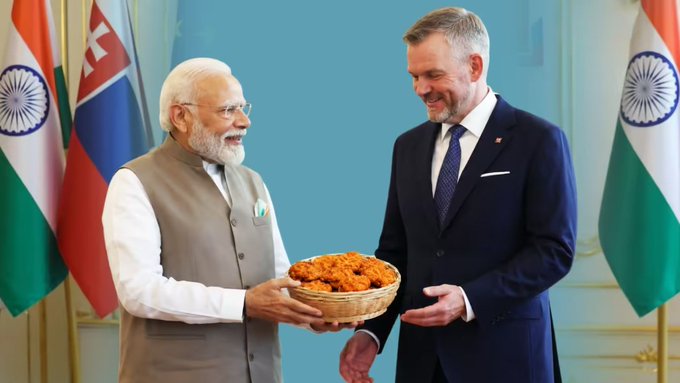
Prime Minister Narendra Modi gifts a basket of Thekua to Slovakia Speaker Richard Raši. (Image Modi on X)
By AMIT KUMAR
From Bihar’s Thekua and Andhra Pradesh’s Kalamkari art to GI-tagged Ashwagandha and Lakadong turmeric, Prime Minister Modi’s diplomatic gifts showcase India’s cultural diversity, artisanal excellence, and civilizational heritage on the global stage.
Patna, June 19, 2026 — Bihar’s delicacies are no more confined to the Bihari diaspora. Bihar’s famed Thekua reached the world’s geopolitical stage with a gesture from Prime Minister Narendra Modi. Earlier, the Prime Minister had made Bihar’s Litti-Chokha a most sought after snacks after partaking the delicacy at an even in New Delhi.
Later, Modi turned his focus to Jhaal-Murhi during campaign trails for West Bengal Assembly elections. This delicacy is joint cravings for the people of West Bengal and Bihar.
Thekua is the key component of the offerings made to the Sun god during the Chhuth Puja festival. This is made of wheat flour, sugar, banana, and dry fruits. Thekua, the sweet delicacy, is prepared by fasting women for the Chhuth festival. The occasion makes the delicacy special.
When Prime Minister Narendra Modi presented a humble Thekua to the Speaker of Slovakia Richard Raši during his recent diplomatic engagements, it was far more than a gift exchange. The traditional sweet from Bihar and Jharkhand symbolized a larger strategy that has become a hallmark of Modi’s diplomacy: using India’s cultural and civilizational wealth as an instrument of soft power.
In recent years, the Prime Minister’s gifts to global leaders have evolved into carefully curated narratives about India. Instead of conventional diplomatic souvenirs, the gifts increasingly highlight India’s regional traditions, ancient knowledge systems, Geographical Indication (GI) products, and artisanal excellence.
Among the most striking gifts was a hand-crafted Kalamkari Mahabharata Painting presented to French President Emmanuel Macron. Created over six months using Andhra Pradesh’s traditional pen-drawing technique, the artwork depicts scenes from the Mahabharata and the teachings of the Bhagavad Gita. The choice reflected India’s philosophical traditions while emphasizing universal values such as ethical leadership, courage, and human dignity.
For France’s First Lady, Modi selected a Pochampally Silk Stole from Telangana. Known for its intricate Ikat weaving, the textile served as a bridge between India’s craft traditions and France’s celebrated appreciation for fashion and design.
The diplomatic symbolism extended to Central Europe as well. Slovakia’s leadership received a collection of gifts representing different regions of India. Prime Minister Robert Fico was gifted a luxurious Kashmiri Silk Carpet, one of India’s most prestigious hand-knotted crafts. President Peter Pellegrini received a Brass Dokra Antelope Set, linking India’s ancient tribal metal-casting traditions with Slovakia’s own natural heritage through the symbolism of the antelope and the Tatra Chamois.
The President was also presented with Himroo Silk accessories from Maharashtra and handcrafted Thewa cufflinks from Rajasthan, both products carrying centuries of craftsmanship and GI recognition.
Perhaps the most intellectually significant gifts were copies of the Charaka Samhita and Sushruta Samhita, presented to Slovak dignitaries. These foundational Ayurvedic texts showcase India’s scientific heritage, including advanced medical and surgical knowledge developed more than two millennia ago.
At the recent G7 Summit, Modi broadened the message by gifting leaders products rooted in India’s wellness traditions. The package included Rajasthan’s GI-tagged Nagauri Ashwagandha, Meghalaya’s high-curcumin Lakadong Turmeric, Jammu and Kashmir’s Ramban Honey, and elegant Banarasi Silk Stoles from Varanasi.
The selection reflects a notable shift in India’s diplomatic storytelling. Instead of relying solely on monuments or political messaging, New Delhi is projecting a narrative built around artisans, farmers, traditional knowledge, and local communities.
Modi’s Global Awards and India’s UNSC Dream: Prestige vs Power
Follow The Raisina Hills on WhatsApp, Instagram, YouTube, Facebook, and LinkedIn




About The Author