Emergency 2.0? The ‘Cockroaches’ Moment of Reckoning Is Here

CJP leaders Saurav Das and Ashutosh Ranka inside the Mandir Marg Police Station. (Image Dipke on X)
By MANISH ANAND
The CJP aspires to rally Gen Z against Modi. It now faces a multi-pronged challenge — how to bring Gen Z to street against Modi government.
New Delhi, October 20, 2026 — With street in Delhi silent, a chief executive magistrate (CEM) court at the Mandir Marg police station in the national capital sent Cockroach Janata Party (CJP) functionaries Ashutosh Ranka and Sourav Daas to two days of judicial custody, extending their stays at Tihar Jail where they had already spent five days. On his way to the Tihar Jail, Daas told Smita Sharma, a journalist-turned-YouTuber, that “India is now under Emergency 2.0.”
Ratna Singh, lawyer of the CJP functionaries, had already been posting regular updates on the CEM court proceedings, arguing that a deliberate move seemed playing out to delay and frustrate. In the end, by evening, Singh’s suspicion was amplified as the CEM court order flashed: the police had sought another five days of judicial custody on grounds of apprehensions that Ranka and Daas would disturb Delhi’s peace.
The ‘Emergency 2.0’ framing by Daas may be seen as an emotional outburst of a youth activist. The description for the state of the affairs also could possibly drop first hints of frustration in the ranks of the CJP.
Daas and Ranka are not the first ones who have been sent to judicial custody on charges which may seem flimsy. A few of Journalists who went to cover a gangrape and murder case in Uttar Pradesh faced similar fate.
Aakriti Choudhary, a Delhi University student, was slapped a charge under National Security Act (NSA) for her alleged participation in the workers’ protests in Greater Noida this year.
Later, the Supreme Court stayed the adverse Allahabad High Court Order against the Gautam Buddha Nagara district magistrate Medha Roopam, who is daughter of Chief Election Commissioner Gyanesh Kumar. There’s no dearth of such cases.
The people have not yet held Roopam accountable for slapping an NSA case against the 25-year-old DU student. Even the varsity students have not thought of urgency to stand with her.
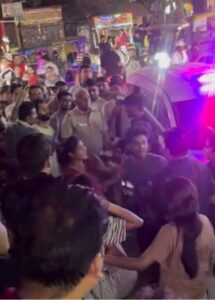
As the police van sped to the Tihar Jail from the Mandir Marg, the street seemed to have become a spectator by not forcing the vehicle to crawl to allow enough footages.
The writing on the wall had begun revealing after the CJP gave the fresh call for agitation to seek resignation of CEC Kumar. The campaign by ‘Cockroaches’ had singled out Prime Minister Narendra Modi for its target. Union Minister for Home Affairs Amit Shah faced a clear challenge to validate and prove his competence as India’s top cop in civilian dress.
Delhi Police personnel found swelling ranks of allies from the paramilitary forces and also from the police units from neighbouring states of Uttar Pradesh and Haryana. The BJP-cheering mobs further supplemented ranks of those who were tasked to tame the CJP.
The script got an administrative re-write as the youth protest faces were commanded to follow the process — bonds, bails, and banishment from the street.
Germany-based YouTuber Dhruv Rathi arguably smelt the air as he first vociferously denied signing any bond and then leaving India by stating that he would lead agitation against the Modi government from abroad, in London. That may be called an honourable exit, for ‘Cockroaches’ would have preferred to have him leading the youth at the Mandir Marg police station and not London.
CJP co-founder Abhijeet Dipke has raised velocity of his laments on the social media against the “brazen subversion of rule of law.” He also may invite criticism for discovering quite late that the ruling dispensation, irrespective of political colour, has always been in the habit of twisting rule of law to serve political expediency.
Late Prime Minister Indira Gandhi’s Emergency had come out with a formal announcement and suspension of fundamental rights. Censors scanned the newspapers’ reports. The Opposition was sent to jails. The people on a largescale sterilization, as Sanjay Gandhi took the issue of population control too seriously. Jhuggi clusters in Delhi were surgically cleared.
As Modi dispensation ritually recalls Emergency to castigate the Congress, critics accuse him of improvising measures taken by Indira Gandhi during Emergency, removing nails which could bleed popular support for him. Media largely in the Modi-era became pro-government. Trouble spots were sanitized — the Comptroller and Auditor General (CAG) of India opted to use its skills in auditing books of the Opposition-ruled states, the Right to Information Act (RTI), for all practical purposes, lost its teeth, and the judicial activism of the past stopped blipping on public radar.
Late Indira Gandhi too could have possibly taken similar measures in the 1970s. But unlike Modi, she had an Opposition that was alive. She also saw millions of people against her swarming the streets across the nation.
Modi is facing episodic protests. They come and go. He commands the popular narrative nozzle. Modi and his Bharatiya Janata Party (BJP) has scale and slots to polarise nationalism.
The CJP aspires to rally Gen Z against Modi. It now faces a multi-pronged challenge — how to bring the Gen Z to the street against an Octopus power which has many arms to tame protests.
(This is an opinion piece. Views expressed are the author’s own.)
Follow The Raisina Hills on WhatsApp, Instagram, YouTube, Facebook, and LinkedIn




About The Author