Liberation Summer Book Review: How the 1968 Miss America Protest Reshaped American Politics
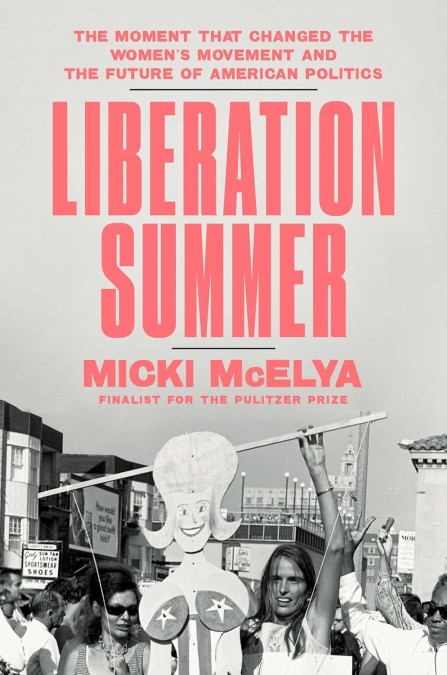
Liberation Summer book review (Image book cover)
TRH Book Desk
Liberation Summer: The Moment That Changed the Women’s Movement and the Future of American Politics
Author: Micki McElya | Publisher: Simon & Schuster | 2026
The Premise
Every retelling of 1968 tends to hit the same beats: the assassinations of Martin Luther King Jr. and Robert Kennedy, the Tet Offensive, the chaos outside the Democratic National Convention in Chicago.
Historian Micki McElya’s Liberation Summer argues that one of the year’s most consequential flashpoints has been consistently left out of that story: the September weekend in Atlantic City when women’s liberationists picketed the Miss America Pageant while, blocks away, the first-ever Miss Black America Pageant staged its own answer to the “lily-white” competition it was protesting.
McElya, a University of Connecticut history professor and a Pulitzer Prize finalist for her earlier book on Arlington National Cemetery, treats that single weekend as a hinge point — the moment, she argues, that beauty itself became explicit political terrain, and where the fault lines of an emerging women’s movement, split by race and ideology, first became visible in public.
What’s Inside
The book moves well beyond the now-iconic (and largely mythical) image of “bra-burning” protesters to reconstruct the months of planning, argument, and coalition-building that led to that day.
It’s populated by a genuinely wide cast: radical organizers Robin Morgan and Carol Hanisch, Betty Friedan, civil rights attorney and activist Florynce Kennedy, reigning Miss America Debra Barnes, first Miss Black America Saundra Williams, and — perhaps more surprising to readers expecting a straightforward feminist history — conservative figures like Phyllis Schlafly and Anita Bryant, whose opposition to the movement McElya treats as part of the same story rather than a footnote to it.
That structural choice is one of the book’s more interesting swings: rather than a single-thread narrative of feminist triumph, Liberation Summer is framed as a study of beauty as contested political ground — fought over not just between feminists and the pageant establishment, but between white organizers and Black organizers building a parallel movement on their own terms.
Critical Reception
The book arrived to strong notices. Kirkus Reviews gave it a starred review, praising McElya for drawing on an extensive body of memoirs, interviews, biographies, and archival histories, and noting that her research translates into a genuinely engaging read rather than a dry academic account.
It was also named to the New York Times’ roundup of the nonfiction titles readers would be talking about this summer, alongside a spot on the Boston Globe’s summer reading list, where critic Chris Vognar highlighted the book’s improbably starry cast of walk-on figures — from Hillary Clinton to Donald Trump — who all intersect with that one Atlantic City weekend in some way.
Historian Sherie M. Randolph, author of a biography of Florynce Kennedy, singled out McElya’s insistence that Black women and their organizations were not peripheral to this history but central to it — a corrective the book makes explicitly and repeatedly.
Elaine Weiss, historian of the suffrage movement, described it as capturing the exact moment second-wave feminism broke into the American mainstream.
‘The Living Declaration’ Traces 250 Years of Arguing Over Four Sentences
Strengths
A genuinely new angle on a familiar story. The Miss America protest has been reduced to a cultural punchline for decades (the bra-burning myth persists despite historians repeatedly debunking it). McElya’s decision to treat it as a serious hinge event, worthy of full archival treatment, feels overdue rather than revisionist for its own sake.
Race is not an afterthought. By giving the Miss Black America Pageant equal narrative weight rather than treating it as a footnote to the “main” protest, the book avoids a trap a lot of second-wave feminist histories fall into — writing a movement history that’s implicitly about white women’s organizing alone.
The cast of characters. Placing Schlafly and Bryant in direct conversation with Friedan and Morgan, rather than covering the backlash in a separate chapter, lets readers see the ideological battle as it was actually fought — in real time, over the same cultural symbol.
Possible Drawbacks
Readers looking for a tight, propulsive narrative should know going in that this is described as a “kaleidoscopic” account — reviewers consistently use words like “sweeping” and “sprawling” to characterize McElya’s approach, which weaves together dozens of figures and organizations rather than following two or three protagonists start to finish.
If you prefer character-driven narrative history in the vein of a single-subject biography, the sheer scope here may occasionally feel diffuse rather than tightly plotted.
It’s also, by design, an argument-driven history: McElya isn’t just recounting events, she’s making the case that beauty politics from 1968 directly shaped #MeToo and the more recent MAGA-era battles over gender.
Readers looking for a purely descriptive account of the pageant protests, without the throughline to contemporary politics, may find the framing more interpretive than they expected.
Who Should Read This
Liberation Summer is aimed squarely at readers of narrative political and cultural history — fans of books that use a single event as a prism onto a broader social movement.
It should appeal to anyone interested in the history of American feminism, the civil rights movement’s overlap with gender politics, or the longer history of beauty standards as a site of political struggle. Given the author’s stated aim of tracing a line from 1968 to today’s gender politics, it’s also a natural pick for readers trying to make sense of the contemporary moment through its historical roots.
Flattened to Punchline
Liberation Summer takes an event that’s been flattened into a punchline — bra-burning feminists at a beauty pageant — and rebuilds it into something closer to what it actually was: a genuinely contested political moment involving Black and white organizers, feminists and their conservative opponents, all fighting over what womanhood in America was supposed to look like.
Backed by a starred Kirkus review and a spot on multiple “best of summer” lists, it’s shaping up to be one of the more talked-about works of narrative history published in 2026.
Rating context: Broad critical consensus has been positive, anchored by a Kirkus starred review and inclusion on best-of-summer lists from the New York Times and Boston Globe.
Follow The Raisina Hills on WhatsApp, Instagram, YouTube, Facebook, and LinkedIn




About The Author