The Fall of Starmer: A Premiership Over Before It Began
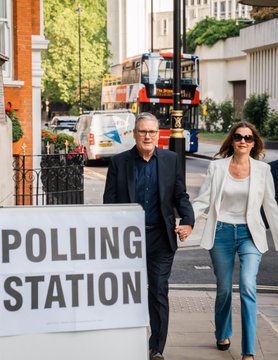
UK Prime Minister Keir Starmer faces rising revolt in Labour Party over poll loss. (Image Starmer on X)
TRH World Desk
Keir Starmer Resigns as Prime Minister: What Happened and What Comes Next
New Delhi, June 22, 2026 — It ended as these things so often do in British politics — not with a bang but with a careful, tearful statement on the steps of Downing Street, a loyal spouse standing close, and a crowd of journalists whose questions, for once, needed no answers.
Keir Starmer, the 16th shortest-serving prime minister in British history, announced his resignation on Monday morning. He will remain in post as caretaker until his successor is chosen. He has asked Labour’s National Executive Committee to open nominations on July 9, with the process concluded before Parliament returns in September.
He pledged to give his successor his “full and unequivocal support, knowing that they will inherit a Britain that is far stronger and fairer than the one I inherited two years ago.”
It was, in its way, a dignified exit. But dignity cannot obscure the scale of the collapse.
The architecture of Starmer’s downfall is by now well documented. The government faced sustained criticism from those to its right over immigration and tax increases, while those to its left criticised its stance on the Gaza War, welfare reform and its refusal to introduce a wealth tax.
The Mandelson disaster — the appointment of Peter Mandelson as US Ambassador, his subsequent firing over ties to Jeffrey Epstein, and the revelation that security clearance had been denied before the appointment was made — corroded trust at the centre of government in ways that proved impossible to repair.
Then came the local elections. The BBC’s projected national vote share indicated that Labour would receive just 17% of the vote if the local elections had taken place across the whole country — in joint third with the Conservatives and down nearly half from the general election. Labour lost control of 35 councils and nearly 1,500 councillors. Wales, which Labour had governed for a century, fell to Plaid Cymru. The party was haemorrhaging from every direction — Reform UK on the right, the Greens on the left.
The fatal blow came on 18 June, when Andy Burnham won the Makerfield by-election with 54.8% of the vote, returning to Parliament specifically to mount a leadership challenge. The Observer headlined on its cover on Sunday that Starmer was “expected to resign” the following day, while The Sunday Telegraph also reported he was “ready” to go, citing allies of the embattled Prime Minister.
Over the weekend, the language of fighting gave way to the language of legacy. Business Secretary Peter Kyle told the BBC that Starmer was “making time to reflect on the political realities, challenges and opportunities that he finds himself in” — adding, carefully: “I know he is a prime minister who always puts his country first.” The statement was not a defence. It was a farewell.
Senior Labour grandee Lord Falconer was more direct. Charlie Falconer, a senior Labour member of the House of Lords, told the BBC on Saturday that Starmer had “absolutely no authority” left, calling for “an agreed transition process in which Andy and Keir cooperate as to when the handover should take place.”
On Monday morning, Starmer spoke to King Charles III. Then he walked out to face the cameras.
His statement was partly a defence, partly a reckoning. He pointed to what he described as Labour’s achievements on the economy, wages, investment, infrastructure, the NHS and workers’ rights, saying: “An economy that is stronger, going faster than our peers, wages rising faster than inflation in every single month since we came to power.”
Then came the sentence that sealed it: “The question my party is asking now is whether I am best placed to lead us into the next general election. I have heard the answer of my parliamentary party to that question, and I accept that answer with good grace.”
Deputy Prime Minister David Lammy, one of Starmer’s most loyal allies, paid tribute immediately. Lammy said Starmer had transformed the Labour Party, rooted out antisemitism, restored trust and “made our party electable again” — adding that his legacy would be one of “change.”
The succession question has, in practice, already been answered. Andy Burnham — the former mayor of Greater Manchester, twice previously a Labour leadership candidate, and now MP for Makerfield — confirmed within hours that he would stand.
Reported potential candidates for the party leadership also include Al Carns, David Lammy, Shabana Mahmood, Angela Rayner and Ed Miliband, though none currently commands anything approaching Burnham’s poll ratings or popular profile.
Candidates need the support of 20% of Labour MPs to be considered. If more than one clears that threshold, a vote will be held among party members and supporters. Nominations open July 9 and close when Parliament breaks for its summer recess on 16 July. If a contest is required, a new leader will be chosen by 1 September.
The one figure expected to challenge Burnham, former Health Secretary Wes Streeting, confirmed Monday that he would back Burnham’s bid instead — dramatically narrowing the field. A coronation, rather than a contest, now looks the most likely outcome. Britain could have a new Prime Minister within ten weeks.
What that prime minister inherits is a country exhausted by political churn, a party that has governed for barely two years yet already burned through its mandate, and a Conservative opposition too divided and a Reform UK too extreme to offer credible alternatives. Burnham’s appeal — rooted in the north of England, sceptical of metropolitan centrism, genuinely popular with working-class voters Labour has been haemorrhaging — may be exactly what the moment requires.
Or it may not be enough. That, as ever, is for the country to decide.
Starmer’s tenure lasted one year and 354 days. Britain’s seventh prime minister in a decade will be sworn in by September.
Follow The Raisina Hills on WhatsApp, Instagram, YouTube, Facebook, and LinkedIn




About The Author