Iran War’s Hidden Economic Weapon: Insurance Pullouts Risks
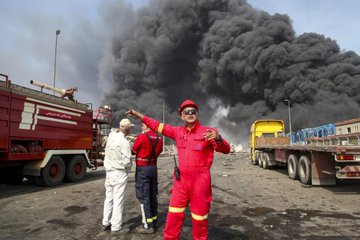
Shahid Rajaee Port Explosion in Iran (Image credit X.com)
Louise Blais, Former Ambassador to the UN, warns of cascading energy and inflation consequences as war risk premiums surge and tanker operators flee Iranian waters
By TRH World Desk
New Delhi, March 3, 2026 — The American and Israeli military campaign against Iran carries an economic dimension that may prove as disruptive as the strikes themselves — and it requires no formal naval blockade to take effect, according to Louise Blais, Former Ambassador to the United Nations and Strategic Advisor on International Affairs.
“Insurance companies are pulling their policies or raising premiums for tankers and vessels near Iran,” Blais warned. She added that “you don’t need a formal blockade to disrupt 20% of global oil flows — and LNG from Qatar.”
The logic is brutal in its simplicity: no insurance means fewer ships willing to transit the region, which drives up freight costs, tightens LNG supply, and ultimately feeds renewed inflation pressure across global economies.
How War Risk Insurance Becomes an Economic Weapon
The mechanism is well established. “War risk insurance operates as a separate policy category from standard marine coverage, with Lloyd’s of London serving as the primary hub for risk assessments,” added the former diplomat, writing on LinkedIn. Premium adjustments can occur within 24 to 48 hours of significant geopolitical developments, with underwriters increasing premiums by factors of 10 to 25 times baseline rates during periods of acute tension.
The scale of disruption this creates is not theoretical. “During the 2023–2024 Red Sea crisis involving Houthi maritime attacks, war risk premiums for vessels transiting affected waters surged from approximately $10,000–15,000 per voyage to $150,000–250,000 per voyage — a tenfold increase that rippled through global freight and energy pricing almost immediately,” Blais added.
With the Strait of Hormuz now under threat, operators facing uninsurable or prohibitively expensive transit routes must consider rerouting via the Cape of Good Hope — adding approximately 6,000 to 7,000 nautical miles to standard Asian market voyages, at an additional fuel cost of $200,000–400,000 per VLCC voyage, plus 7 to 10 additional days of vessel utilisation time per trip.
The Inflation Boomerang: Has Washington Done the Maths?
Blais posed a pointed question to the White House: “Has the White House factored this in? Did the intended secondary target, China, cloud the analysis of the boomerang impact of higher prices on American consumers?”
She raised the possibility that Washington may be calculating the conflict will be short enough to limit sustained disruption — but warned that if the war extends into weeks, the world should expect higher energy prices and strategic reserve politics, serious debates over naval escort programmes for commercial tankers, and significant energy pressure across Asia and Europe.
Qatar’s LNG exports — a critical supply source for European energy security — are particularly exposed, given simultaneous Iranian attacks on Gulf gas infrastructure reported on Day 3 of the conflict.
Winners, Losers, and the Global Inflation Risk
Blais identified the likely economic fault lines with clarity. Potential winners include oil and gas producers in North America, who stand to benefit from elevated global energy prices. Potential losers are far more numerous: consumers around the world, China, Europe, and Middle East exporters themselves — nations whose economic stability depends on uninterrupted energy flows through the very waters now under fire.
The cascading effect follows a clear sequence: insurance pullouts lead to fewer ships, fewer ships drive higher freight rates, tighter LNG supply feeds energy price spikes, and energy price spikes translate into renewed inflationary pressure — hitting hardest in economies already managing fragile recoveries.
The Strait of Hormuz: 20% of Global Oil at Risk
The Strait of Hormuz remains the world’s single most critical oil chokepoint, with approximately 20% of global oil flows and significant volumes of Qatari LNG passing through its waters daily. The IRGC’s reported de facto closure warnings to commercial shipping on Day 3 of the conflict have transformed what was an insurance pricing question into a direct supply disruption threat.
As Blais framed it, the economic impact of this war will be felt not only on the battlefield but at fuel pumps, utility bills, and inflation indices across the globe — and the question of whether Washington fully calculated that consequence remains, for now, unanswered.
Why Iran Chaos Not Soaring Oil to $100: 160-Million-Barrel Worry
Follow The Raisina Hills on WhatsApp, Instagram, YouTube, Facebook, and LinkedIn




About The Author