Three Indians Dead, Modi Silent: India’s Foreign Policy Is on Trial
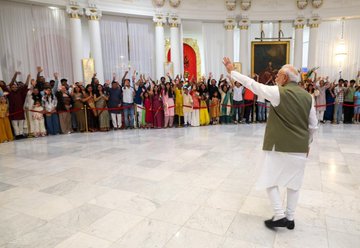
Prime Minister Narendra Modi waves at Indian diaspora in Paris on Sunday. (Image Modi on X)
By TRH Op-Ed Desk
As PM Modi is in France for G7, geopolitics analyst says America’s Gulf killings of three Indians expose a dangerous pattern of diplomatic softness — and warns the silence may cost India more.
New Delhi, June 14, 2026 — Prime Minister Narendra Modi has arrived in Paris. The G7 summit in the south of that country awaits. The photo opportunities with world leaders will be choreographed with the usual precision. And somewhere in the margins of those meetings, Modi is expected to sit across from Donald Trump — a president whose navy has just killed three Indian citizens in the Gulf of Oman with missile strikes on unarmed commercial ships.
The question that diplomatic circles in New Delhi are quietly asking is whether Modi will raise those three names with Trump at all.
India’s participation in G7 outreach summits is not new. Atal Bihari Vajpayee was the first Indian prime minister to attend. Manmohan Singh did so five times. Modi has been a regular presence. But this summit arrives in a uniquely difficult moment — and what Modi does with that moment will speak louder than any joint communiqué.
“After two days of public outrage, External Affairs Minister Jaishankar finally called Marco Rubio,” said Manish Anand, journalist and founder of the political and policy platform The Raisina Hills, in a recent video analysis. “But even that call was decoded by the diplomatic community as far too mild. The condemnation that was needed — a fierce, unambiguous denunciation of America’s attack on unarmed Indian civilians — simply didn’t come,” Anand added.
The US State Department’s readout of the Jaishankar-Rubio call made no mention of regret for the three Indian deaths. Instead, it doubled down: the American blockade in the Gulf of Oman would be enforced strictly, and any violators would face consequences. Three dead Indians apparently did not constitute grounds for an apology. They constituted a warning.
Anand places this failure in a longer, more troubling arc. “When Iranian naval personnel — who were in India as guests, attending a ceremony in Visakhapatnam — were killed by American strikes as they returned home, India did not strongly condemn it,” he noted. “The result is what you see today. Silence invites escalation. America will not stop if India does not speak,” he stressed.
The logic is sobering. India’s Indian Ocean neighbourhood — its zone of maritime influence — is now a theatre where the US Navy is firing missiles at commercial ships carrying Indian crew members. More than 18,000 Indian seafarers are currently working in the Gulf region. India’s maritime trade majorly moves through these waters. The stakes could not be higher — and yet New Delhi’s public language has remained, in Anand’s words, “soft, cautious, and carefully non-confrontational.”
“What is wrong is wrong. No reason can make it right,” Anand said bluntly, adding: “America firing missiles at unarmed people on commercial ships in what is effectively India’s maritime backyard — that needs to be called out in the strongest terms, at the United Nations and bilaterally. The MEA has not done that. And the United Nations, notably, has spoken more strongly than India’s own foreign ministry.”
The backdrop to Modi’s G7 trip is further complicated by the state of India-US ties under Trump’s second term. Trump has leaned conspicuously toward Pakistan during the India-Pakistan tensions of the past months. A European joint statement on the sidelines of a recent summit reportedly carried language on Jammu and Kashmir that aligned with Pakistan’s framing. The EU, Anand observed, appeared to be drifting toward Islamabad’s narrative when Kaja Kallas, the security chief of the bloc, was in Islamabad.
“The strategic autonomy India has spoken of for decades is now a question mark,” Anand said, adding: “Modi’s twelve years in office are being judged right now — on whether India can look a superpower in the eye and say: you killed our people, and that is unacceptable.”
The hardest diplomatic question Modi faces at G7 is not about tariffs or trade or technology partnerships. It is this: will he look Trump in the eye — as Anand says China would, without flinching — and demand accountability for three Indian lives? Or will the meeting produce a warm handshake and a joint statement that buries the Gulf of Oman under the language of partnership?
India’s answer, in the next 48 hours, will be heard long after the cameras have left France.
(Based on the monologue by Manish Anand for the YouTube channel of The Raisina Hills.)
The World Comes to Evian: Why the G7 Summit Could Be the Most Consequential in a Decade
Follow The Raisina Hills on WhatsApp, Instagram, YouTube, Facebook, and LinkedIn




About The Author