India Expands Africa Outreach Through Tech and Maritime Ties
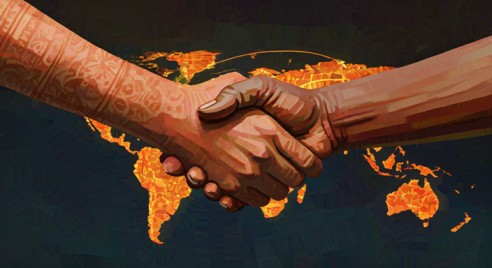
Africa Rising India's Strategic Partnerships (Image TRH)
A new analysis says India is reshaping its Africa policy around digital infrastructure, maritime security, technology sharing, and South-South cooperation as geopolitical competition intensifies across the Global South.
By TRH Strategic Affairs Desk
New Delhi, May 8, 2026 — India’s engagement with Africa is rapidly evolving into a multidimensional strategic partnership focused on technology, maritime security, digital infrastructure, and Global South cooperation, according to an analysis by strategic affairs commentator Vivek Puri published in Defence Research and Studies.
The article argues that India’s Africa policy is no longer confined to historical solidarity rooted in anti-colonial movements and the Non-Aligned Movement. Instead, New Delhi is increasingly positioning Africa at the centre of its geopolitical and economic outreach amid growing competition for critical minerals, maritime influence, digital connectivity, and emerging technologies.
Puri notes that India and Africa share deep civilisational and maritime linkages through the Indian Ocean, with ties strengthened after decolonisation through diplomatic cooperation, trade, and educational exchanges. Over the decades, India expanded this relationship through initiatives such as the Indian Technical and Economic Cooperation Programme and successive India-Africa Forum Summit meetings held in 2008, 2011, and 2015.
According to the analysis, the partnership gained fresh momentum under Prime Minister Narendra Modi, who articulated ten guiding principles for India-Africa relations in 2018. These focused on local capacity-building, digital transformation, counter-terrorism cooperation, climate resilience, maritime security, and inclusive development.
The article highlights that Africa has become one of the largest recipients of Indian development assistance, with India extending more than $11 billion in Lines of Credit across sectors such as power, railways, agriculture, healthcare, and telecommunications.
Trade relations have also expanded significantly. India-Africa bilateral trade reportedly rebounded strongly after the COVID-19 pandemic, reaching over $102 billion in 2022. Indian investments have deepened in countries such as Nigeria and Ethiopia, particularly in pharmaceuticals, energy, textiles, engineering, and digital services.
The analysis further emphasises maritime cooperation as a cornerstone of the relationship. Initiatives such as SAGAR and MAHASAGAR, anti-piracy operations, humanitarian assistance, and the Africa-India maritime engagement exercises in Dar es Salaam are cited as evidence of India’s growing strategic role in the Indian Ocean Region.
Puri argues that the next phase of India-Africa ties will increasingly revolve around digital public infrastructure, artificial intelligence, fintech, cybersecurity, and space-based technologies. The upcoming Fourth India-Africa Forum Summit scheduled for May 2026 is expected to further deepen collaboration in these sectors.
The article concludes that India’s Africa policy is emerging as a proactive, partnership-driven model rooted in South-South cooperation rather than great-power competition.
Follow The Raisina Hills on WhatsApp, Instagram, YouTube, Facebook, and LinkedIn




About The Author