Three Failures Leave Europe Exposed as the Iran War Widens
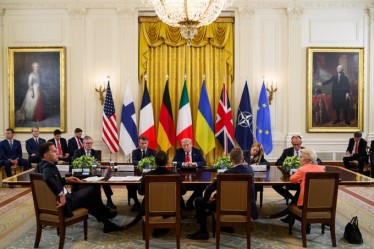
US President Donald Trump hosts Ukrainian President Zelenskyy and European allies at the White House! (Image The White House)
As Trump’s 48-hour ultimatum to Iran expires and the Strait of Hormuz stays closed, former Lithuanian Foreign Minister Gabrielius Landsbergis delivers a stark warning: Europe is unprepared for autonomous drone warfare, excluded from US war planning, and dangerously exposed on its eastern flank — all at the same time.
By TRH World Desk
New Delhi, March 26, 2026 — As US President Donald Trump’s 48-hour ultimatum to Iran lapsed — threatening to “obliterate” Iranian power plants unless the Strait of Hormuz is fully reopened — one of Europe’s most prominent foreign policy voices delivered a blunt diagnosis: Europe is not ready, not informed, and not safe.
Gabrielius Landsbergis, former Foreign Minister of Lithuania and one of the Baltic region’s sharpest security analysts, outlined three interlocking failures in a LinkedIn post.
The military gap
Landsbergis’s first point was the starkest. Western militaries, he wrote, “are not ready to deal with the low-cost autonomous war fighting revolution that accelerated after 2022.” Iran, he noted, spent four years alongside Russia refining drone, speedboat, and underwater attack doctrine — and that knowledge is now being applied in the strait. “What do Europeans have to offer to defend against this? Very little,” he wrote.
That assessment tracks with what US commanders are saying publicly. Trump himself told reporters Friday that reopening the strait was “a simple military maneuver” requiring “ships and volume,” but added that NATO hadn’t had the “courage” to assist. US Central Command Admiral Brad Cooper acknowledged earlier this week that US jets had struck underground Iranian coastal facilities storing anti-ship cruise missiles — yet shipping traffic through the strait remains effectively halted.
The trust deficit
Landsbergis’s second concern was political. Europeans, he wrote, “were not involved in the preparatory stage of the war” and are “kept in the dark about the goals of the war as it stands currently.” The fear in European capitals is simple: could the US suddenly withdraw, leaving Europe and Gulf partners to manage the aftermath? That anxiety has been amplified by Trump’s own erratic signalling — cycling from diplomatic overtures to lifting Iranian oil sanctions to threatening civilian infrastructure — raising questions about whether Washington entered the war with any exit plan at all.
The strategic contradiction
The third failure Landsbergis identified may be the most consequential for Europe’s eastern flank. Washington’s own National Security Strategy, he noted, directs European focus toward deterring Russia while the US handles threats elsewhere. Yet three weeks into the Iran war, the discussion has shifted entirely to European support for a US campaign in the Middle East — precisely “elsewhere.” Spain’s Prime Minister Pedro Sánchez warned of a “global tipping point” and demanded the strait be reopened, reflecting growing European alarm. Meanwhile, with US ammunition reserves shrinking and American attention diverted, Landsbergis warned that “Russia’s ambition to test NATO could have only grown.”
Landsbergis concluded with a direct warning: European involvement in the Iran theatre, “before a rebuilding of at least some of the lost trust, and without stronger US security guarantees for Europe and Ukraine, might be a very dangerous endeavour.”
The Escalation Trap: How the Iran War Could Spiral Beyond Control
Follow The Raisina Hills on WhatsApp, Instagram, YouTube, Facebook, and LinkedIn




About The Author