Government Will Pay IAS, IPS Legal Bills? The Truth Behind DoPT’s 2026 Circular
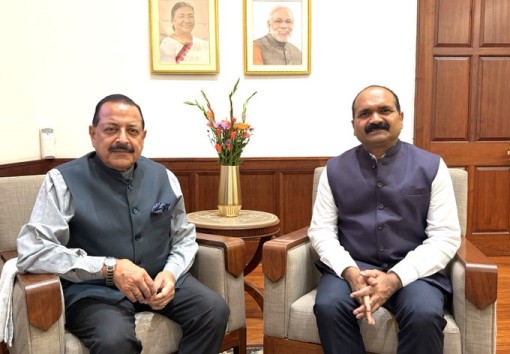
Newly appointed Director of the Lal Bahadur Shastri National Academy of Administration B. Rajender called on Union Minister Jitendra Singh. (Image DoPT on X)
By P. SESH KUMAR
The June 15 communication revived a legal-assistance framework dating back to 1959—but the real question is where protection for honest administration ends and taxpayer-funded immunity begins.
New Delhi, August 12, 2026 — A communication issued by the Department of Personnel and Training (DoPT) on June 15, 2026, has been portrayed in parts of social media as a new Central Government rule granting IAS, IPS and Indian Forest Service officers—serving as well as retired—government-funded legal protection for acts performed in office.
The document is genuine, but the description is not quite so.
DoPT has created no new rule. It has reiterated a legal-assistance regime whose foundations go back to 1959, extended parts of it to retired government servants and retired All India Service officers in 1977, and reinforced its rationale for AIS officers in 1993.
The principle behind the arrangement is defensible: an honest public servant should not have to mortgage his house to defend a government decision merely because an aggrieved private party has chosen to sue him personally.
Yet the same principle becomes dangerous if “official duty” is stretched until corruption, abuse of power, vendetta or personal enrichment is repackaged as official action and the taxpayer is made to finance the defence.
The “new rule” that is neither new nor quite a rule
The story begins with DoPT Letter No. 11018/01/2024-AIS-III dated June 15, 2026, addressed to the Chief Secretaries of all States and Union Territories.
DoPT said questions had arisen regarding the availability and circumstances in which legal and financial assistance could be given to All India Service officers. It pointed to existing instructions appended to the All India Services (Discipline and Appeal) Rules, 1969, identified the 1959 and 1977 orders and said the instructions were being reiterated for information.
There is no amendment notification creating a new statutory entitlement and no newly inserted rule granting IAS, IPS or Indian Forest Service officers a legal-expenses bonanza.
That distinction matters.
A statutory rule can confer rights, impose duties and delimit discretion. What has resurfaced is essentially an executive framework for deciding when government may stand behind an officer who becomes involved in litigation because of public duties.
The framework is discretionary, fact-sensitive and full of qualifications. An officer does not acquire a blank cheque merely because the words “official duty” appear somewhere in a complaint.
Nor should this arrangement be confused with Rule 17 of the All India Services (Conduct) Rules, 1968. Rule 17 deals with vindication of official acts and character. It ordinarily requires an AIS officer to obtain previous government sanction before approaching a court or the press to vindicate an official act subjected to defamatory attack or adverse criticism.
Rule 17 is not the source of the legal-financial assistance now being discussed.
The actual parentage is far older.
1959: The principle beneath the controversy
The foundational document is Ministry of Home Affairs O.M. No. 45/5/53-Estt.(A), dated January 8, 1959.
The memorandum recorded that the decisions were taken after consultation with the Ministries of Law and Finance and the Comptroller and Auditor General.
It separated litigation into different categories instead of treating every officer in court as either a martyr or a villain.
Where government itself institutes civil or criminal proceedings against an officer concerning his official duties or position, the 1959 instructions say government will not finance his defence while those proceedings are underway.
If the proceedings ultimately conclude in his favour, government may consider reimbursing reasonable defence costs—but only if the facts show that he was subjected to those proceedings without proper justification.
An acquittal or favourable result does not mechanically produce a reimbursement cheque.
At the opposite end lies purely private conduct.
Where proceedings do not arise out of or have a connection with official duty or official position, government neither finances the litigation nor reimburses the officer, irrespective of who started the proceedings.
The difficult middle category is a case brought by a private party against an officer in relation to official duties.
Here, government may decide that public interest requires it to undertake the officer’s defence. If so, the proceedings may effectively be defended as though government itself were the defendant.
Alternatively, if the officer conducts his own defence, reasonable expenditure may subsequently be considered for reimbursement if the case concludes in his favour.
Even then, success does not automatically justify reimbursement.
The degree to which the court has actually vindicated the officer’s conduct matters.
That is a far more cautious regime than the expression “Government will pay officers’ legal bills” suggests.
Why retired officers were brought within the shield
The next significant step came in 1977.
Government recognised an obvious practical problem. Administrative litigation frequently takes years. An officer may sign an order today, retire several years later and face personal litigation long after leaving office.
On January 20, 1977, the Department of Personnel and Administrative Reforms extended provisions applicable to private-party litigation connected with official duty to retired government servants, subject to limitations.
The provisions were then extended specifically to retired members of the All India Services through a letter dated April 29, 1977.
The logic remains compelling.
Retirement does not magically convert yesterday’s government decision into today’s private act. If an officer acted lawfully for the State and is sued years later because of that act, his pension date should not determine whether the State stands behind its own administration.
But the 1977 document also produces one of the more surreal features of the 2026 reiteration.
For a retired government servant, the interest-free advance contemplated in the old instructions was capped at Rs 500.
Thus, in 2026, a government communication solemnly reiterates a framework containing a Rs 500 ceiling inherited from 1977.
The doctrine may have survived. The rupee plainly has not.
The One Number That Could Make or Break West Bengal’s First BJP Budget
1993: Why Government thought officers needed protection
The policy rationale became even more explicit in a DoPT communication of September 15, 1993.
Government recorded an increasing tendency to lodge complaints against officers in their personal names for official acts.
It noted that some State Governments required officers to finance their own defence and seek reimbursement later, causing harassment and uncertainty.
It then articulated the institutional logic clearly: in performing official acts, an officer is frequently implementing a government decision. In such situations, it is not unreasonable to expect government to undertake the defence.
That rationale remains persuasive.
Consider the District Magistrate who orders an evacuation during a flood, the Forest Service officer who removes an illegal encroachment, the police officer who orders deployment during communal tension, the Secretary who rejects a Rs 500-crore claim against government or the regulator who closes a hazardous establishment.
Administrative decisions create losers.
If every officer must calculate the price of years of private litigation before signing an unpleasant but lawful order, the result will not be cleaner government.
It will be government by frightened file-notings.
There is therefore a legitimate public interest in telling an honest civil servant that if he has acted for the State, within the broad perimeter of his responsibilities and without private gain or malice, the State will not abandon him merely because litigation followed.
The trouble begins with the next question: What exactly counts as acting for the State?
The dangerous phrase: “connected with official duties”
Few phrases in public law have done more work than “official duty,” and few are more capable of elastic interpretation.
A bribe may be demanded in an office. An unlawful detention may occur in a police station. A procurement manipulation may be recorded on an official file. Land may be allotted through an official order.
None becomes legitimate merely because the accused was sitting behind a government desk.
Conversely, a genuine administrative act does not cease to be official merely because it was later found erroneous, negligent or even in excess of authority.
The distinction is therefore between improper performance of an official function and using official position as the opportunity or cloak for a personal wrong.
Supreme Court jurisprudence concerning sanction for prosecution offers a useful parallel. In D. Devaraja v. Owais Sabeer Hussain, the Court reiterated that protection relating to official duty applies where there is a reasonable connection between the act complained of and the discharge of official functions.
It cannot be used merely as a cloak for an objectionable act.
That distinction should sit at the heart of any modern legal-assistance regime.
The State should insure the risks of honest administration, not the risks of dishonest administrators.
When protection turns into privilege
Suppose a private complainant alleges that an officer cancelled his licence pursuant to government policy. Government examines the file, finds that the officer acted on recorded reasons and authorisation, and undertakes his defence.
There is little difficulty. Now alter one fact.
Suppose the complainant says the licence was cancelled because he refused to pay a bribe. The cancellation order still exists on a government file. The officer can still say he was exercising statutory power.
Should the taxpayer fund his senior counsel because the impugned act took the form of an official order? The problem becomes sharper where an officer and political executive jointly approve a questionable concession.
If the State Government itself decides whether defending the officer is in the public interest, the Government deciding the application may have a political interest in defending the transaction under challenge. “Public interest” then risks becoming circular.
The 1959 framework does not fully resolve this institutional conflict because it leaves substantial discretion with the administrative Government.
Acquittal is not the same as vindication
There is another important feature of the original scheme.
It refuses to equate winning a case with moral exoneration.
Criminal and civil proceedings can fail for many reasons. Evidence may be insufficient. Limitation may intervene. A complainant may lack standing. A prosecution may collapse because sanction was defective. Witnesses may turn hostile.
A court may conclude that misconduct occurred but that the particular offence charged was not established beyond reasonable doubt.
The old instructions therefore require government to consider how far the court actually vindicated the officer’s acts.
That principle should be retained and strengthened.
Public money should not be paid on the crude formula: case dismissed = officer innocent = taxpayer pays.
Article 320: The Constitution itself saw the problem coming
This is not merely an administrative curiosity.
Article 320(3)(d) of the Constitution specifically contemplates claims by serving or former civil servants that legal costs incurred in defending proceedings relating to acts done or purported to be done in execution of duty should be paid from the Consolidated Fund.
The 1959 instructions themselves recognise this constitutional connection.
They say consultation is obligatory in the relevant class of case where a reasonable connection exists between the officer’s act and official duties. The claim must be reasonable, not “pretended or fanciful.”
That phrase may provide the best one-line test for 2026:
A connection with duty must be real, not manufactured after the summons arrives.
The taxpayer enters the courtroom
Once government pays the lawyer, the issue ceases to be only a service matter between government and officer.
It becomes a public expenditure question.
Section 13 of the Comptroller and Auditor General’s (Duties, Powers and Conditions of Service) Act, 1971 requires the CAG to audit expenditure from the Consolidated Funds and examine whether money was legally available and applicable to the purpose for which it was spent and whether expenditure conformed to the governing authority.
That is where legal-defence expenditure becomes important from an accountability perspective. The audit question need not be whether the CAG agrees with the officer’s legal defence.
The legitimate questions are different: Who authorised the expenditure? On what recorded finding was the conduct held sufficiently connected with official duty? Was public interest recorded? Was the Law Department consulted?
Was an expensive private senior counsel engaged when an empanelled counsel was available? Were prescribed fee ceilings followed? Was reimbursement granted merely because proceedings terminated, or was actual judicial vindication considered?
Was an advance recovered when the conditions attached to it failed? These are ordinary questions of financial regularity and propriety.
The black robe of counsel does not render the voucher invisible to audit.
The real test
The 2026 DoPT communication is therefore neither a bureaucratic scandal nor the major new welfare measure for senior civil servants that some online descriptions suggest.
It is an old administrative compact brought suddenly back into public view. That compact says to the civil servant: the Republic will not abandon you merely because you took an unpopular decision on its behalf.
But democracy must add the second sentence: The Republic will not pay your lawyer merely because you committed a personal wrong while occupying its office.
Between those two propositions lies the entire architecture of administrative courage and administrative accountability. India in 2026 needs more than a reminder of old instructions.
It needs a rulebook capable of distinguishing the officer who is in court because he did his duty from the officer who invokes “duty” because he has landed in court.
That is where protection should end and accountability begin.
(This is first of the two-part series. This is an opinion piece. Views expressed are the author’s own.)
CBDT’s Avlokan: More Tax Agreements, But Where Is the Evidence of Public Value?
Follow The Raisina Hills on WhatsApp, Instagram, YouTube, Facebook, and LinkedIn




About The Author