Delimitation Debate: Manish Tewari Questions Regional Seat Gains and Warns of a Weaker Parliament

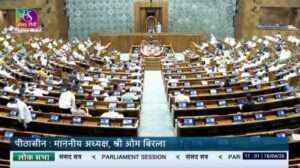
The Lok Sabha on Thursday witnessed din during tabling of bills. (Image X.com)
By The Raisina Hills Political Desk
The Congress MP has questioned the regional distribution of additional Lok Sabha seats and argued that expanding Parliament from 543 to over 800 members could weaken its deliberative role. His intervention comes as M.K. Stalin refuses to withdraw the DMK’s support for the Centre’s Delimitation Bill despite appeals from senior INDIA bloc leaders.
New Delhi, November 29, 2026 — The delimitation debate is acquiring a wider political and constitutional dimension, with Congress MP Manish Tewari questioning not only the proposed distribution of additional Lok Sabha seats among India’s regions but also the consequences of a substantially enlarged Parliament for the country’s parliamentary system.
Tewari’s intervention comes at a politically significant moment. The Congress-led opposition has been attempting to persuade regional allies to oppose the Centre’s proposed delimitation legislation. But the DMK, led by M.K. Stalin, has decided to support the revised Bill, arguing that rejecting it could leave Tamil Nadu without even the minimum safeguards for its parliamentary representation.
In a post on X, Tewari presented an estimated regional distribution of the gains from delimitation. According to his calculations, seven states in the Hindi heartland could gain approximately 104 seats; 10 states in eastern and northeastern India around 46; eight southern states 69; four states and Union Territories in western India 39; and seven states and Union Territories in northern and northwestern India around 22 seats.
Tewari argued that northern and northwestern India, which suffered heavily during Partition and continues to serve as India’s strategic frontier, could emerge as the biggest loser in the proposed exercise.
His intervention adds a new dimension to the familiar North-South debate. The political argument is no longer limited to whether states that achieved greater success in population control would lose relative parliamentary influence. It now also concerns the distribution of additional representation among different regions and the possible consequences for India’s federal balance.
The numbers and the questions they raise
The regional estimates put forward by Tewari deserve closer scrutiny. They are presented as approximate gains, rather than as an official seat-allocation formula. Their significance lies in the political question they raise: how will the proposed increase in parliamentary representation be distributed, and what principles will determine the outcome?
There is also a numerical discrepancy that needs clarification. Tewari refers to the Lok Sabha expanding from 543 to 815 seats. The government’s stated proposal, however, envisages an increase to 816 seats, representing a 50 per cent expansion of the existing strength.
The regional figures cited by Tewari add up to approximately 280 seats. That does not directly reconcile with the increase implied by either 815 or 816 seats. The estimates therefore need to be treated as his political assessment, not as a confirmed allocation of seats.
Stalin’s decision exposes differences within INDIA
The political challenge for the Congress has become more complicated with Stalin’s refusal to reconsider the DMK’s position.
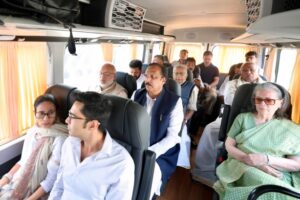
A delegation led by Congress president Mallikarjun Kharge, and including Sonia Gandhi, Rahul Gandhi and Mamata Banerjee, met Stalin in Chennai to persuade him to withdraw the DMK’s support for the Centre’s Bill.
Stalin remained firm. He argued that defeating the legislation would mean losing the limited safeguards available to Tamil Nadu and that the opposition had not offered an alternative proposal. His position is that the state’s interests must take priority.
The DMK’s stand reflects a regional calculation that differs from the Congress’s broader strategy of opposing the proposed exercise. The party maintains that the revised framework offers protection to Tamil Nadu’s parliamentary strength.
This disagreement illustrates the difficulty of building a common opposition position on an issue where regional parties have different electoral and federal priorities. For the DMK, the immediate question is the protection of Tamil Nadu’s representation. For the Congress, the concern extends to the national political consequences of the delimitation exercise.
How much time will the exercise take?
Author Krishan Pratap Singh has raised another important question on X: the time required to complete the delimitation process.
The previous Delimitation Commission, headed by former Supreme Court judge Justice Kuldip Singh, was constituted in 2002. It submitted its final recommendations in 2007, while the exercise was completed in 2008.
Singh has pointed out that government sources are now indicating that the proposed exercise could be completed in approximately two years.
The comparison raises questions about the time available for consultation, examination of demographic data, preparation of constituency boundaries and resolution of regional concerns. The new exercise is expected to operate in a different legislative and political framework, so the previous Commission’s timeline cannot automatically be treated as a fixed benchmark. Nevertheless, the proposed two-year schedule makes transparency and public scrutiny particularly important.
Tewari’s larger concern: Will Parliament remain Parliament?
Tewari’s most consequential argument, however, goes beyond the distribution of seats.
In another post on X, he questioned the legitimacy and parliamentary character of debating the Constitution (132nd Amendment) Bill, 2026, in a Lok Sabha whose composition, in two years and five months, would no longer reflect the electoral mandate delivered on June 4, 2024.
He also described the proposed constitutional amendment and the Delimitation (Second) Bill, 2026, as containing serious lacunae and contradictions. He challenged the government to allow a conscience vote, either through a secret ballot or by withdrawing the party whip and allowing MPs to vote freely.
Tewari argued that increasing the strength of the Lok Sabha from 543 to 815 members would fundamentally alter the Westminster character of India’s parliamentary system. He compared the possible outcome to China’s National People’s Congress, which he described as a rubber stamp of the executive.
He linked this concern to the anti-defection law under the Tenth Schedule, arguing that the law had already weakened the ability of MPs to exercise independent judgment. In his view, a much larger House, operating under the existing party-whip system, could further diminish Parliament’s deliberative role.
This is a political and institutional warning, rather than an inevitable consequence of increasing the number of MPs. A larger legislature does not automatically become less democratic. Its effectiveness also depends on the powers of parliamentary committees, the quality of debate, the independence of members and the accountability of the executive.
But Tewari’s argument raises a question that deserves attention: if Parliament expands substantially, will its procedures and institutional capacity also be strengthened?
Women’s reservation as an alternative route
Tewari has proposed what he considers a simpler alternative: immediately provide one-third reservation for women in the existing 543 Lok Sabha seats and state legislative assemblies.
His argument is that women’s representation need not wait for a much larger Parliament or a comprehensive delimitation exercise.
The proposal also intersects with the position taken by the Left parties. In their November 29 joint statement, CPI(M), CPI, CPI(ML) Liberation, RSP and Forward Bloc demanded that the Women’s Reservation Act passed in 2023 be implemented immediately and delinked from delimitation.
The government, meanwhile, is seeking to move the Constitution (132nd Amendment) Bill, the Delimitation (Second) Bill and the Union Territories Laws (Amendment) Bill during the special parliamentary sitting beginning November 30. The government’s stated objective is to enable a 50 per cent increase in Lok Sabha and legislative assembly seats and implement 33 per cent reservation for women in the 2029 elections.
The debate, therefore, involves three interconnected questions: how parliamentary seats should be distributed, how the interests of different states should be protected, and whether women’s reservation can be implemented without waiting for the completion of delimitation.
The opposition’s internal differences have made the political contest more complicated. Tewari’s intervention also brings the institutional future of Parliament into the discussion.
The issue is no longer simply about whether India should have a larger Lok Sabha. It is about the principles governing representation, the balance between regions and the ability of Parliament to hold the executive accountable after its expansion.
Modi’s Delimitation Plan Faces an Equality Test: Who Really Benefits?
Follow The Raisina Hills on WhatsApp, Instagram, YouTube, Facebook, and LinkedIn




About The Author