Budget 2026 Without Outcomes Remains Half-Finished
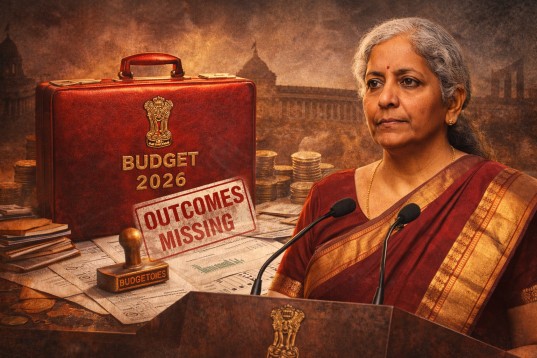
A creative representation of Union Budget 2026 presentation in the Lok Sabha. (Image TRH)
Union Budget 2026 highlights spending and intent, but without a credible outcomes evaluation, accountability in public finance remains missing
By P. SESH KUMAR
New Delhi, February 9, 2026 — Union Budget 2026 once again dazzles with allocations, announcements, targets and intent—but arrives stripped of the one thing that makes public finance meaningful: a hard, independent assessment of what earlier budgets actually achieved. Without a PEFA-style Public Financial Management (PFM) outcomes report alongside the Budget, citizens are invited to celebrate spending, not results. The Government pleads “cash accounting limitations”, while the Comptroller and Auditor General of India (CAG) retreats into delayed Finance Accounts and ‘academic’ State Finances reports that measure rupees, not real-world change.
The Budget That Never Looks Back
Every February, the Union Budget arrives like a blockbuster trailer—promising infrastructure booms, social upliftment, manufacturing revolutions, startup miracles, green transitions, skilling waves and fiscal prudence all at once.
What never arrives with it is the sequel. No official reckoning of whether the big promises of Budget 2024 or Budget 2025 delivered anything beyond expenditure figures. No consolidated outcomes report showing: Did MSME credit actually improve survival rates? Did capex spending accelerate project completion? Did skilling schemes convert into stable employment? Did health and education allocations shift outcomes? Did infrastructure outlays reduce logistics costs or just inflate invoices?
Budget 2026, like its predecessors, talks breathlessly about what will be spent—but remains mute on what earlier spending achieved. In defence, it could be said that outcomes in Government interventions take a while to achieve and 12 months is too short for such assessment.
Which is rather like a company announcing fresh investments every year without ever publishing its profit and loss statement.
In corporate India, that would invite SEBI probes. In public finance, it earns applause.
Execution: The Elephant Everyone Sees- And No One Audits (or too vast and canvas to audit in 12 months)
The Daily Pioneer article by Dr Govind Bhattacharjee correctly nails the central rot: India does not suffer from shortage of schemes or money. It suffers from an accountability vacuum on execution.
Budgets are designed in Delhi. Outcomes may die quietly in districts.
Targets look glorious in Budget Speech PDFs. Delivery fragments across ministries, states, contractors, and intermediaries. Leakages hide behind utilization certificates.
Delays vanish into revised estimates. Yet no institutional mechanism systematically asks: “What did last year’s Budget actually change on the ground?”
Not politically. Not administratively. Not auditorially. And that is precisely where modern Public Financial Management (PFM) systems across the world have moved.
What the World Does Differently (And Why India Pretends It Can’t or rather Won’t)
Globally, governments now pair budgets with outcome evaluations using frameworks such as PEFA- Public Expenditure and Financial Accountability.
The Public Expenditure and Financial Accountability framework doesn’t obsess over whether money was merely booked correctly.
It examines: Budget credibility, Policy-linked spending, Predictability of funds, Procurement efficiency, Service delivery outcomes, Internal controls, Audit follow-up, and Transparency
In simple words: Not “Was the money spent?” But “Did spending actually work?”
Countries using PEFA—from developing economies to advanced administrations—routinely publish performance snapshots showing whether public finance systems are delivering value.
India, ironically one of the world’s most scheme-heavy governments, produces almost none.
The Great Excuse: “We Use Cash Accounting”
Whenever PEFA-style evaluation is suggested, the stock response surfaces: “PEFA requires accrual accounting. India follows cash basis. So it won’t work here.”
This is bureaucratic fiction dressed as technical wisdom. PEFA is not an accounting standard. It is a performance measurement framework. Many PEFA indicators work perfectly under cash systems: Budget credibility, Expenditure controls, Procurement systems, Debt transparency, Internal audit strength, service delivery linkages, timeliness of financial information, accrual improves depth—but absence of accrual does not block outcome evaluation.
In fact, dozens of PEFA-assessed countries still operate largely on cash or modified cash systems. India’s refusal is not technical. It is institutional reluctance to measure performance.
I have argued in my post ‘PEFA is for aid-dependent countries, not for India’ last month how and why we must start adapting elements of PEFA into our reporting and audit framework.
Where GASAB and IGAS Were Meant to Step In
India already has a reform vehicle precisely for modernising government accounting and performance frameworks—the Government Accounting Standards Advisory Board headed by a Deputy CAG with representatives from Government.
Through IGAS (Indian Government Accounting Standards), GASAB was supposed to progressively help align India’s public financial reporting with global best practices—including better disclosures, outcome linkages and transparency.
Yet IGAS reforms have largely remained confined to format tweaks, classification clarifications and bookkeeping refinements. Continuing reluctance of Government/s to the to adoption of IGAS/IGFRS regime has considerably thwarted the efforts of transition.
What never emerged thus, was the real reform leap: Linking budgets to measurable outcomes.
Which makes the constant “accrual excuse” even hollower- because nothing prevents outcome evaluation even under current IGAS architecture.
And Where CAG Quietly Stepped Away from Outcomes
The most disturbing institutional silence is that of the Comptroller and Auditor General of India. CAG has global constitutional authority to examine not merely legality of spending- but economy, efficiency and effectiveness. Yet what dominates the audit landscape? Apart from few and far in between really effective all India performance audits?
Finance Accounts—arriving 12–18 months late—that tell you how much was spent, not what changed. Appropriation Accounts—comparing budget vs actuals like a cheque-book tally. Odd State Finances reports—macro fiscal analyses often released years after policy moments pass-more because of the initiative of an odd enterprising senior officer who knew the subject, rather than a continuing professional initiative.
Moreover, these are accounting documents. These are not governance outcome evaluations. Performance Audits exist—but scattered, scheme-specific, delayed and rarely consolidated into a comprehensive Budget outcomes narrative.
There is no annual “Budget Results Report” from CAG answering: What did last year’s ₹45 lakh crore actually achieve? Which ministries delivered? Which failed? Which reforms moved indicators? Which were cosmetic?
In advanced SAIs like GAO (US) and NAO (UK), such outcome-centric reporting is routine. In India, it remains the missing link.
But There is Output Outcome Monitoring Framework (OOMF) from 2026- isn’t it?
Starting FY 2026-27, the Government has formalized the Outcome Budget presentation as an “Output Outcome Monitoring Framework (OOMF)” document that accompanies the Budget. The OOMF attempts to set out clearly defined outputs and outcomes, measurable performance indicators, and the associated financial outlays.
This answers an important factual point: Government has commenced bringing out an outcome budget document with its annual budget.
However, in practical terms, the Government’s Outcome Budget (or OOMF) is forward-looking and largely expressed in planned outputs/outcomes for the coming year(s) based on allocations, rather than delivering a retrospective, audited, independent evaluation of what previous budgets actually achieved on the ground—which is what many public finance accountability advocates demand.
That Budget 2026 “remains incomplete without a report on outcomes or progress achieved on plans/interventions praised in preceding budgets”—still holds in the sense that: The Government’s Outcome Budget is not a retrospective evaluation of actual results achieved from earlier budget allocations.
Although the Outcome Budget/OOMF is published, its structure and purpose are forward-looking and based on planned indicators rather than independent assessment of past performance.
Even CAG does not routinely provide a consolidated, timely, independent evaluation of past budget outcomes concurrent with the budget cycle- it mainly produces Finance Accounts and Appropriation Accounts (accounting records), and odd and scattered performance audits that are often released much later and in fragmented form, not as a comprehensive outcomes report. This gap reinforces concerns about incomplete public accountability.
In short: Yes, an Outcome Budget is being presented, but because it is not a timely and retrospective, independently verified outcomes report on previous budgets, the broader institutional critique remains substantively valid.
Why This Weakens Democracy Itself
A Budget without outcomes reporting quietly changes the accountability equation.
Parliament debates allocations- not results. Media tracks headline numbers-not performance. Citizens judge intent-not delivery. Ministries defend spending- not effectiveness.
This creates a perverse incentive system: Spend fully and appear successful, leave money unspent and face questioning, deliver poor outcomes but go mostly unnoticed.
In such a system: Speed of expenditure matters more than quality of impact. Large schemes flourish regardless of effectiveness. Failures recycle under new names every few years.
Which is why we see: Schemes merging, rebranding, relaunching—but rarely being killed for non-performance.
Why Budget 2026 Is Institutionally Incomplete
A truly modern Budget should arrive as a twin document: Part One—Future plans and allocations; Part Two—Independent outcomes report on previous budgets; and Budget 2026 delivered only half the architecture.
Without an outcomes companion: There is no learning loop. No institutional memory. No policy correction mechanism. No reward for effective delivery. No penalty for wasteful schemes. Just annual financial theatre.
A Practical, Not Theoretical, Reform Path
India does not need to wait for full accrual accounting ‘nirvana.’ A near-PEFA tailored Indian Outcomes Framework can start immediately.
Joint Government-CAG Budget Outcomes Report within 3–4 months of Budget presentation. Outcome dashboards for major ministries linked to last year’s allocations. Delivery indicators replacing mere expenditure percentages. Procurement and project completion metrics.
Service delivery impact indicators. Audit-verified performance narratives. All fully possible under current cash systems. GASAB can embed reporting standards. CAG can audit performance data reliability. Parliament can debate results, not just rupees.
Turning Budgets into Governance Instruments
If we are serious about “minimum government, maximum governance” and “outcome-based budgeting”, three shifts are essential: Every Union Budget must be accompanied by a formal Budget Outcomes Report covering at least the two preceding years.
CAG must institutionalise annual outcome audits of major spending sectors-not delayed accounting compilations. GASAB must be adequately empowered to enable and evolve IGAS/IGFRS to mandate performance-linked public financial reporting.
Until that happens, every Budget- including Budget 2026- remains a beautifully packaged promise document floating free from accountability. Money will continue to move. Results will continue to be optional. And governance will continue to be judged by announcements rather than achievements.
In one line: A Budget without outcomes evaluation is not public finance—it is public relations.
(This is an opinion piece. Views expressed are author’s own.)
Follow The Raisina Hills on WhatsApp, Instagram, YouTube, Facebook, and LinkedIn




About The Author