Inside BJP’s Organisational Reset: Irani and Madhav Return, Malviya Exits
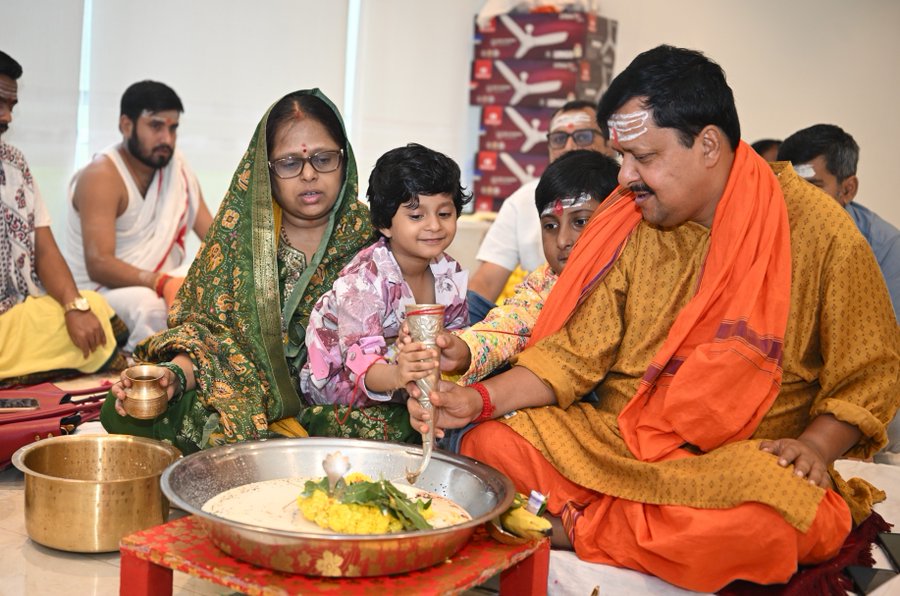
BJP president Nitin Nabin celebrates Nag Panchami on Monday. (Image Nabin on X)
By AMIT KUMAR
BJP president Nitin Nabin unveils a 64-member national team featuring veteran leaders, youth faces and wider regional representation, alongside a major overhaul of the party’s digital organisation.
New Delhi, August 17, 2026 — In a major structural overhaul, Bharatiya Janata Party (BJP) president Nitin Nabin announced his new team of national office-bearers on Monday, with the 64-member lineup blending seasoned ideological veterans along with youth leaders.
The most notable is the return of former Union Minister Smriti Irani as national general secretary, replacing Radha Mohan Das Agrawal. Irani’s ouster from Prime Minister Narendra Modi-led Union Cabinet had been a subject of speculations.
Irani while bagging the coveted Ministry of Education portfolio in the Modi Cabinet had subsequently lost the limelight as she was not only dropped from the government but also not given any organisational responsibility.
The BJP sources said that Irani now returns in a key organisational role as Congress leader Rahul Gandhi remains on an offensive against the Modi government. Irani had once defeated Rahul Gandhi from the Amethi Lok Sabha seat to emerge a giant killer in the Indian politics.
Along with Irani, former BJP heavyweight Ram Madhav also returns to the key organisational role. Madhav has been appointed as the BJP vice president.
In his previous stint in the BJP, Madhav had looked after the party’s affairs in Jammu and Kashmir and the Northeast. Madhav is widely known as an ideologue of the RSS, while also being an author.
Other notable new general secretaries are Harish Dwivedi (replacing Arun Singh), Satish Poonia (replacing Tarun Chugh), Gajendra Patel (replacing Dushyant Gautam), Sanjay Bhatia (former Karnal MP who vacated his seat for Manohar Lal Khattar), and former Tripura Chief Minister Biplab Deb. Senior leaders Sunil Bansal and Vinod Tawde stay in their existing roles in the BJP.
Pradeep Verma, Rajya Sabha MP from Jharkhand, has been nominated as national secretary in the BJP. He’s known for his silent ground-level organizational work during the assembly elections in Bihar and West Bengal.
In another notable induction, Sandeep Pathak, a recent high-profile entrant from the Aam Aadmi Party (AAP), has been appointed national secretary. Pathak is known to have been the key AAP functionary in Punjab.
Digital Overhaul: The Exit of Amit Malviya
Among the most talked-about exits is that of Amit Malviya, who had led the BJP’s IT and Social Media Cell since 2015. Malviya’s removal and the appointment of Deepak Mahaske as his successor mark a major pivot in the party’s digital communications strategy.
The reshuffle follows mounting criticism from party sympathizers and internal voices regarding the IT Cell’s messaging and operational performance, paving the way for a revamped digital apparatus.
Mahaske hails from Chhattisgarh where he had handled the social media department for the state unit of the BJP. While being an engineer by professions, he’s known to be a key asset in poll data crunching in the party.
The changes across several frontal wings: BJYM (Youth Wing): Dr. Hemant Joshi takes charge as president, succeeding Tejasvi Surya.
Treasurer: Union Minister Piyush Goyal takes over the post from Rajesh Agarwal.
Mahila Morcha: Roop Kumari Choudhary replaces Vanathi Srinivasan.
OBC Morcha: Amarpal Maurya succeeds K. Laxman.
Kisan Morcha: Bansilal Gurjar replaces Rajkumar Chahar.
SC Morcha: Shivesh Kumar Ram replaces Lal Singh Arya.
ST Morcha: Mangalam Rawat takes over from Samir Oraon.
Minority Morcha: Basit Ali succeeds Jamal Siddiqui.
Other prominent leaders excluded from the national team include former Union Minister Ravneet Singh Bittu (following the end of his Rajya Sabha term and cabinet exit), Saroj Pandey, Laxmikant Bajpai, and Sanjay Mayukh.
Social Coalition and Regional Focus
The team reflects an emphasis on broad representation:
Marginalized Communities: Over 40% of the team represents underprivileged backgrounds, including four tribal leaders (two of whom are women) from West Bengal, Madhya Pradesh, Maharashtra, and the Northeast, as well as Scheduled Caste representatives from Uttar Pradesh, Tamil Nadu, and Madhya Pradesh.
Gender & Broad Representation: The national office includes 10 seasoned women leaders and diverse religious representation, including Hindu leaders alongside Sikh, Christian, Muslim, Jain, and Parsi members.
Northeast Priority: A dedicated North-East Coordination Cell headed by Sambit Patra continues, backed by leadership representation from Tripura, Assam, and Nagaland.
Follow The Raisina Hills on WhatsApp, Instagram, YouTube, Facebook, and LinkedIn




About The Author