Argentina Break English Hearts Again: Messi’s Late Magic Lifts Albiceleste
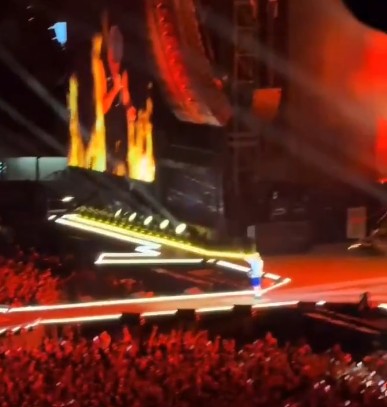
Crowd celebrates as Lionel Messi sets up Argentina’s winning goal against England. (Image video grab)
By AMIT KUMAR
Argentina beat England 2-1 in a fiery World Cup 2026 semi-final. Late goals, Messi’s twin assists, foul-fest fireworks, and a Spain final await.
New Delhi, July 16, 2026 — Some rivalries don’t need an introduction, and this one wrote another unforgettable chapter. Defending champions Argentina came from behind to beat England 2-1 in a bruising, foul-strewn World Cup semi-final at Mercedes-Benz Stadium, booking a date with Spain in Sunday’s final and extending a football feud that stretches back to 1966.
It was, in truth, two matches in one: a cagey, niggly first half that produced not a single shot on goal for 32 minutes — a World Cup record wait — followed by a frantic, momentum-swinging second half that delivered everything the occasion promised, including two of the latest, cruelest gut-punches England has suffered on the world stage.
The Crowd’s Response: A Stadium Split Down the Middle
Long before kickoff, Atlanta had already chosen its temperature. Supporters filed in through separate gates at opposite ends of the stadium under some of the tightest security of the entire tournament, with law enforcement treating the fixture as one of the highest-risk matches of the World Cup.
Argentine fans, who vastly outnumbered their English counterparts inside the ground, spent the pre-match hours in full voice — chants and whistles loud enough to drown out both “God Save the King” and “Sweet Caroline” before kickoff.
That intensity never really let up. Every crunching Argentine tackle drew a roar from the majority-blue-and-white crowd; every English free-kick or penalty appeal was met with a wall of whistles.
When Anthony Gordon volleyed England in front in the 55th minute, the away end briefly silenced the stadium — only for Enzo Fernandez and Lautaro Martinez to hand it back, twice, in the closing minutes. By full time, the Argentine end had turned Atlanta into a sea of celebration, while England’s fans stood in stunned, familiar silence.
Messi Magic: The Architect Strikes Again
At 39, Lionel Messi remains the single biggest reason Argentina keeps finding a way. He didn’t score against England, but he was the author of both goals that mattered.
His driving run and clever ball forward set up Enzo Fernandez’s leveller in the 85th minute, and moments later he turned provider again, crossing for Lautaro Martinez to head home the stoppage-time winner.
It capped a knockout-stage habit that has become almost routine: across his last eight World Cup knockout appearances, Messi has now been directly involved in thirteen goals. Opposition players seemed to know it too — any hint of contact on him brought a swarm of Argentine shirts sprinting toward the referee, a pattern that repeated itself all night and became one of the match’s defining, and most debated, images.
Sidelights: The Numbers Behind the Nerves
– Shots: Argentina finished with 15 attempts to England’s five, and an expected-goals tally of 1.84 to England’s 0.53 — a lopsided story that the scoreline eventually reflected.
– Slow start: The teams went a combined 32 minutes without registering a shot, the longest goalless opening spell to start a knockout match in tournament history.
– Shirt superstition: Argentina wore its navy alternate kit rather than the famous sky-blue-and-white stripes — the same jersey it wore during its 1986 and 1998 World Cup wins over England.
– History renewed: It was the first meeting between the nations in 21 years, and their first at a men’s World Cup since England’s 1-0 group-stage win in 2002.
– Road ahead: England will face France in Saturday’s third-place playoff, while Argentina moves on to Sunday’s final in New York/New Jersey against Spain, setting up a first-ever meeting between Messi and rising Spanish star Lamine Yamal on the game’s biggest stage.
“Directed Towards Argentina”: Probing the Storm Behind Messi’s World Cup Comeback
Coaches: Respect Off the Pitch, War On It
The build-up had been laced with tension — including politically charged comments from an Argentine official that added extra heat to an already smouldering rivalry — but the two head coaches pointedly refused to play along.
Argentina’s Lionel Scaloni repeatedly downplayed the narrative in the days before kickoff, insisting it was simply “a football game” against a difficult opponent with an excellent coach.
England’s Thomas Tuchel echoed the sentiment, saying engaging emotionally with the history of the fixture “does not help,” and the pair were pictured sharing a warm, hand-on-shoulder exchange pitchside before kickoff.
That composure evaporated once the whistle blew. Tuchel was a constant, animated presence on the touchline, at one point erupting at the officials over a disputed throw-in decision that went against his side, drawing comparisons on social media to England managers of tournaments past for the sheer intensity of his sideline reactions.
After the final whistle, though, he was measured in defeat, saying he had no regrets and calling it perhaps England’s best performance of the tournament even in a loss. Scaloni, for his part, again credited the size of the occasion rather than any personal rivalry, and turned quickly to preparing his squad for Sunday.
Actions on the Pitch: Substitutions and Momentum Swings
Both benches shaped the match’s second-half swing. With England ahead and dropping deeper to protect the lead, Tuchel withdrew goalscorer Gordon for defensive reinforcement Ezri Konsa, and later replaced an injured Reece James with Nico O’Reilly before sending on Dan Burn for Declan Rice — a set of changes designed to see out a one-goal lead.
Scaloni countered aggressively, making a triple substitution to refresh his attack and eventually introducing Lautaro Martinez, whose headed finish would prove decisive. The tactical chess match, as much as individual quality, decided who controlled the closing stages.
On-Field Controversies: A Night Defined by Fouls
If there was a single word to describe the first half, it was chippy. Argentina set an aggressive tone from the opening minute, and England’s Elliot Anderson bore the brunt of it early — fouled multiple times inside the first ten minutes yet somehow the first player shown a yellow card, for a challenge on Messi that ignited a furious group protest from Argentine players toward referee Ismail Elfath.
By the halftime whistle the two sides had combined for 19 fouls and just two yellow cards, a disparity that frustrated fans and pundits alike, with some publicly questioning why so few of the challenges were punished.
The whistle itself became a subplot. Elfath, whose selection had already stoked online chatter about supposed favouritism given his history overseeing Argentina matches, was targeted by frustrated supporters throughout the broadcast, while a heated Tuchel confronted match officials directly over a reversed throw-in call.
Add in theatrical appeals for cards, a wrestling-match flare-up between Enzo Fernandez and Anderson, and persistent surrounding of the referee whenever Messi was touched, and the match played out as much as a psychological battle as a tactical one — fitting, given a rivalry that already includes the 1986 “Hand of God” goal and David Beckham’s 1998 red card among its lore.
Follow The Raisina Hills on WhatsApp, Instagram, YouTube, Facebook, and LinkedIn




About The Author