Fish, Faith and Votes: How Food Scripted the Bengal Battleground
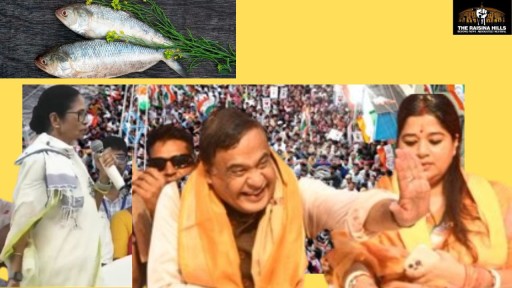
Assam Chief Minister Himanta Biswa Sarma addresses a rally ahead of the 2026 West Bengal Assembly elections (Image X.com)
Political analyst Manish Anand explains what Tathagata Roy’s book reveals about Bengali Hindu identity and BJP’s cultural strategy.
By TRH Op-Ed Desk
New Delhi, April 23, 2026 — The 2026 West Bengal Assembly election has produced many unusual moments. But few have been quite as striking as a sitting Chief Minister challenging his rival to a fish-eating competition — in public, on social media, and apparently in complete seriousness.
Amid an intensifying political row over food habits ahead of the West Bengal Assembly elections, Assam Chief Minister Himanta Biswa Sarma challenged West Bengal Chief Minister Mamata Banerjee to a fish-eating contest on April 17, dismissing TMC allegations that the BJP, if voted to power in West Bengal, would impose curbs on the consumption of meat and fish.
In a post on X, Sarma said: “I invite Mamata Didi to send a representative for a fish-eating competition. Let us see who can eat more fish — someone from Assam BJP or someone from TMC — and end this rumour mongering once and for all.”
Sarma went further in subsequent remarks, claiming he could personally eat one kilogram more hilsa fish than Mamata Banerjee herself. It was a boast laced with political calculation — and a new book on Bengal politics helps explain precisely why.
The Book That Frames It All
Tathagata Roy — former Governor of Tripura and one of the BJP’s most prominent voices from West Bengal — has just published Desires, Dreams, Powers: Reminiscences of West Bengal and the Northeast. Political analyst Manish Anand, speaking on his YouTube channel The Raisina Hills, drew a direct line between a passage in that book and the current spectacle on the campaign trail.
“Roy recounts a Mansarovar Yatra that he undertook with a group of BJP workers from across the country — West Bengal, Maharashtra, Uttar Pradesh, various states,” Anand told his viewers. “The moment there was a stop, Roy and his Bengali companions were immediately on the lookout for eggs. When the other travellers found out, they were genuinely shocked. ‘Dada, you are on a religious pilgrimage to Mansarovar, and you are searching for eggs and chicken?’ Roy had to spend considerable effort explaining to pilgrims from Gujarat, Maharashtra, and Uttar Pradesh that Bengalis who are Hindu are largely Shakta Hindus — devotees of Shakti — and that the worship of Shakti has a tradition of animal sacrifice. So meat, fish, and eggs are not prohibited. They are, in fact, a staple. Part of the daily food habit.”
Anand noted that the anecdote travels well beyond the personal. “Roy writes that he extended this point to all of eastern India,” he said. “Bihar, West Bengal, Odisha, Assam, the Northeast — in these states, non-vegetarian food is woven into the food culture because of the prevalence of Shakti worship. And yet, he says, he struggled enormously to make his co-travellers understand. They simply could not accept that someone could be on a sacred pilgrimage and still want an omelette.”
Hilsa, Culture, and the Politics of the Plate
At the centre of the BJP’s cultural outreach this election season is the hilsa — the ilish of Bengali tradition. The fish, which originates primarily in the Padma river between Bangladesh and Tripura, is among the most prized and expensive in the subcontinent. In Delhi’s markets it commands a steep price; in Tripura it is abundant and fresh. For Bengalis, it is not merely a food but a cultural symbol.
“When a Bengali family holds a wedding,” Anand explained, “it is tradition for the groom’s side to arrive at the bride’s home bearing a hilsa fish. The fish is considered auspicious — a shagun. It is embedded in Bengali culture at the level of ritual.”
This is why Sarma’s challenge carries a specific political message. The BJP — a party associated in much of North India with cow protection, Navratri shop closures, and restrictions on non-vegetarian food in public spaces — is under sustained attack from the Trinamool Congress on the question of food freedom. By challenging Mamata Banerjee to a fish-eating contest, Sarma is effectively telling Bengali voters: we are not what you have been told we are.
Anand pointed out that the messaging extended across the party. “Union Minister Anurag Thakur was filmed eating fish this week — tika on the forehead, shawl on the shoulder, and all — and the reel was circulated widely,” he said. “The BJP is trying to show Bengal that it is fully at home in Bengali culture, that there is no divide. And Prime Minister Modi eating jhal muri — the quintessential Bengali street snack — was very much part of the same strategy.”
The Irony of the Challenge
There is a sharp irony at the heart of Sarma’s one-kilogram boast, and Anand did not miss it.
“I have been to several of Mamata Banerjee’s lunch programmes — around five or six times,” he told his viewers. “She is an exceptionally gracious host. She serves elaborate fish preparations, multiple varieties, with great warmth and respect. But she herself eats very little. Multiple authors who have written biographies and biographical accounts of Mamata Banerjee have noted that she is a very light eater. If one piece of fish is a lot for her, then the claim to eat one kilogram more than her is not really a culinary challenge. It is a political message, and Sarma knows exactly what he is doing.”
A Different Kind of Election
The political controversy erupted after the TMC claimed that the BJP, if voted to power in West Bengal, would impose restrictions on the consumption of meat and fish — charges the BJP has strenuously denied. The backdrop includes incidents in Delhi’s CR Park — a Bengali-dominated market — where activists reportedly attempted to shut down fish stalls during Navratri, only to be told by the shop owners that fish is consumed even during Durga Puja, not despite it.
For Anand, it all adds up to something he says he has not witnessed in over two decades of election journalism. “In all the elections I have covered,” he said, “I have never seen a campaign where the competition to eat meat and fish has become this central. It is colourful, it is peculiar, and it is revealing. It tells you how seriously the BJP is trying to embed itself in Bengali cultural identity.”
Whether the fish will do what the rallies could not remains to be seen. But in West Bengal 2026, the road to the assembly runs through the kitchen.
(Manish Anand is a political analyst and host of The Raisina Hills YouTube channel.)
Follow The Raisina Hills on WhatsApp, Instagram, YouTube, Facebook, and LinkedIn




About The Author