Media Decries Police Storming News Agency UNI Mid-Shift
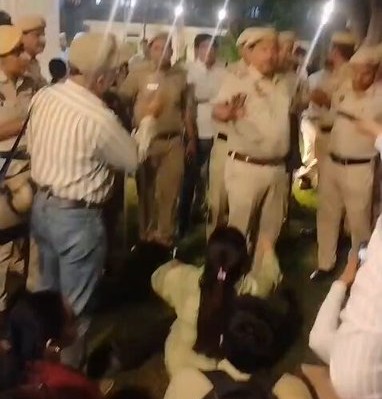
Delhi police seal the office of UNI in New Delhi. (image video grab)
Hundreds of police and paramilitary personnel descended on United News of India’s Rafi Marg office within hours of a High Court ruling — evicting women journalists by force, and sealing the premises.
By TRH News Desk
New Delhi, March 21, 2026 — On the afternoon of Friday, a court order was pronounced. By evening, hundreds of police and paramilitary personnel had already surrounded the Rafi Marg office of United News of India — one of India’s oldest and most storied wire services. Journalists were still at their desks.
What followed has drawn furious condemnation from the Editors Guild of India, the Press Club of India, opposition parliamentarians, and journalists across the country.
Staff members say they were physically removed from the premises before UNI management had even been informed of the order. Female journalists allege they were manhandled. Several employees were denied time to collect personal belongings before the building was sealed. At the time of the operation, the High Court order had not yet been uploaded to the court’s own website.
Delhi Police have denied the manhandling allegations. What they have not denied is the speed and scale of the operation.
“An unprecedented atrocity,” said The Statesman, describing the police deployment as one that would put an anti-terror operation to shame.
The Editors Guild of India stopped short of questioning the court’s authority but issued a sharp rebuke of how it was executed. “The alacrity with which the authorities reacted, as well as the overwhelming display of force, sends a chilling message to the media. The action has not only halted the dissemination of news to UNI’s subscribers, but has also cast a shadow over the future of the organisation, and the careers of hundreds of journalists,” it said in a media statement.
The Press Club of India was more direct, calling the action a violation of the constitutional right to work and demanding action against those responsible.
Journalist Anjali Ojha, who witnessed the eviction, posted on X: the manner in which Delhi Police behaved was “appalling,” adding — “I’m sure they knew they were talking to working people, not criminals. Quite a statement on where the media stands.”
CPI Member of Parliament Sandosh Kumar P called it “a grave and unprecedented assault on press freedom,” noting that women journalists were not spared in the dragnet.
UNI itself, posting from its official account, alleged that some Delhi Police personnel present were intoxicated while on duty, and that two lawyers accompanying the police abused several individuals on the premises — claims that have not yet been officially addressed.
The land in question falls under the Land and Development Office of the Union Ministry of Housing and Urban Affairs. The High Court had cancelled UNI’s allotment — but the window between the ruling and the boots-on-ground response, measured in hours rather than days, is at the centre of the controversy.
Press freedom organisations and media bodies are now asking a pointed question: even if the law was being enforced, was there any justification for the manner in which it was done — with no notice served, no time given, no management consulted, and no mercy shown to women journalists working the evening shift?
As of publication, UNI’s operations remain suspended. Hundreds of journalists face an uncertain future. And India’s media freedom record — already under scrutiny — has taken another blow that will not be easily forgotten.
Follow The Raisina Hills on WhatsApp, Instagram, YouTube, Facebook, and LinkedIn




About The Author