Trump-Xi Summit Signals ‘Strategic Stability’ Framework: Analyst
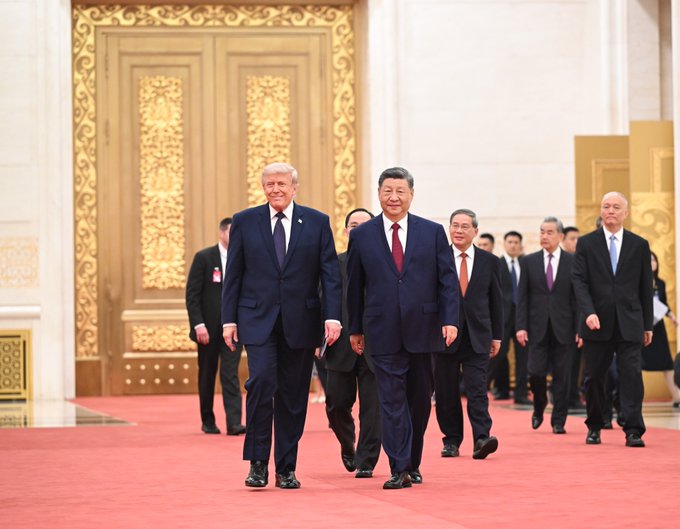
China President Xi Jinping held a welcoming banquet for US President Trump. (Image China MFA)
By TRH World Desk
Rush Doshi says China is trying to lock in a long-term “strategic stability” framework with the US after Day 1 of the Trump-Xi summit. Taiwan, AI, Iran, fentanyl and investment talks dominated the discussions between Donald Trump and Xi Jinping.
New Delhi, May 14, 2026 — The first day of the high-stakes summit between Donald Trump and Xi Jinping has triggered intense geopolitical analysis, with China watcher and Georgetown University assistant professor Rush Doshi describing Beijing’s messaging as an attempt to establish a long-term “strategic stability” framework with the United States.
Posting a detailed assessment on X, Doshi said the most significant development from the summit was China unveiling what he called a “new formulation” for bilateral ties. According to Doshi, Beijing appears eager to lock in a post-trade war détente that extends beyond the Trump presidency and sets the baseline for future U.S.-China relations.
Doshi highlighted a Chinese statement claiming that both leaders had agreed on “a new vision of building a constructive China-U.S. relationship of strategic stability.” He argued that Beijing may later use this framework to portray future American actions — including measures targeting Chinese industrial overcapacity or military deterrence efforts — as violations of the new understanding.
Despite the summit taking place amid ongoing tensions over trade and technology, Doshi noted the surprising absence of detailed references to rare earth minerals and export controls in official readouts from both sides.
Taiwan, however, emerged as a sharper point of concern. Doshi observed that China publicly warned mishandling the Taiwan issue could trigger “clashes and even conflicts,” while the American readout avoided mentioning Taiwan altogether.
Artificial Intelligence also surfaced indirectly during the summit. U.S. Treasury Secretary Scott Bessent told CNBC that Washington and Beijing would begin discussions on AI governance and safety protocols. Bessent argued that America’s lead in AI development was a major reason China was willing to engage diplomatically.
Another notable issue was Iran and energy security. Doshi pointed out that the White House unusually quoted Xi directly regarding opposition to the militarization of the Strait and China’s interest in increasing purchases of American oil.
The summit discussions also reportedly covered Chinese investment in the U.S., fentanyl precursor controls, and military-to-military communication channels. Doshi further noted that Trump invited Xi to visit the United States again in September, possibly coinciding with the UN General Assembly session in New York.
Why Trump-Xi Summit Matters for India and the Global Economy
Follow The Raisina Hills on WhatsApp, Instagram, YouTube, Facebook, and LinkedIn




About The Author