Why Trump-Xi Summit Matters for India and the Global Economy
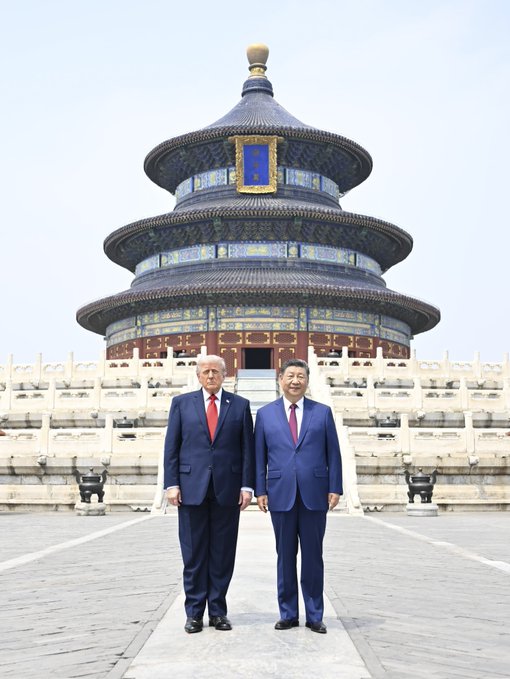
US President Xi Jinping and President Trump visited the Temple of Heaven and had a photo taken in front of the Hall of Prayer for Good Harvests. (Image China MFA)
By Prof. S. S. SOMARA
Prof. S. S. Somara argues that the Trump-Xi summit demonstrates how global powers balance rivalry with cooperation. He says India must focus on economic productivity, technological strength, and pragmatic diplomacy if it aims to emerge as a decisive global power.
Jaipur, May 14, 2026 — US President Donald Trump’s visit to Beijing is not merely a formal state visit, but a reflection of a changing global order in which economic competition, geopolitical tensions, and strategic partnerships are deeply intertwined, and in today’s world, competition and cooperation go hand in hand.
While the two countries are locked in conflict over trade, technology, and strategic dominance, they are also compelled to maintain dialogue on issues such as the global economy, supply chains, climate change, and war. Before the visit, Trump stated that trade would be his primary focus, including deals for American food and aircraft.
Principal Deputy Press Secretary Anna Kelly confirmed that the US plans to host Xi later this year. The red-carpet welcome Trump received in China after nine years demonstrates that the world’s two largest economies are willing to keep channels of dialogue open despite their conflict.
This meeting comes at a time when tariffs affecting approximately $525 billion in trade have destabilized both countries’ industries and global markets. Discussions of a potential “Board of Trade” in Beijing indicate that both sides are willing to move toward at least managing the economic conflict.
The most significant aspect of this visit is that Trump is not alone. He is accompanied by several prominent figures from the US corporate world, including Tesla’s Elon Musk, Apple’s Tim Cook, NVIDIA’s Jensen Huang, Boeing’s Kelly Ortberg, and Citigroup’s Jane Fraser. This demonstrates that politics and business can no longer operate in separate paths. American companies understand that China is not just a rival but also the world’s largest consumer market.
Apple’s growing share in China, recently achieving the top spot in the Chinese smartphone market with a 28% increase in shipments, and Tesla’s 36% year-over-year sales of its Chinese-made vehicles further illustrate this economic reality. But this visit isn’t limited to business interests alone.
Mideast Crisis: Modi’s WFH, Online Classes Call Raises Questions
The escalating Iran crisis in West Asia and growing concerns about the Strait of Hormuz are also central to this summit. China’s economy is heavily dependent on Iranian oil, while the US wants to maintain a regional balance of power. Consequently, Beijing’s talks could impact global energy security and the potential for war. Sensitive issues like Taiwan, AI technology, and rare earth supply chains further complicate this meeting.
While China considers Taiwan a matter of national interest, the US has consistently supported it as part of its Indo-Pacific strategy. Similarly, the growing competition between the two countries over AI and semiconductor technology will determine the future global power structure.
The US-China summit situation holds several important lessons for India. The primary lesson is that in global politics, there are not permanent friends or enemies, but permanent interests. The continuation of dialogue despite the intense competition between the US and China demonstrates that major nations never completely compromise their economic interests. India too must place greater emphasis on pragmatic and interest-based foreign policy rather than emotional or ideological ones.
The second major lesson is the importance of economic power. China has become a challenge to the US today because of its sustained investment in manufacturing, exports, technology, and infrastructure over the past three decades.
Military power or population alone does not make a country a superpower; economic productivity and technological self-reliance are what truly empower it. If India aspires to a decisive role on the global stage, it must rapidly advance in job-generating industries, high-tech, semiconductor, AI, and green energy sectors.
The third lesson relates to supply chains and trade opportunities. Due to rising tensions between the US and China, the world is moving towards a “China Plus One” strategy. This is a major opportunity for India. Stable policies, a fast-track judicial system, affordable logistics, skilled labour, and a trustworthy administration will attract foreign companies. If India slows down on reforms, countries like Vietnam, Indonesia, and Mexico could seize this opportunity.
Fourth lesson: In FY26, actual cash recovery was only ₹85,000 crore against a target of ₹5.04 lakh crore. Confirmed tax dues of ₹9 lakh crore remain uncollected annually from large corporates and individual defaulters. Ensuring that tax demands are actually collected using any digital monitoring will be a strong signal that the nation’s sacrifices are truly being shared. This is also a good time to reconsider whether India’s tax system is structurally progressive enough. India abolished its wealth tax in 2015 and has had no estate or inheritance duty since 1985. The top 1 percent of Indians own approximately 40 percent of the country’s wealth.
A temporary crisis surcharge on very high income earners, a windfall levy on commodity traders and domestic refiners—or a carefully designed wealth tax on companies that benefit from this disruption—would serve multiple purposes: raising revenue to offset fiscal losses, clearly equalizing burden sharing, and giving the broader movement the moral authority it needs. Ultimately, the lesson is one of diplomatic balance. India should enhance its strategic partnership with the United States, but also keep channels of dialogue open with China. Despite border disputes and security concerns, outright confrontation with neighbouring countries is not a long-term solution.
To become a global power, India must adopt “multipolar diplomacy,” where it can maintain relationships with various blocs in accordance with its interests. Ultimately, the US-China summit sends the message that the true competition of the 21st century will be decided not on the battlefield, but in economics, technology, innovation, and diplomatic influence. The biggest lesson for India is that if it wants to be a decisive power in the coming decades, it must move beyond political debates and focus on economic and institutional strength.
Key Takeaways:
- Trump’s China visit highlights deep US-China economic interdependence
- Business leaders joining the trip underline corporate stakes in China
- Iran, Taiwan, AI and trade tensions dominate summit agenda
- India can benefit from “China Plus One” manufacturing shifts
- Economic strength and technological self-reliance are central lessons for India
- Multipolar diplomacy remains crucial for India’s long-term strategy
(This is an opinion piece. Author is Head of Department, Department of Economics, University of Rajasthan, Jaipur.)
Follow The Raisina Hills on WhatsApp, Instagram, YouTube, Facebook, and LinkedIn




About The Author