“Thank You, Darling”: Trump Walks Out on NBC as He Wages War on the Press
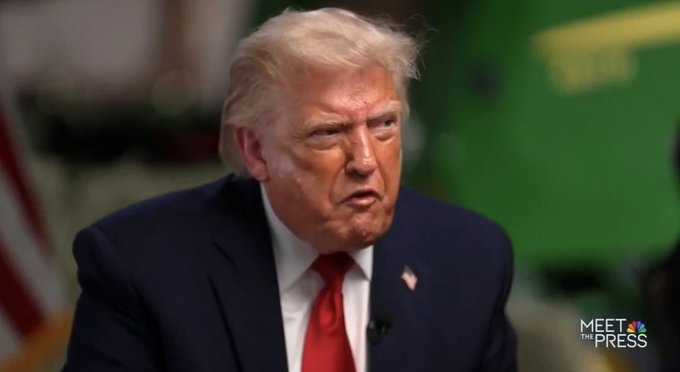
Trump Walks Out of NBC Interview and Inside His War on the American Press (2026) (Image video grab NBC)
By TRH World Desk
The line Trump threw over his shoulder as he walked out of the Wisconsin barn deserves more attention than it typically receives as a moment of spectacle. It inverts the foundational American argument about the relationship between democracy and a free press.
New Delhi, June 8, 2026 — It ended the way so many Trump encounters with the press end — with a shrug of contempt, a dismissive endearment, and an empty chair.
“Let’s call it quits, because I’ve had enough. Thank you, darling.”
Those were the words US President Donald Trump directed at NBC’s Meet the Press anchor Kristen Welker on Friday, before rising from his seat, gesturing to people behind the cameras, and walking off the set of a barn in Chippewa Falls, Wisconsin, where the interview had been filmed ahead of a farmers’ roundtable. He had sat through nearly 50 minutes of back-and-forth — interrupted by waves of rain hammering the metal roof — before reaching his limit.
The trigger, as it so often is with Trump, was accountability. Welker had pressed him repeatedly for evidence to support his claims that California’s ongoing vote count in Tuesday’s primary elections was fraudulent, and challenged his long-running and repeatedly debunked assertions about the 2020 presidential race. When the anchor continued to push, Trump snapped. He called Welker and the media “crooked,” attacking her credibility and denouncing what he called “the fake, dirty press.”
His parting shot as he left the set carried the real message: “You ought to straighten out your press, because you know what? A country can never be great with a dishonest press.”
It was not a throwaway line. It was a policy statement.
A Pattern, Not an Incident
Anyone who treats the Wisconsin walkout as a colourful one-off has not been paying attention. Since returning to the White House in January 2025, Trump has waged what press freedom advocates now describe not as hostility toward the media, but as systematic warfare against it.
Reporters Without Borders (RSF) — which tracks press freedom globally — was unsparing in its assessment after Trump’s first year back in office. “Trump is waging an all-out war on press freedom and journalism,” the organization declared. “Any coverage, journalist, or outlet that displeases him becomes a target, and not just with empty threats.” RSF placed Trump on a trajectory to join the ranks of what it calls the world’s worst press freedom predators.
The numbers are staggering. Poynter’s Press Freedom Watch documented 76 federal actions against journalists in 2025 alone, and counted 13 lawsuits filed by media organizations against the Trump administration over press freedom violations — not counting Freedom of Information Act disputes or mass data deletions.
Tim Richardson, program director for journalism and disinformation at PEN America and a former Washington Post reporter, has put it plainly: “It’s safe to say this assault on the press over the past year has probably been the most aggressive that we’ve seen in modern times.”
He Sues. He Threatens. He Names Names.
Trump’s relationship with the press has always been combative, but his second term represents a qualitative escalation. Three tools define his current approach: litigation, legal intimidation, and public shaming.
The Lawsuits: Trump has turned the American court system into an instrument of editorial pressure. In July 2025, he filed a $10 billion defamation lawsuit against The Wall Street Journal and its parent company News Corp over a story connecting him to financier Jeffrey Epstein. Two months later, in September 2025, he filed a $15 billion libel suit against The New York Times and four of its reporters, accusing the paper of acting as a “mouthpiece” for the Democratic Party.
These followed an earlier CBS settlement — arguably the case that set the tone for Trump’s second-term press strategy. In July 2025, CBS’s parent company Paramount, which required administration approval for a planned merger, agreed to pay $16 million to Trump’s future presidential library and to release transcripts of future presidential candidate interviews on 60 Minutes. It was, critics noted, a textbook case of regulatory leverage producing editorial compliance.
Trump has been direct about the intent. “It costs a lot of money to do it,” he said of his press lawsuits at a Mar-a-Lago press conference, “but we have to straighten out the press.”
Stripping Access: Legal action is only one lever. Within weeks of his January 2025 inauguration, the administration stripped the Associated Press of access to the Oval Office and Air Force One — not for anything it reported, but for refusing to adopt Trump’s executive order renaming the Gulf of Mexico the “Gulf of America.” The message to other outlets was clear: editorial compliance is the price of access.
The White House simultaneously rewrote the rules of press accreditation, issuing nearly 500 new press passes to podcasters and alternative outlets while tightening credentials for traditional news organizations. Reporters who once moved freely through official Washington now make appointments to speak with senior press officials and face public reprimands from the president or his press secretary.
The Shaming List: In November 2025, the administration launched a “Hall of Shame” website — officially dubbed the White House Bias Tracker — naming journalists and outlets it accused of misrepresenting the administration. It was, in effect, a state-sponsored blacklist, something RSF noted was more familiar in authoritarian capitals than in Washington, D.C.
Arrests and Raids: The intimidation has not remained rhetorical. On January 29, 2026, Georgia Fort, a regional Emmy-winning independent journalist, was arrested at her home in the suburbs of St. Paul, Minnesota, in connection with her reporting — a scenario Amnesty International USA described as “familiar to journalists working under repressive governments.” In January 2026, the FBI raided the residence of Washington Post journalist Hannah Natanson, allegedly seeking to identify a government contractor leak. In October 2025, Atlanta-based Spanish-language journalist Mario Guevara was deported to El Salvador following critical reporting.
During protests in October 2025, multiple credentialed reporters were subjected to force by law enforcement. By early December 2025, there had been 170 reports of assaults on journalists in the United States, 160 of them at the hands of law enforcement, according to the U.S. Press Freedom Tracker.
The Chilling Effect: What This Means for American Journalism
Intimidation does not have to succeed to succeed. It only has to make reporters hesitate, editors self-censor, and lawyers counsel caution. A multi-billion-dollar defamation suit need not prevail in court to drain resources, damage morale, and concentrate minds on what not to write.
The effect on the broader media landscape has been measurable. Fearing federal legal action, CBS lawyers prevented the broadcast of a Senate candidate’s appearance on The Late Show with Stephen Colbert, which was published only to YouTube. In September 2025, following administration pressure, Jimmy Kimmel Live! was suspended for nearly a week before being reinstated. By January 2026, the FCC had changed its rules on the equal-time doctrine in ways critics called a direct tool for regulating the speech of political opponents on television.
Meanwhile, public trust in the media — already eroded before Trump’s return — sits at just 28% in Americans having a “great deal” or “fair amount” of trust in the press, according to Gallup. It is a crisis Trump did not create, but one he has exploited and deepened with extraordinary skill.
“A Country Can Never Be Great with a Dishonest Press”
The line Trump threw over his shoulder as he walked out of the Wisconsin barn deserves more attention than it typically receives as a moment of spectacle.
It inverts the foundational American argument about the relationship between democracy and a free press. The Founders understood an adversarial press not as a threat to a great country, but as a precondition for one. The First Amendment was not designed to protect comfortable speech — it was designed to protect exactly the kind of accountability journalism that Kristen Welker was practicing when she asked a sitting president, repeatedly, to provide evidence for his claims.
Trump’s formulation reverses that logic. In his telling, journalism that challenges his assertions is itself the source of national dishonour. The press is “dirty” and “crooked” not because of what it gets wrong, but because of what it refuses to get wrong on his behalf.
That is not a media critique. It is an ideology — one that has moved, in the course of eighteen months, from rhetoric to policy, from tweets to lawsuits, from press conferences to deported journalists and raided newsrooms.
As Trump Shakes Earth, Americans Check the Sky for What Comes Next
Follow The Raisina Hills on WhatsApp, Instagram, YouTube, Facebook, and LinkedIn




About The Author