AAP’s Rajya Sabha Collapse: Rebuild or Risk Irrelevance
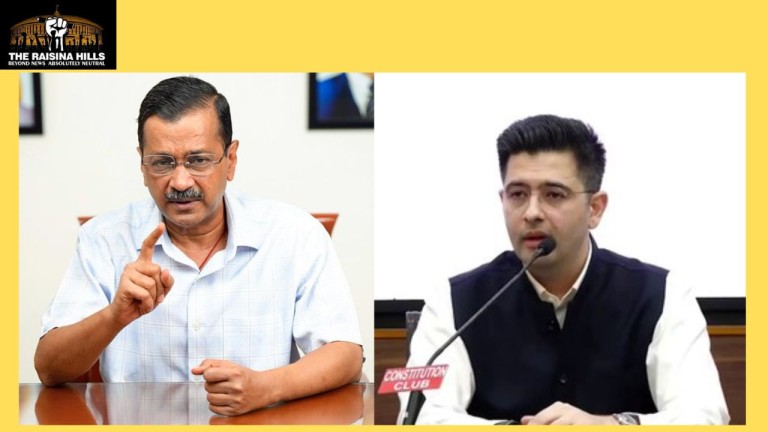
AAP Imploding From Within as Seven Rajya Sabha MPs to Join BJP. (Image X.com)
Political analyst Manish Anand says Kejriwal must decentralise power or face further collapse — while Punjab 2027 hangs in the balance.
By TRH Op-Ed Desk
New Delhi, April 24, 2026 — When Raghav Chadha walked out of the Aam Aadmi Party on Friday, he did not walk alone. He took seven of AAP’s ten Rajya Sabha members with him — and, analysts say, a significant portion of the party’s organisational credibility in Punjab.
The defection, constituting well over the two-thirds threshold required under the anti-defection law, means the group can legally merge with BJP without inviting disqualification. In effect, lock, stock and barrel — AAP’s entire Rajya Sabha presence barring three members — has shifted to the ruling party in a single afternoon.
Political analyst Manish Anand, speaking in a detailed monologue for YouTube channel The Raisina Hills, called the development a foreseeable implosion — one whose warning signs had been visible for over a year. “If you look at Raghav Chadha’s public statements and activities over the past eighteen months, people had already begun to sense that his relationship with Arvind Kejriwal was no longer healthy,” Anand said. “When AAP’s leadership was in Tihar jail, Chadha was neither on the streets nor speaking against investigative agencies. He was in America, then England. He was simply not doing what an AAP leader should have been doing.”
The Chadha Problem — and Kejriwal’s Own Making
Anand was pointed in his assessment of both sides. Chadha, he argued, had allowed personal ambition to outgrow party loyalty. “AAP gave Raghav Chadha a very big platform and established him as a political leader. But his personal aspirations grew larger than the party itself. That clash with the party’s inner circle was perhaps inevitable,” he said. The fact that Chadha joined BJP specifically — and not any other party — Anand noted, lends credence to AAP’s earlier accusations of pre-existing alignment with the ruling establishment. “He didn’t join anyone else. He joined BJP. So the allegation that there was already an understanding with BJP — that has been validated today,” added Anand.
But Anand was equally critical of Kejriwal’s own decisions. “When the time came to send MPs to the Rajya Sabha, Kejriwal prioritised businessmen — people with no long history with the party. The allegation that money power drove those nominations has now been proven, in a sense. Ashok Mittal, whose premises were raided just days ago, is now rushing to join BJP. That tells its own story,” said Anand.
Punjab 2027: Windfall for BJP or Mirage?
The defection’s most consequential dimension is its Punjab overhang. Chadha was widely regarded inside AAP as the de facto architect of Punjab strategy — described by many as a “defacto Chief Minister” operating behind Bhagwant Mann. His intimate knowledge of the party’s Punjab organisation, its networks, and its political fault lines now sits across the aisle.
Yet Anand cautioned against reading this as an automatic breakthrough for BJP. “Punjab’s electorate chose AAP precisely because they were exhausted with mainstream parties. BJP is also a mainstream party. Whether Raghav Chadha comes or anyone else comes, if people’s mood is against mainstream politics, BJP’s good days in Punjab are not visible,” he said. Punjab’s political contest, he added, has effectively narrowed to a straight fight between AAP and Congress, with all other parties relegated to the margins.
The Deeper Crisis: A One-Man Party
For Anand, the defection is symptomatic of a structural disease inside AAP that predates Friday’s events. “The entire party revolves around one person — Arvind Kejriwal. In such a situation, every discontented element will eventually leave,” he said. He pointed to the near-total absence of AAP’s senior leadership from Delhi’s streets over the past year. “Kejriwal is not visible. Manish Sisodia is not visible. Sanjay Singh is not visible. A politics of struggle and hard work is fading. And without that struggle, how long can you survive — especially when your opponent is an organisation as powerful as BJP,” asked Anand.
Anand framed the mass exit as an “implosion” that must precede reconstruction. “Before rebuilding comes the collapse. These seven departures are that implosion. If Kejriwal learns from this — if he decentralises power, convinces people that this is not a one-man party — AAP can be revived. But the signals right now are not encouraging,” added Anand.
BJP’s Gain — and Its Own Question Mark
For BJP, the windfall is real but not without caveats. Anand acknowledged that the additions strengthen BJP’s Rajya Sabha numbers and further weaken an already-fragmented opposition. “One by one, opposition faces are being weakened. This will be seen as a show of strength,” he said. But absorbing leaders whose base belongs to a rival party’s organisation is a different challenge altogether, he warned — comparing it to eating a sweet that may not agree with the digestion.
As Punjab counts down to February 2027, AAP governs but no longer dominates the narrative it once owned. The party that was founded on transparency and anti-corruption now faces the oldest question in Indian politics: who controls the party — and at what cost to everyone else?
(Manish Anand is a political analyst and host of The Raisina Hills on YouTube.)
Blow to AAP: Raghav Chadha and 7 Rajya Sabha MPs to Join BJP
Follow The Raisina Hills on WhatsApp, Instagram, YouTube, Facebook, and LinkedIn




About The Author