NITI Aayog Releases Twin Reports to Ease R&D in India
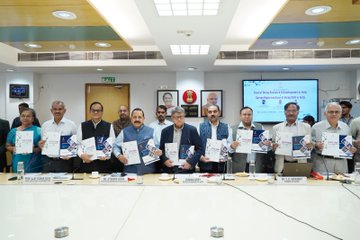
NITI Aayog Releases Twin Reports to Ease R&D in India. (Image Niti Aayog on X)
In a significant push to strengthen India’s innovation infrastructure, NITI Aayog on Saturday released two landmark reports aimed at dismantling bureaucratic barriers slowing down research and development across the country.
By TRH News Desk
New Delhi, April 11, 2026 —The reports — titled “Ease of Doing Research & Development in India” and the “Survey Report on Ease of Doing R&D in India” — were formally released by NITI Aayog Vice Chairman Suman Bery alongside Jitendra Singh, Minister of State (Independent Charge) for Science & Technology.
The release was attended by V. K. Saraswat, Member of NITI Aayog, Secretaries of scientific departments, senior government officials, presidents of science academies, and representatives from academia and industry — signalling the breadth of institutional buy-in behind the initiative.
What the Reports Say
The twin reports provide a comprehensive assessment of India’s R&D ecosystem and lay out actionable recommendations across four critical pillars: funding, governance, regulatory frameworks, and research translation. Their central argument is that India’s research institutions need a more trust-based, outcome-oriented, and facilitative environment to unlock their full potential.
Bery, in his address, underlined that translating research into practical, real-world applications remains a defining priority — a gap that has long hobbled India’s ability to convert scientific output into economic and social impact.
Singh stressed that the reports are evidence-grounded and reflect the lived realities of India’s research ecosystem rather than top-down prescriptions. Saraswat acknowledged the diversity of India’s research institutions while pointing to common structural pain points — from cumbersome internal processes to external ecosystem constraints spanning funding bottlenecks, policy gaps, and regulatory friction.
India has consistently struggled to convert its large scientific talent pool into proportional R&D output. Gross Expenditure on R&D as a percentage of GDP has remained stubbornly below 1% for years — well behind global peers. These reports represent the government’s most structured attempt yet to diagnose the problem and prescribe systemic reform, with the explicit goal of making India a globally competitive research destination.
The move aligns with the broader ambition of the National Education Policy and Anusandhan National Research Foundation to reposition India as an innovation-first economy by 2047.
FAQ
Q: What are the NITI Aayog R&D reports released in 2026?
NITI Aayog released two reports — “Ease of Doing Research & Development in India” and the “Survey Report on Ease of Doing R&D in India” — providing a comprehensive assessment of India’s research ecosystem with recommendations on funding, governance, regulation and research translation.
Q: Who released the NITI Aayog R&D report?
The reports were released by NITI Aayog Vice Chairman Suman Bery and Jitendra Singh, Minister of State (Independent Charge) for Science & Technology, in the presence of NITI Aayog Member V. K. Saraswat.
Q: What are the key recommendations in NITI Aayog’s Ease of Doing R&D report?
The reports recommend reforms across four pillars: stronger R&D funding, improved governance, streamlined regulatory frameworks, and better mechanisms to translate research into practical applications, within a trust-based and outcome-oriented ecosystem.
Q: Why is India’s R&D ecosystem a concern?
India’s Gross Expenditure on R&D has remained below 1% of GDP for years — significantly behind global peers — limiting the country’s ability to convert its large scientific talent base into proportional innovation output and economic impact.
Follow The Raisina Hills on WhatsApp, Instagram, YouTube, Facebook, and LinkedIn




About The Author