London Riots Erupt After France Knocks Out Morocco at World Cup
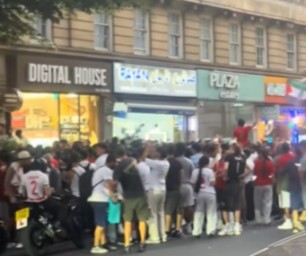
Riot police in formation on Edgware Road, London, after Morocco’s World Cup exit. (Image video grab)
By TRH World Desk
Riot police flooded London’s Edgware Road after France beat Morocco 2-0 in the World Cup quarter-final. Here’s what happened — and why it keeps happening.
New Delhi, July 10, 2026 — Riot police were sent into London’s Edgware Road on Thursday night after celebrations among Morocco supporters curdled into disorder following the team’s exit from the 2026 World Cup. It’s the latest flashpoint in a tournament that has already seen French authorities brace for unrest of their own — and it raises the now-familiar question of why major football results keep triggering street violence in European cities with large diaspora communities.
Hundreds of fans had gathered along Edgware Road — long the social and commercial heart of London’s Middle Eastern and North African community — to watch the quarter-final. When Morocco went down 2-0 to France, the mood on the street turned, and riot police were deployed in force to bring the situation under control.
Footage circulating on social media showed flares and fireworks being lit, traffic blocked, and fans climbing onto traffic lights before rows of officers in riot gear moved in to clear the junction near Seymour Street.
One man was seen lying on the ground as paramedics and police rushed to attend to him, and police vans worked through the evening to clear the street of supporters by around 11:30 p.m. Video shared online also showed dozens of Metropolitan Police officers in full public order kit — helmets, shields, a marked van — standing in formation as smoke drifted across the road, with debris scattered nearby.
As of the time of reporting, the Met had not issued a detailed public statement on arrest numbers or the full sequence of events.
The match: France grinds down Morocco again
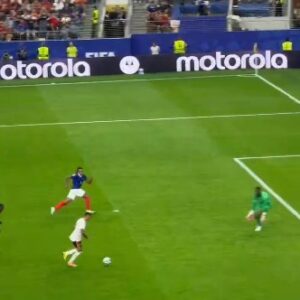
On the pitch, this was a fairly one-sided affair. Kylian Mbappé scored and set up a goal after missing a first-half penalty, while Ousmane Dembélé added the second, as France beat Morocco 2-0 in Thursday’s quarterfinal in Foxborough, Massachusetts.
Mbappé’s strike arrived in the 60th minute — his 20th World Cup goal, one behind Lionel Messi’s record — before he turned provider six minutes later for Dembélé’s fifth goal of the tournament.
France finished with a commanding 21-4 edge in shots and an 8-1 advantage in shots on target.
It’s a familiar script for Morocco. France eliminated the Atlas Lions by the identical 2-0 scoreline in the semi-finals of the 2022 tournament in Qatar, and Morocco’s run this time still made history of its own — the first African team to reach back-to-back World Cup quarter-finals — even if that offered little comfort in defeat.
France, meanwhile, moves on to face the winner of Spain and Belgium, chasing a third straight World Cup final appearance.
“Directed Towards Argentina”: Probing the Storm Behind Messi’s World Cup Comeback
Why sports riots keep breaking out in Europe
Thursday’s scenes weren’t an isolated event, and they weren’t really about football itself. A few patterns recur almost every time a major tournament passes through a European city with a large diaspora population:
Diaspora hotspots become pressure valves. Streets like Edgware Road, or Belgian and French neighbourhoods with large North African communities, function as informal fan zones during international tournaments. They concentrate enormous, unmanaged crowds in a small footprint — which is combustible with or without a bad result, and even more so with one.
This isn’t new for this fixture. France and Morocco have a recent history of triggering unrest after they meet. Their 2022 semi-final produced 266 arrests in France alone, 167 of them in Paris, prompting French police to prepare far more aggressively this time —including the use of drones to monitor streets and an extended ban on pyrotechnics around Paris regardless of the result.
Politics and grievance ride along with the football. In France specifically, football unrest has become entangled with wider domestic tension. Commentary ahead of this tournament noted that some politicians frame French national team support itself as a proxy for immigration debates, while officials have separately pointed to a wave of unrelated unrest — including widespread disorder after Paris Saint-Germain’s Champions League wins — as evidence that football is often simply the occasion, not the cause, for young men looking to clash with police or loot shops.
Policing itself can escalate things. Large, joyful crowds are hard to manage even when nothing is wrong. Traffic gridlock, trapped buses, and a slow initial police presence can turn celebration into confrontation once officers try to physically break up a crowd that has already spilled into the road — a dynamic that has repeated itself in London before, including after other diaspora communities’ teams have gone deep in past tournaments.
The stakes are symbolic, not just sporting. For communities watching a team like Morocco — representing a country that reached the semi-finals for the first time ever as an African and Arab nation in 2022 — a match carries identity and pride well beyond the scoreline. Losing, especially to France, a former colonial power with a large Moroccan diaspora of its own, can amplify frustration that has little to do with football tactics.
None of this makes Thursday night’s violence in London inevitable, and most fans on Edgware Road were there simply to watch a football match. But the pattern is now well-established enough that police forces across Europe increasingly plan for it before a ball is even kicked.
793 AD All Over Again: Norway Set to Raid England’s World Cup Dream
Follow The Raisina Hills on WhatsApp, Instagram, YouTube, Facebook, and LinkedIn




About The Author