India’s First Hydrogen Train Nears Reality as Railways Pushes Green Revolution

India's first hydrogen train is near reality (Image Indian Railways)
By ANUSHKA SAXENA
From Concept to Reality: India’s First Indigenous Hydrogen Fuel Cell-Based Train Set Approved for Operation on the Jind–Sonipat Section of Northern Railway
New Delhi, June 1, 2026 — Indian Railways, one of the world’s largest railway networks, has embarked upon a transformative journey towards clean and sustainable transportation through the development of hydrogen-powered trains. The recent approval on 27 May 2026 of India’s first indigenous Hydrogen Fuel Cell-based train set for operation on the Jind–Sonipat section in Haryana of Northern Railway marks a significant milestone in the country’s clean-energy transition and its commitment to achieving net-zero carbon emissions. Soon we will see it running on tracks.
Hydrogen-powered rail transportation represents one of the most promising alternatives to diesel traction for non-electrified routes. With this initiative, India joins a select group of countries such as Germany, Japan, China, the United States and the United Kingdom that are exploring hydrogen as a fuel for railway operations.
The project is aligned with the National Green Hydrogen Mission, Mission Net Zero Carbon Emission Railway by 2030, and the broader national objective of reducing dependence on fossil fuels while promoting indigenous technological capability under the vision of Atmanirbhar Bharat.
What is a Hydrogen Train?
A hydrogen train is a railway vehicle powered by hydrogen fuel cells rather than conventional diesel engines. Unlike diesel locomotives, hydrogen trains do not burn fuel. Instead, they generate electricity through an electrochemical process.
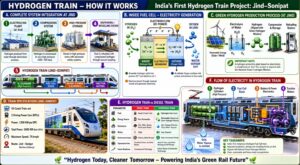
Hydrogen gas stored in high-pressure tanks is supplied to fuel cells mounted on the train. Inside the fuel cell, hydrogen reacts with oxygen from the atmosphere to produce electricity. This electricity powers traction motors, which drive the train. The only by-products of the process are water vapour and heat. Because there are no combustion and no exhaust emissions, hydrogen trains are regarded as a clean alternative to diesel-powered rail transport.
Understanding Fuel Cell Technology
The heart of a hydrogen train is the fuel cell. A fuel cell is an electrochemical device that converts hydrogen directly into electricity without burning it. Inside the fuel cell, hydrogen molecules are split into protons and electrons. The movement of electrons generates electricity, while the hydrogen combines with oxygen from the air to produce water.
Unlike a battery, which stores electricity, a fuel cell continuously generates electricity as long as hydrogen is supplied. Multiple fuel cells are assembled into a fuel-cell stack capable of generating sufficient power to operate a train. This technology offers high efficiency, low noise levels and zero tailpipe emissions.
Green Hydrogen: The Foundation of Sustainable Hydrogen Mobility
The environmental benefits of hydrogen trains depend largely on how the hydrogen itself is produced. Hydrogen can be produced in different ways. Hydrogen generated from coal is commonly called brown hydrogen, while hydrogen produced from natural gas is known as grey hydrogen. Blue hydrogen is produced from natural gas with carbon-capture systems.
The most environmentally desirable form is green hydrogen, which is produced by splitting water into hydrogen and oxygen through electrolysis using renewable energy sources such as solar, wind or hydroelectric power.
Indian Railways has linked its hydrogen initiative with the National Green Hydrogen Mission and has established an electrolysis-based hydrogen production facility at Jind. The project has clearly been conceived around green- hydrogen principles and India’s clean-energy objectives.
Why Hydrogen When Indian Railways is Already Electrifying?
A natural question arises: if Indian Railways is rapidly electrifying its network, why is it investing in hydrogen trains?
The answer lies in the fact that hydrogen trains are not intended to replace conventional railway electrification. Electrification through overhead equipment (OHE) remains the most energy-efficient solution for heavily used routes. However, there are situations where full electrification may be technically difficult, economically expensive, environmentally sensitive or operationally less attractive. Such routes may include remote branch lines, certain hill railways, heritage corridors and low-density sections where the cost of installing and maintaining overhead infrastructure may not be justified.
Hydrogen trains can therefore complement rather than replace electrification. They provide a potential clean-energy alternative to diesel traction on routes where continuous overhead electrification may not be the most practical solution.
For Indian Railways, the hydrogen initiative is as much about developing future technological capability as it is about finding alternative propulsion systems.
Evolution of India’s Hydrogen Train Programme
- 2021: The Beginning
India’s hydrogen mobility journey formally began in August 2021 when the Indian Railways Organisation of Alternative Fuels (IROAF), the dedicated green-fuel vertical of Indian Railways, invited bids for introducing hydrogen fuel-cell technology on the railway network.
The Sonipat–Jind section of Northern Railway, approximately 89 kilometres long, was identified as the pilot corridor. The initial concept envisaged the conversion of existing Diesel Electric Multiple Unit (DEMU) rakes to hydrogen operation, effectively retrofitting a DEMU into a Hydrogen Fuel Cell Multiple Unit (HFCMU).
The initiative was supported by technical specifications developed by the Research Designs and Standards Organisation (RDSO), the research arm of Indian Railways, which laid down the framework for hydrogen fuel-cell systems on Indian Railways.
- 2023: Launch of “Hydrogen for Heritage”
In February 2023, Indian Railways announced the ambitious “Hydrogen for Heritage” programme. Under this initiative, Railways envisaged introducing 35 hydrogen-powered trains on heritage and hill railway routes. The estimated cost was approximately ₹80 crore per train, with an additional infrastructure requirement of about ₹70 crore per route. Based on officially announced cost estimates, full implementation of the Hydrogen for Heritage vision could potentially involve investments exceeding ₹5,000 crore.
Apart from the heritage initiative, the Jind–Sonipat pilot project was sanctioned at an estimated cost of ₹111.83 crore, including supporting infrastructure. The Jind project included retro fitment of an existing DEMU rake and establishment of hydrogen infrastructure.
- 2024: The CSTEP Study
Independent studies have also contributed to the broader policy discourse surrounding hydrogen-based rail mobility. In 2024, the Bengaluru-based think tank, the Centre for Study of Science, Technology and Policy (CSTEP), published a report titled: “Potential and Challenges of Using Hydrogen to Decarbonise Indian Railways.” The study examined the technical, economic and environmental implications of hydrogen-powered railway operations in India and evaluated the opportunities and challenges associated with railway decarbonisation. The study has contributed significantly to the wider policy discussion on hydrogen mobility and railway decarbonisation.
- 2025: Prototype Completion
A major milestone was achieved in December 2025 when Indian Railways announced completion of manufacturing of India’s first hydrogen-powered train set. The prototype was manufactured and retrofitted by the Integral Coach Factory (ICF), Chennai.
The development programme included:
Static and factory tests: Leak checks
- Fuel-system integrity tests
- Electrical-system validation: Dynamic on-track trials
- Acceleration and braking tests
- Range and endurance evaluation Safety and emergency response testing
- Refuelling-system validation Crew training and operational integration
Simultaneously, a hydrogen production facility based on the electrolysis process was established at Jind to support train operations.
The train set has been described by Indian Railways as the world’s longest and most powerful hydrogen train operating on a broad-gauge platform at the time of the announcement.
- 2026: Operational Approval
On 27 May 2026, the Ministry of Railways announced approval for operation of a 10-car Hydrogen Fuel Cell-based train set on the Jind–Sonipat section of Northern Railway.
The train was approved to operate at a maximum speed of 75 kmph, marking the transition of the project from development phase to operational deployment.
Vande Bharat Sleeper Trains: India’s Leap into Future of Rail Travel
The Jind–Sonipat Pilot Project
The Jind–Sonipat section in Haryana has emerged as the centrepiece of India’s hydrogen rail initiative.
The project involves not merely a train but the creation of a complete hydrogen ecosystem comprising:
- Hydrogen production facilities Electrolysis systems ● Hydrogen compression units
- High-pressure storage facilities Refuelling infrastructure ● Safety and monitoring systems
- Maintenance facilities Operational protocols
This integrated approach makes Jind India’s first railway-based hydrogen mobility hub.
The train itself consists of: Two Driving Power Cars (DPCs) and Eight passenger coaches
Thus, the complete train comprises ten coaches. Each Driving Power Car is rated at 1200 kW, giving the train a total installed power of 2400 kW.
How the Jind Hydrogen Ecosystem Works
The operational sequence is designed as a closed hydrogen value chain. Electricity is used to split water into hydrogen and oxygen through electrolysis.
The hydrogen is then:
- Compressed
- Stored in high-pressure tanks
- Dispensed through a dedicated refuelling station
- Filled into onboard hydrogen storage cylinders
The stored hydrogen is supplied to fuel-cell stacks, which generate electricity for traction motors and auxiliary systems. This integrated arrangement minimises transportation requirements and simplifies operational logistics.
Safety Architecture
Hydrogen is highly inflammable and therefore demands rigorous safety measures.
The Jind project incorporates:
- Hydrogen leak detection systems Flame detectors ● Continuous monitoring arrangements
- High-pressure safety systems Approved operating procedures ●Regular safety audits
- Specialised maintenance protocols Trained and certified operating personnel
The Petroleum and Explosives Safety Organisation (PESO) has granted the required approvals for hydrogen storage and dispensing infrastructure.
Additional maintenance arrangements have also been developed at Shakurbasti in Delhi.
Institutions Behind the Project
The hydrogen train initiative is the result of collaboration among multiple organisations.
- Indian Railways – Project owner and policy driver
- Railway Board – Strategic oversight and policy direction
- Northern Railway – Operational implementation
- IROAF – Hydrogen mobility initiative and strategic planning
- RDSO – Specifications, standards, testing and safety protocols
- BHEL – Fuel-cell and propulsion-related technology development
- PESO – Safety approvals for hydrogen storage and dispensing
Together, these organisations have created the technological and institutional framework necessary for hydrogen rail operations in India.
Hydrogen for Heritage: A Parallel Vision
As pointed out above, alongside the Jind pilot, Indian Railways has proposed deploying hydrogen-powered trains on heritage and hill railways under the Hydrogen for Heritage initiative. The concept aims to combine sustainable transportation with tourism and heritage conservation.
The proposed 35 train sets are planned for heritage and hill routes including:
- Kalka–Shimla Railway Darjeeling Himalayan Railway ● Nilgiri Mountain Railway
- Matheran Hill Railway Kangra Valley Railway ● Bilmora–Waghai Railway
- Patal Pani–Kalakund Railway Marwar–Goram Ghat Railway
Why Heritage Routes?
- Many are non-electrified. Terrain makes electrification difficult.
- Hydrogen avoids extensive overhead infrastructure.
- Provides a clean and modern image for tourism. Supports India’s decarbonisation goals.
The Jind pilot is fundamentally a technology demonstrator intended to establish technical and economic viability. The Hydrogen for Heritage initiative, on the other hand, represents a future deployment vision aimed at combining sustainability with India’s rich railway heritage.
Hydrogen Trains vs Battery Trains
Globally, hydrogen trains and battery-electric trains are often viewed as competing alternatives to diesel traction.
Battery-electric trains are generally more energy-efficient because electricity is stored directly in batteries and used for propulsion. However, they require charging infrastructure and are generally better suited to shorter routes or routes with partial electrification.
Hydrogen trains typically offer- Longer operating range, Faster refuelling, Greater operational flexibility, Traction for longer routes
While fully battery-powered passenger trains are not yet widely operational on Indian Railways, battery-based traction technologies and energy-storage systems are increasingly being explored. Kolkata Metro has commissioned a large Battery Energy Storage System (BESS) on its Blue Line. The system can provide emergency traction power and move trains to the next station during power failures. It is India’s first underground metro deployment of a large-scale railway battery energy storage system. This is not a battery-powered train in the strict sense, but it is an important step toward battery integration in rail transport.
Globally, battery trains are considered a strong alternative for shorter non-electrified routes, whereas hydrogen trains may offer greater range and operational flexibility on longer sections
The future railway ecosystem may ultimately use a combination of electrification, battery-electric traction and hydrogen-powered trains depending upon route characteristics and operational requirements.
Global Status of Hydrogen Trains
Hydrogen rail technology remains at a relatively early stage worldwide.
- Germany is generally regarded as the pioneer, having introduced the Alstom Coradia iLint hydrogen train into passenger service.
- Japan continues to develop advanced hydrogen mobility technologies.
- China has invested heavily in hydrogen-powered transit systems and railway applications.
- The United Kingdom and the United States are also pursuing pilot and demonstration projects.
Although global deployment remains limited, hydrogen trains are increasingly being viewed as an important option for decarbonising rail transport where full electrification is difficult or uneconomical.
Advantages of Hydrogen Trains
Environmental Benefits
- Zero tailpipe emissions: Cleaner air
- Reduced greenhouse-gas emissions: Elimination of diesel exhaust
Energy Benefits
- Reduced dependence on imported diesel Improved energy security
- Better utilisation of renewable energy
Operational Benefits
- Quieter operation Suitable for non-electrified routes
- Reduced local pollution
Strategic Benefits
- Development of indigenous technology Promotion of green industries
- Support for national climate commitments
Challenges and Limitations
Despite their promise, hydrogen trains face significant challenges.
- High initial capital cost: Expensive hydrogen production and storage systems
- Significant refuelling infrastructure requirements: Complex safety requirements
- Technology still evolving globally
From an energy-efficiency perspective, direct electrification remains more efficient than producing hydrogen and converting it back into electricity. Long-term operating economics are still being evaluated worldwide.
For Indian Railways, the hydrogen initiative is currently viewed not merely as a commercial venture but as a strategic investment in future transportation technology.
Conclusion
India’s hydrogen train programme represents one of the most significant technological initiatives undertaken by Indian Railways in recent decades. From the first policy discussions in 2021 to operational approval in 2026, the project has evolved into a comprehensive effort encompassing train technology, hydrogen production, infrastructure development, safety systems and institutional collaboration.
The Jind–Sonipat project is not merely a pilot train operation. It is a test bed for India’s future hydrogen economy and demonstrates the country’s commitment to sustainable transportation, indigenous innovation and clean-energy technologies. Whether hydrogen eventually becomes a mainstream railway fuel or remains a specialised solution for selected routes, the project has already established India as an important participant in the global search for clean, sustainable and technologically advanced rail transportation. If the pilot proves successful, hydrogen technology could find wider application on non-electrified routes, branch lines, hill railways, freight operations and specialised transport corridors.
The project therefore represents not only a new train but also a significant step towards India’s long-term vision of green mobility, technological self-reliance and energy transition.
(Author is a policy and data analyst at an MNC and a passionate railway enthusiast)
Follow The Raisina Hills on WhatsApp, Instagram, YouTube, Facebook, and LinkedIn




About The Author