Modi Govt’s Fuel Price Narrative Faces Scrutiny After Latest Hike
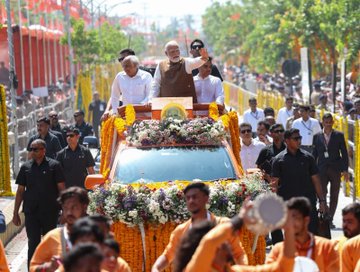
Prime Minister Narendra Modi during a roadshow in Guwahati on Tuesday. (Image Modi on X)
By RAVI SHANKER KAPOOR
Fuel Price Hike Exposes India’s Taxation Con Job, Not Just Global Crude Shock
New Delhi, May 16, 2026 — Technically, oil marketing companies (OMCs) raised the retail prices of petrol and diesel by at least ₹2.83 per litre and compressed natural gas (CNG) by ₹2 per kg. In reality, however, the decision was political and carefully calibrated by the Narendra Modi government after weighing electoral and economic considerations. The rationale offered to justify the hike is both misleading and deeply questionable.
Even after the latest increase, with petrol retailing at around ₹98 per litre, consumers continue to pay nearly 28 per cent of the price in taxes—higher than the GST imposed on most goods and services. In other words, the elevated retail price is still driven more by taxation than by global crude oil prices, which are hovering around $109 per barrel for the Indian basket. More importantly, when global crude prices were substantially lower in the past, consumers never received proportionate relief.
Between 2014 and 2016, for instance, crude oil prices had collapsed to below $30 per barrel at one stage. Yet petrol prices in Delhi continued to remain in the ₹60-72 per litre range. The disparity revealed how governments at both the Centre and state levels used fuel taxation as a revenue-generating mechanism rather than passing on the benefits of cheaper crude to consumers.
These facts underline a larger political reality: virtually the entire political class has benefited from high fuel taxes because states, irrespective of whether they are ruled by the BJP or opposition parties, also derive substantial revenues from petroleum products. The pattern has remained consistent—when crude prices decline, governments increase taxes to boost revenues; when crude prices rise, they invoke the financial stress of OMCs to justify further increases in retail prices.
That appears to be precisely what unfolded this time as well. Prime Minister Narendra Modi first appealed to citizens to conserve fuel and foreign exchange, effectively preparing public opinion for higher fuel costs. Soon after, Petroleum Minister Hardeep Singh Puri spoke about the mounting losses that oil marketing companies could suffer, even though public sector undertakings dominate India’s fuel retail market. Puri initially ruled out an immediate increase in petrol and diesel prices. Yet within a day, Reserve Bank of India Governor Sanjay Malhotra publicly acknowledged the likelihood of a fuel price hike, signalling that the decision had already moved into the final stage of policy execution.
(This is an opinion piece. Views expressed are the author’s own. The article brought in a collaboration with The Hindu Chronicle.)
Follow The Raisina Hills on WhatsApp, Instagram, YouTube, Facebook, and LinkedIn




About The Author