When GDP Turns Hollow: Delhi Question That India Can’t Ignore
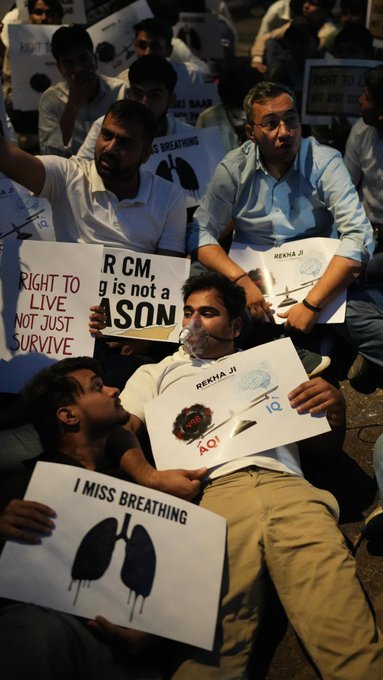
NSUI activists protest against air pollution in Delhi. (Image NSUI on X)
If citizens of the national capital cannot breathe clean air or drink safe water, what exactly are we celebrating in our growth story?
By TRH Edit Desk
New Delhi, December 2, 2025 — When a man who once ran one of the world’s largest public systems pauses and asks, “What does GDP really mean for people?” the question cannot be brushed aside as rhetorical. When that man is Ashwani Lohani—a former chairman of the Railways Board, a known reformer in public administration, and today the director of the PM Museum & Library—his words carry the weight of lived governance.
Lohani’s anguish is not abstract. It is rooted in the lived reality of Delhi—a capital that symbolizes India’s rise on the global stage yet increasingly represents its deepest civic failures. He says he feels “depressed living in Delhi.” That single line should unsettle every policymaker thumping the desk over quarterly growth numbers.
For nearly two months, Delhi’s air has hovered between hazardous and suffocating. The sky looks permanently bruised.
Children develop burning eyes within minutes outdoors. Elderly citizens avoid morning walks. Doctors, helpless against atmospheric poison, prescribe little more than repeated eye washing.
Pharmacies thrive on respiratory medicine sales. Air purifiers—mostly imported—sell faster than refrigerators in summer. This is not a freak episode. This is Delhi’s new normal.
And then comes Lohani’s most devastating question: If people cannot breathe clean air or drink clean water, what does GDP growth actually mean?
This question strikes at the heart of India’s development narrative. We celebrate stock market milestones. We headline corporate profits. We trumpet India’s march toward becoming the world’s fourth-largest economy. But growth that does not translate into dignity of life becomes a hollow statistic.
The Constitution of India does not speak in the language of balance sheets. Under Article 21, it guarantees the Right to Life. Not merely existence—life with dignity. That dignity is fundamentally built on two ingredients: clean air and clean water. Without them, every speech on constitutional values becomes ceremonial noise.
Lohani points to a darker irony. The capital of a powerful nation cannot guarantee its citizens safe air and potable water. If this is the state of the national capital, what moral authority do we have on achieving progress in the hinterland?
The garbage mountains of Ghazipur, Bhalswa and Okhla are not just environmental disasters; they are monuments of institutional decay. During every monsoon, drains overflow because they were never truly cleaned.
Garbage is not merely dumped—it is often burned, adding toxic smoke to already lethal air. Three artificial “mountains” of waste now greet anyone entering the national capital. These are not natural formations. They are the by-products of failed governance.
Lohani’s most uncomfortable word is corruption. Not inefficiency. Not shortage of funds. But corruption. And the evidence is visible in Delhi’s internal apartheid. The NDMC areas—where ministers, MPs and top officials reside—enjoy clean roads, uninterrupted electricity, better sanitation and comparatively breathable air.
The rest of Delhi, inhabited by ordinary citizens, negotiates with filth, traffic chaos, power cuts, contaminated water and unbreathable air. Two Delhis exist within one city. One constitutional. One colonial in its neglect.
Lohani’s comparison with Thailand is equally damning. A country with far fewer resources than India delivers cleaner cities, better civic discipline and safer air. The difference, he implies, is not wealth—it is governance.
This brings us to the heart of India’s GDP obsession. Economic growth has become an end in itself rather than a means to human well-being. Corporate profits rise. Share prices surge. But the citizen’s lungs shrink. The state’s success is measured in digitized dashboards while children grow up inhaling toxic particles.
We recently marked Constitution Day with speeches, selfies and social media campaigns celebrating the greatness of the document. But a Constitution is not honored by hashtags. It is honored when a child can breathe without fear. When a mother can pour water from a tap without suspicion. When a city does not drown every monsoon. When landfills do not become taller than flyovers.
Lohani’s critique is not anti-growth. It is a demand for meaningful growth—growth that travels from GDP charts into the veins and lungs of ordinary Indians.
If economic expansion cannot ensure clean air in the capital of the country, then our development model is not merely incomplete—it is fundamentally distorted.
The real question, therefore, is not how fast India is growing. The real question is: Who is this growth truly for? And until that question is answered honestly, every celebration of GDP will remain, as Lohani warns us, an empty triumph.
A Capital Paradox: Despite Rs 9000 cr fund, people breathe poisonous air in Delhi NCR
Follow The Raisina Hills on WhatsApp, Instagram, YouTube, Facebook, and LinkedIn




About The Author