


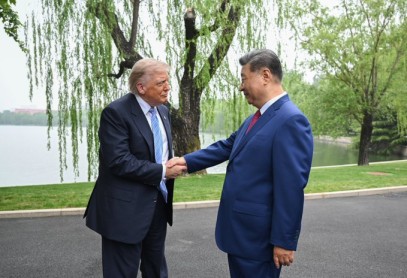
By TRH Op-Ed Desk
Chinese President Xi Jinping confronted Donald Trump on Taiwan during the Beijing summit. Geopolitics analyst Manish Anand breaks down what it means for India, the US-China rivalry, and the emerging multipolar world.
New Delhi, May 15, 2026 — In what geopolitical analysts are calling one of the most consequential diplomatic encounters of the decade, United States President Donald Trump’s two-day visit to Beijing for a summit with Chinese President Xi Jinping has sent shockwaves through the global order — with implications stretching far beyond Taiwan, Japan, or South Korea, reaching all the way to New Delhi.
The meeting, their second in just ten months — the first having taken place on the sidelines of the APEC Summit in South Korea in October 2025 — came after a bruising period of tariff wars, supply chain confrontations, and deepening strategic rivalry. Yet it was China, not America, that walked away with the upper hand.
Xi Sets the Tone — Literally
Even the optics of the summit spoke volumes. Observers noted that Xi Jinping’s sofa was visibly higher than Trump’s during their joint seating, making the American president appear physically uncomfortable and visually diminished before global cameras. Analysts say the staging was deliberate — a carefully choreographed signal of China’s confidence on the world stage.
“Xi Jinping directly confronted Trump on Taiwan, telling him clearly that if America continues to interfere, military conflict could be the consequence,” said Manish Anand, a geopolitics analyst who hosts The Raisina Hills YouTube channel. “Xi issued what was effectively a warning to Trump’s face — and Trump, one of the most publicly aggressive leaders on the world stage, was put on the back foot,” he added.
No Concessions, Only Confrontation
Trump arrived in Beijing with one of the largest delegations of his presidency — Treasury Secretary, Trade Secretary, Secretary of State Marco Rubio, and a sweeping business cohort including the CEOs of some of America’s biggest corporations. The expectation was a package of concessions from Beijing on trade, Iran, and Taiwan.
He left largely empty-handed.
On Iran, Trump urged Xi to stop supplying military weapons to Tehran. Xi’s response was unambiguous — China has significant oil-purchasing ties with Iran and made no commitment to curtail them. On Taiwan, when Trump was pressed about halting weapons sales to the island, he deflected: “I don’t want to talk on such matters right now.” Beijing, by contrast, stated its red lines with unmistakable clarity.
The only concrete deliverable Trump secured was a Chinese commitment to purchase approximately $768 billion in American goods — a figure analysts suggest may simply reflect routine commercial transactions rather than a meaningful strategic concession.
“Trump could not extract a single significant concession from Xi,” Anand observed, adding: “Instead, Xi delivered a counter-narrative to the entire world — that China is not a middle power. It is a superpower, and the next world order will be shaped with Beijing as a central pillar.”
China’s Leverage Is Structural
Analysts point to the structural roots of China’s confidence. American supply chains remain deeply embedded in Chinese manufacturing. Critical minerals, rare earth elements, and vast swathes of consumer goods still flow from China to the United States. These are not bargaining chips that disappear overnight — they are systemic dependencies that Beijing understands, and exploits, with precision.
Xi also made clear that China envisions a multipolar world order — one governed by rules-based international norms rather than the diktat of a single superpower. “China consistently says: if you give an inch to a bully, they’ll take miles,” Anand noted, referencing the strategic philosophy underpinning Beijing’s diplomacy since Trump’s second inauguration.
A Warning for India
Perhaps the most pointed dimension of Anand’s analysis concerns what the summit means for India. While Trump and Xi were meeting in Beijing, New Delhi was hosting a BRICS Foreign Ministers’ meeting — and China conspicuously sent only its ambassador, not its Foreign Minister Wang Yi, citing scheduling conflicts.
“China sent a signal to India that this major diplomatic event means nothing to us,” Anand said bluntly, adding: “The argument that India could emerge as a strategic counterweight to China — that comparison is falling further and further behind. China has arrived as a world power. India is still positioning itself as an emerging one.”
Anand’s broader message for Indian policymakers is stark: “Strategic autonomy cannot be compromised. Build your leverage. Until you hold the levers of global supply chains and economic power, no world leader will truly respect you. India must learn from how China handled Trump — with consistency, firmness, and zero retreat.”
(Manish Anand is a geopolitics analyst and host of The Raisina Hills, a YouTube channel covering global strategic affairs.)
Zhou Qunfei: The Chinese Billionaire Who sat with Musk and Cook
Follow The Raisina Hills on WhatsApp, Instagram, YouTube, Facebook, and LinkedIn




