


By TRH World Desk
The Dow surged 930 points after Trump canceled Iran strikes and declared a peace deal imminent. Here’s everything known about the deal.
New Delhi, June 12, 2026 — For the third time in as many months, financial markets whipsawed on the promise — and the ever-present threat of collapse — of a US-Iran peace deal. On Thursday, June 11, Wall Street booked its best single session in two months. But the rally wasn’t born of earnings or economic data. It was born of a Truth Social post.
“Discussions with the Islamic Republic of Iran have been brought to the highest level of Iranian leadership and approved,” US President Donald Trump wrote Thursday evening, pausing a set of military strikes he had ordered just hours earlier against Iranian energy infrastructure.
He stated that the time and place of a formal signing would “be announced shortly” — a formulation that had the Dow Jones Industrial Average surging 929.97 points, or 1.86%, closing at 50,848.75. The S&P 500 climbed 1.75% to 7,394.30, and the Nasdaq Composite jumped 2.54% to 25,809.66. The Russell 2000 led all major indexes, rising 3.02%.
Oil told the inverse story. Crude prices tumbled more than 3% on the prospect of the Strait of Hormuz — the chokepoint through which roughly 20% of global oil transits — finally reopening after months of US-enforced blockade.
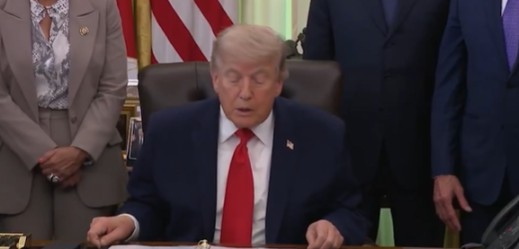
Later, speaking at the Oval Office with reporters, Trump said that the “deal with Iran will be signed in Europe.” He will not be attending, added Trump.
At a White House press briefing Thursday, Trump framed the emerging agreement in sweeping terms. “We have a deal that Iran will never have a nuclear weapon — which was the whole purpose of what we had to go through to get this,” he told reporters, according to reporting by CNSNews. “That was a very big thing,” Trump added.
The US president said the signing ceremony would likely take place possibly over the upcoming weekend, with Vice President JD Vance representing the United States in his absence. “The strait will officially open as soon as we sign, which could be soon, very soon, maybe, over the weekend,” Trump said.
He also predicted downstream economic benefits: “Oil will start coming down. And when oil comes down, everything else comes down.”
Earlier Monday, Trump had told reporters after attending the NBA Finals in New York that the two parties were in the final stages of a deal — one that would represent “a very, very good deal that will not in any way allow nuclear weapons,” per CNBC.
Trump said he believed a resolution was only “two or three days” away and that the Strait of Hormuz would reopen “immediately” after an agreement.
On social media, Trump described how he had “cancelled the scheduled strikes and bombings against Iran this evening” — a reversal that marked his second cancellation of a major strike package in this conflict alone.
He cited five unnamed regional nations that had urged him to halt military action and press forward with diplomacy. “These countries were very concerned. They love the deal that we have been negotiating,” Trump told reporters, per CNN.
Indian Blood in the Gulf: Three Dead, MT Jalveer Also Attacked
What’s Actually In The Deal
According to an Axios report from late May citing a US official, the agreement under negotiation involves a 60-day ceasefire extension during which the Strait of Hormuz would be reopened and Iran would be permitted to freely sell oil, while negotiations on curbing Tehran’s nuclear program would proceed in parallel. The same report cautioned that it remains unclear whether the arrangement would lead to a lasting peace agreement that fully satisfies Trump’s nuclear demands.
Trump’s publicly stated red lines include a complete prohibition on Iranian nuclear weapons, immediate and toll-free reopening of the Strait of Hormuz, US-IAEA joint destruction of enriched uranium buried at bombed nuclear sites, and no financial transfers “until further notice.” In a Friday Truth Social post two weeks prior, he listed these terms explicitly — and Iranian state news outlet Fars pushed back, saying some of Trump’s conditions “contradict the provisions of the agreement’s text,” per CNBC.
Netanyahu: The War Has Not Ended
If Trump is reaching for the handshake, Israeli Prime Minister Benjamin Netanyahu is still reaching for the holster.
In a televised address Monday, Netanyahu said Israel had halted its attacks on Iran — but stopped conspicuously short of endorsing Trump’s ceasefire framing. “The war against Iran and Hezbollah has not yet ended,” he said, per CNBC. He warned bluntly: “If Iran makes the mistake of resuming attacks on us, we will respond with overwhelming force.”
In a statement issued by Israeli Prime Minister, it was stated that the full destruction of the nuclear capabilities of Iran be achieved in the “memorandum of understanding” to be signed between the US and Iran.
Why Markets Believe Him (Again)
Thursday’s rally was striking not only for its size but for its context. It came one day after the Dow had shed 953 points — its own 1.87% drop — when Trump threatened more Iran attacks, saying on Truth Social that Iran had “taken too long to negotiate a deal that would have been great for them, now they will have to pay the price!!!” Oil prices had risen sharply on those threats, per CNBC.
Markets have now played this whipsaw trade more than two dozen times since the conflict began in late February, when US and Israeli forces launched a coordinated bombing campaign that killed Iranian Supreme Leader Ali Khamenei. The conflict — which Trump initially projected would last “four to six weeks” — crossed its 100-day mark last Sunday.
Investors are choosing, again, to believe the deal is real. The Cboe Volatility Index fell nearly 12% on Thursday. Tech, industrials, and materials led gains in the S&P 500. Gold and silver also rose — a sign that while risk appetite improved, hedging remains in fashion.
The producer price index, meanwhile, delivered an unwelcome counterpoint: wholesale inflation came in at 6.5% year-over-year for May — the highest since November 2022 — underscoring the economic stakes of a prolonged war on energy markets. The European Central Bank, fighting the same inflation fire, raised its key rate a quarter-point Thursday to 2.25%.
THE Question Nobody Can Answer
Will this deal actually get signed?
The history here is humbling. Trump has previewed a “final determination” that never came. He has set deadlines — “two weeks,” “days,” “this weekend” — that have dissolved into fresh bombardments. Iranian state media has contradicted White House characterizations in real time. Israel has acted unilaterally at least twice without notifying Washington until the missiles were already airborne.
What is different now, perhaps, is the pressure architecture. Iran’s airspace has returned to normal conditions. Flight operations have resumed. Iran’s IRGC has signalled suspension of operations against Israel, per CNN. Iranian officials have told CNN directly that Tehran has “no problem” with peace talks, so long as the US is “honest and sincere.”
And markets — whatever their flaws as political forecasters — are telling you the probability of a deal has just risen meaningfully.
The question is whether the jets on the runway stay there this time.
Follow The Raisina Hills on WhatsApp, Instagram, YouTube, Facebook, and LinkedIn




