


By TRH World Desk
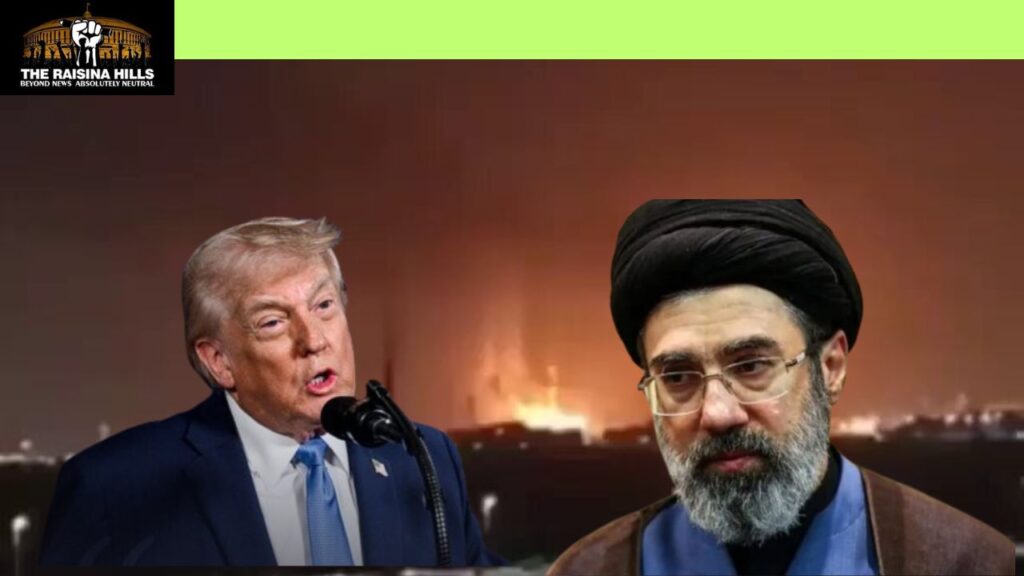
The world awaits with bated breath the signing of the peace deal between the US and Iran, and Pakistan’s Prime Minister Shehbaz Sharif says that it would happen in the next 24 hours.
New Delhi, June 13, 2026 — Hormuz diplomacy has turned serene in the last 24 hours. No fiery Trump Truth Social posts. No Iranian leaks in the local media. Will the US and Iran finally cross the bridge? The question seems heavily pregnant with an answer, and Pakistan Prime Minister Shehbaz Sharif seems acting as a midwife, ready to break the good news to the world.
Sharif first hit the post button on X to calm down a furious Trump, saying that the deal work is in progress. Twenty-four hours later, Sharif once more hit the post button. This time he announced that the deal will be signed “electronically.” Technical talks will take place afterwards, added the Pakistani PM.
There is something almost surreal about Pakistan announcing the end of a war it did not fight. But then again, almost everything about the 2026 conflict between the United States and Iran has defied conventional expectation — from its catastrophic opening act on February 28, when US and Israeli strikes killed Supreme Leader Ali Khamenei, to its current condition: a fragile ceasefire, a closed Strait of Hormuz, and a diplomatic endgame being brokered not in Geneva or New York, but in Islamabad.
The problem, as so often in this conflict, is that not everyone is standing in the same place.
Iran’s Foreign Minister Abbas Araghchi insisted on Friday that a deal had never been closer. That came after Trump furiously accused Tehran of negotiating in bad faith — a reaction triggered when Iranian media published what was purportedly on the table, including Iran’s insistence on retaining its right to enrich uranium and control shipping through the Strait of Hormuz. That account clashed sharply with what Washington was saying.
A senior White House official told AFP that Iran had agreed to dismantle its nuclear programme, destroy its enriched uranium stockpile, and reopen the strait — and that Tehran would not see any of its frozen funds returned until it had honoured these commitments.
These are not minor discrepancies in translation. They are opposite accounts of what is being signed.
Araghchi, speaking on Iran’s Press TV late Friday, stressed that no agreement had been signed. He said the deal being considered had two stages: the first a memorandum of understanding, and the second the beginning of negotiations on several issues.
Under the first stage, fighting would be halted, with commitments not to relaunch attacks — while questions around Iran’s nuclear future, the lifting of sanctions, and the unfreezing of assets would be addressed only in the second stage. That is a very different architecture from what Washington claims is already settled.
Al Jazeera reported the mood in Washington as cautiously forward-leaning. A senior Trump administration official told reporters that the negotiating team had reached “a very good spot” but acknowledged they were “not quite at the finish line yet.” Iran’s parliamentary speaker and chief negotiator Mohammad Bagher Ghalibaf added a note of cryptic resolve, posting on X: “Commitments made must be commitments kept. No ifs, no buts, no excuses. For the close deal ahead, there is no other way.”
Which brings us back to Islamabad, and to what exactly Pakistan’s role in all this means. The Islamabad Talks in April 2026 failed to produce an agreement. Qatar and other Gulf states subsequently stepped in as facilitators.
Yet Sharif has reclaimed the mediator’s chair with considerable energy, and the framework being discussed is formally called the Islamabad Memorandum of Understanding — a naming that gives Pakistan a kind of diplomatic equity in the outcome regardless of where the signing ultimately happens.
Iran’s foreign minister confirmed that the upcoming ceasefire agreement features the unfreezing of confiscated Iranian assets, which is notable because it directly contradicts what US Vice President JD Vance has been saying publicly — that no funds or cash would be released to Iran simply for signing. The gap between those two positions is not a footnote; it is the deal.
What is not in dispute is the scale of what a signed agreement would mean. The Strait of Hormuz has been closed since late February. Reopening it is widely seen as a substantial issue in the talks, with Trump having made it a condition of the US ceasefire pause while Iran described the US counter-blockade as a potential violation of that same pause. Global trade, energy prices, and the broader architecture of Middle Eastern security all hang in the balance.
Pakistan finds itself in a role that rewards both its geographic position and its recent willingness to absorb diplomatic risk. Sharif’s 24-hour clock is either an act of faith or an act of theatre — or both. The world, watching from Hormuz to Washington, hopes it is the former.
Trump Blasts Iran Over Leaked Deal Terms as Hormuz Diplomacy Unravels
Follow The Raisina Hills on WhatsApp, Instagram, YouTube, Facebook, and LinkedIn




