


By P. SESH KUMAR
An analysis argues that commercialization and financial misconduct are not unique to Hindu temples but affect religious institutions worldwide, making governance—not religion—the central issue.
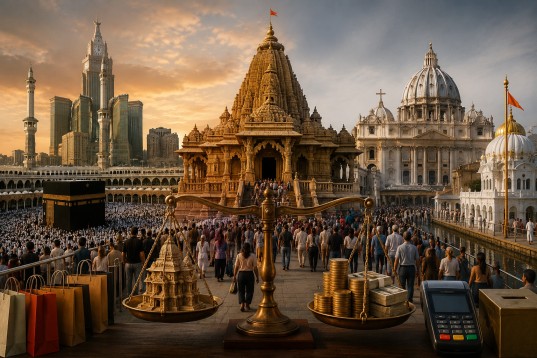
New Delhi, July 9, 2026 — This essay responds to the claim that modern Hindu temples have turned into spiritual theme parks where devotion is merely the décor and commerce is the real deity. It situates India’s temple economy within a much wider, cross‑religious and transnational pattern: the aggressive commercialization of pilgrimage and worship in churches, mosques, gurudwaras and shrines worldwide, from Mecca’s luxury high‑rises to Vatican real‑estate scandals and donation scams in marquee Indian temples.
The real fault line is not between religions but between stewardship and extraction: wherever large flows of anonymous cash, weak governance, and emotional mobilisation converge, malpractice follows. Yet alongside the scams sits a quieter, powerful record of hospitals, schools, langars, disaster relief and social uplift funded by religious institutions.
Devdutt Patnaik’s quip as reported in Navbharat Times is wickedly clever: “Mughals broke temples to loot them; Sanatanis build temples to loot them.” It has the satisfying sting of a tweet and the easy rhythm of a WhatsApp forward. It also has one large problem: it confuses a very old human weakness with a very particular religious blame‑game. The disease is not “Hindu temples”; the disease is what happens when money, mythology and weak accountability are locked together in a room and asked to behave.
Temples, in his telling, are now spiritual theme parks: eat, shop, donate, queue, buy VIP darshan, click selfies, make reels, repeat. Hotels, prasad counters, parking lots, donation boxes–the whole circus wired to a cash register. That picture is not entirely wrong; religious tourism has indeed become big business, in India and far beyond it, and sacred sites across traditions have been folded neatly into the global tourism industry. Scholars of religious tourism now frankly describe pilgrimages and visits to churches, mosques and temples as an integrated market segment in Europe and globally, complete with tour operators, packaged “experiences” and carefully priced access to holy places. The problem begins when we pretend this is uniquely a Hindu failing.
Take Mecca — the very comparison Devdutt himself tees up. Over the last two decades, the skyline around the Grand Mosque has been transformed by a forest of high‑rise hotels, shopping malls and luxury complexes, many of them overshadowing the holy Kaaba itself.
Architectural critics note — with barely concealed alarm — that what was once a landscape of historic neighbourhoods and simple lodgings has been bulldozed into an upscale district where five‑star rooms with a view of the sacred precincts can run into thousands of dollars a night.
The Hajj, religiously conceived as a levelling exercise in humility and equality, is increasingly ring‑fenced by premium hospitality, branded retail and tiered access, prompting some Muslim commentators to warn that an austere rite of passage is at risk of mutating into a very expensive religious holiday.
That is not “Sanatani capitalism.” That is global capitalism doing what it always does: finding the highest‑margin square inch of real estate on the planet and building up. And it does so in Rome and Jerusalem as cheerfully as it does in Mecca or Ayodhya.
Consider the Vatican. Behind the solemn marbled corridors and incense‑laden chapels, the Holy See has spent years wrestling with its own money demons. A 350‑million‑euro investment in a luxury London property, funded substantially by donations from the faithful, has exploded into a landmark criminal trial involving a cardinal and multiple senior advisers, who are accused of embezzlement, abuse of office and corruption.
Pope Francis himself has publicly acknowledged that financial corruption exists within Vatican operations and that some of its property deals and bank activities were, in his own words, “a scandal.” These are not street‑corner pundits; this is the institution admitting that, even in the heart of Christendom, the sanctified collection plate can become a very worldly slush fund.
Lourdes is a prominent market town in the Pyrenees mountains of southwestern France. It is most famous globally as a major Catholic pilgrimage destination, where millions of visitors travel annually to visit the Sanctuary of Our Lady of Lourdes and seek physical or spiritual healing. There is the observation that Lourdes is highly commercialized. It is a very common and valid critique, often debated by visitors, scholars, and theologians alike. There is however, a sharp, visible contrast between the spiritual atmosphere inside the holy sites and the aggressive retail economy just outside its gates.
Cross the street, figuratively, to the bustling world of mega‑churches. In the United States, Africa, Latin America and parts of Asia, televangelist empires have been built on prosperity preaching: donate generously and God will return the favour, often advertised from a stage backed by LED walls, concert‑grade sound systems and branded merchandise. Investigative reporting and prosecutions have repeatedly exposed cases where such ministries channelled millions in donations into private jets, luxury homes and personal businesses, all while their on‑air messaging urged viewers to “seed” their faith with cash. This is the “VIP darshan” model translated into tithes and televised miracles, and it thrives in Christian contexts as energetically as any temple town bazaar.
The gurudwara looks, at first glance, like a radical counter-example. Its theology leans hard into equality, service and sangat; the langar is open to all, and the ritual of eating together on the floor cuts through the class lines that other religious spaces sometimes reinforce. Yet even here, the combination of large cash flows and human frailty refuses to disappear. In India and overseas, there have been very public disputes and court battles over control of gurudwara management committees, allegations of misappropriation of donations, and political interference in the governance of prominent shrines, illustrating that Sikh institutions are not magically immune to the temptations that attend substantial community funds. When control of the cash box also means control of the microphone and the real estate, factions invariably emerge.
Back in India’s temple towns, the pattern is familiar enough that one could draft the screenplay in one’s sleep. A shrine becomes a political mascot. The town is recast as a destination. Roads, hotels and markets swell to keep up with the crowds. The devotee arrives with folded hands; everyone else arrives with calculators.
In Ayodhya, the newly iconic Ram temple has already been mired in allegations that large amounts of donations–cash and jewellery — were siphoned off or badly mismanaged, prompting special investigations, multiple arrests and the recovery of significant sums in cash from those handling the counting and custody of offerings. Audit reports warned, years earlier, that donation management was “highly unprofessional” and that there was no systematic record, no proper SOPs, and no robust stock registers for valuables, yet the warnings went largely unimplemented until scandal forced everyone’s hand.
If one strips away the religious vocabulary, these stories sound eerily similar: a fast‑growing cash‑heavy business with little external oversight, emotional customers, weak internal controls, and leadership that answers more to tradition and charisma than to auditors and regulators. Whether the altar holds a murti or idol, a cross, a scripture or a sacred stone, the movie is the same.
Devdutt’s other thrust — that traders have turned priests into their sales force and temples into their factories — is also worth reframing. The religious bazaar around sacred sites is not a uniquely Hindu phenomenon; it is structurally baked into modern pilgrim economies. Studies of commercialization at religious sites in South Asia, for instance, show Hindu and Buddhist shrines in Nepal surrounded by rings of shops, ticket counters, and service providers offering everything from flowers and ritual items to photo packages and guided tours. Visitors themselves are split into camps: some resent the intrusion of commerce into their spiritual time; others welcome the convenience, the improved infrastructure, and the sense that their spend is supporting local livelihoods.
Exactly the same debates play out in European cathedrals that now host gift shops and ticketed “experiences,” and in old city mosques where guided tours and curated retail lanes are part of the urban plan. Sacred spaces everywhere are learning the language of tourism; the question is not whether commerce exists, but whether it is controlled, transparent and subordinate to the core purpose of the place.
If the pathology is general, so too is the promise. Religious institutions, at their best, are not just passive landlords of faith; they are engines of social capital. The same ecosystem that can breed scams can also, when designed with integrity, deliver extraordinary public goods. The gurudwara langar is the most visible face of this: community kitchens attached to Sikh shrines in Delhi, Amritsar and across the world serve free meals at enormous scale, often stepping up heroically during disasters and crises.
Hindu temple trusts and Christian dioceses in India routinely run schools, colleges, hospitals and charitable programs in rural and urban areas, providing education and healthcare that would otherwise be out of reach for many communities. In the Islamic world, zakat and waqf traditions continue to fund welfare activities, scholarship programs and relief initiatives, even as debates rage over how to modernise waqf governance and reduce leakage.
In other words, the story of “faith money” is not a straight line from devotion to loot; it is a forked road. One path leads to ghost‑accounting and golden‑throne selfies; the other leads to night‑schools, blood banks and community kitchens. The choice is less about which god a community prays to and more about whether its institutions accept that religious funds are, in substance, public trust money–subject to the same disciplines we expect of mutual funds, charities or listed companies.
So what does a grown‑up response look like? First, we stop playing communal whack‑a‑mole. If Mecca’s skyline can be colonised by luxury towers and malls, if the Vatican can lose millions of euros of donations in opaque real‑estate ventures, if mega‑church empires can be built on prosperity marketing, and if the most politically celebrated temple in India can face allegations of donation embezzlement within months of consecration, then the common denominator is not creed; it is governance.
Second, we recognise that religious tourism is here to stay. European policymakers now openly speak of “religious tourism” as a distinct product category. Cities brand their churches, mosques and temples as attractions; travel agencies bundle pilgrimages as packages. Trying to rewind this tape to a pre‑commercial era is fantasy. The real task is to civilise the interface:
Turn temple trusts, church dioceses, mosque committees and gurudwara boards into professional fiduciaries, with audited accounts, clear SOPs for handling cash and valuables, and regular public disclosure of inflows and outflows. The Ram temple audit experience is a textbook case of what happens when the “we’ll manage” approach collides with thousands of crores in donations.
Use technology–digital payment channels, real‑time dashboards, independent audit trails–to reduce cash‑handling risk and make every rupee tell a story that donors can actually see.
Enforce fit‑and‑proper criteria for those managing large religious trusts, much as financial regulators do for key personnel in capital‑market intermediaries.
And, critically, protect and scale the parts of the religious economy that demonstrably work: langars, charity hospitals and schools, relief funds, and community welfare programs that are run with transparent budgeting and measurable outcomes.
Devdutt is right about one thing: the devotee often walks in with folded hands while others walk in with calculators. The answer, however, is not to sneer at the folded hands. It is to ensure that the calculators are pointed at balance sheets that can stand daylight, irrespective of whether the building they sit in is called a temple, a church, a mosque or a gurudwara.
When we do that, “Hindu khatre mein hai” and its cousins across religions can retire as marketing slogans, and faith can go back to what it was always meant to be: a source of meaning and solidarity, not a particularly profitable real‑estate vertical.
(This is an opinion piece. Views expressed are the author’s own.)
Ram Temple Donation Row: A Crisis of Accountability That Has Outgrown a Theft Investigation
Follow The Raisina Hills on WhatsApp, Instagram, YouTube, Facebook, and LinkedIn




