


By Ravi Shanker Kapoor
Drawing on the childhood story of Swami Dayanand Saraswati, the author argues that India’s legal and political climate has narrowed the space for questioning religion, with Section 299 of the Bharatiya Nyaya Sanhita at the centre of the debate.
New Delhi, July 12, 2026 — On a Shivaratri night, circa 1832, an eight-year-old boy named Mool Shankar, the son of a Brahmin priest, Karshanji Tiwari, saw a rat nibbling at the offerings made to Lord Shiva.
A question shook his faith: if the deity could not protect his own offerings from a meek rodent, how could he be divine?
The boy may have been the world’s youngest skeptic, but he did not grow into an atheist or an agnostic.
Instead, he became one of modern India’s greatest religious reformers—Swami Dayanand Saraswati, who founded the Arya Samaj and triggered a social, religious, and cultural revival across north and north-west India.
Nearly two centuries have passed since that epiphanous moment. India has become independent. Education has expanded enormously.
Science and technology have advanced dramatically, and communication has undergone multiple revolutions. Yet, is it possible today for a boy or girl, a man or woman, to ask a similar question? Perhaps it is. But can they publicly raise such questions? No.
Something similar to what young Mool Shankar witnessed two centuries ago is unfolding before the nation today, only on a much larger scale.
This time, however, the offenders are not rodents but men allegedly caught stealing offerings made to Lord Ram. There have also been allegations of illegal land deals in Ayodhya. Yet no politician or public figure dares to raise doubts about Lord Ram’s divinity.
None asks, as the eight-year-old Mool Shankar once did, the obvious question: if the deity could not protect his own offerings from thieves, how could he be divine?
This is the power of India’s blasphemy law—Section 299 of the Bharatiya Nyaya Sanhita (formerly Section 295A of the Indian Penal Code). Though the law never uses the word “blasphemy,” it effectively criminalises it. It penalises “deliberate and malicious acts intended to outrage religious feelings of any class by insulting its religion or religious beliefs.”
The point I wish to make is that India, despite all its shortcomings 200 years ago, offered greater space for religious and intellectual questioning than it does today. The country was politically fragmented and steadily falling under British rule. The economy was declining, social conditions were dismal, and women and the so-called lower castes faced severe discrimination.
Yet, despite these shortcomings, the Hindu intellectual tradition did not suppress the instinct to question—even in deeply religious households such as Mool Shankar’s.
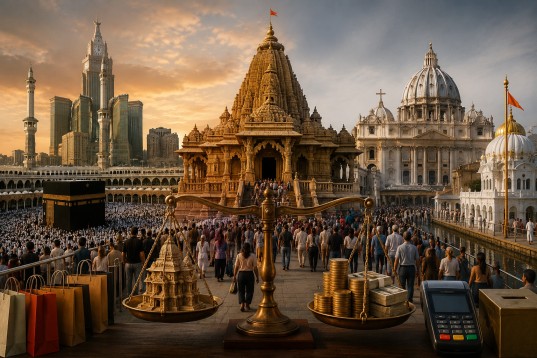
From Ayodhya to Mecca: The Real Problem Is Commercialized Faith
Scientific inquiry was limited, and philosophical innovation had slowed, but the spark of curiosity, doubt and questioning had not been extinguished. British rule introduced the ideas of the Western Enlightenment, which helped ignite a social, religious and cultural revival, giving rise to reformist movements such as the Brahmo Samaj and the Arya Samaj.
By the end of the nineteenth century, however, patriotism had gradually transformed into nationalism, weakening Enlightenment ideals such as free speech, individual liberty and limited government.
One of the earliest casualties was freedom of expression. Mahatma Gandhi, the foremost leader of the nationalist movement, played an important role in shaping public opinion against what he regarded as blasphemous expression.
In the 1920s, Muslim groups objected to the publication of Rangila Rasool (1924), a book written by a Hindu author under a pseudonym that discussed aspects of Prophet Muhammad’s private life. The book itself was a response to earlier publications such as Krishna, Teri Geeta Jalani Padegi and Unnisvin Sadi ka Lumpat Maharshi, which were critical of Hindu figures.
Traditionally, Hindus had no concept of blasphemy and generally did not seek legal bans on such writings. Muslim organisations, however, demanded criminal action against Rangila Rasool.
Since the original Indian Penal Code drafted by Thomas Macaulay contained no provision criminalising blasphemy, the publisher, Rajpal, was acquitted by the Lahore High Court after initially being convicted by lower courts. (Rajpal was later assassinated in 1929 by a young Muslim fanatic.)
Muslim groups demanded a law against blasphemy, and the British government accepted the demand. Gandhi also strongly opposed publications he regarded as blasphemous. Writing in Young India, he said: “The very title is highly offensive… I have asked myself what the motive possibly could be in writing or printing such a book except to inflame passions… As a contribution to religious propaganda, it has no value whatsoever. The harm it can do is obvious.”
Gandhi’s position lent legitimacy to the demand for legal restrictions. In 1927, Section 295A was introduced into the IPC and passed comfortably in the Imperial Legislative Council. Prominent leaders, including Lala Lajpat Rai and Madan Mohan Malaviya, supported it, although many also warned that it could endanger historical scholarship, scientific writing and honest criticism of religion.
Interestingly, Mohammad Ali Jinnah argued that the law should apply only to those who indulged in “wanton vilification” of religions and that scholars engaged in historical research or bona fide criticism should remain protected.
That distinction, however, is deeply problematic. The line between “wanton vilification” and “honest criticism” is often subjective and contested.
If someone questions the morality of Lord Ram’s decision to banish his pregnant wife, would that constitute vilification? Many Hindu nationalist groups might say yes. Yet Hindu traditions have long permitted criticism of deities.
More than fifty years ago, I remember my father—a deeply religious man named Ram Charan—criticising Lord Ram for this very act. Had he expressed the same view publicly today, he might have faced violent retaliation despite his faith.
Likewise, critical observations about Prophet Muhammad’s conduct during wars or aspects of Islamic theology can also be interpreted as “wanton vilification.”
This is not merely a theoretical concern. Five years ago, a Hindutva mob forced the withdrawal of a remix of the song Naache Madhuban Mein Radhika.
More recently, a Maharashtra legislator faced criminal charges under Section 295A after praising the Mughal emperor Aurangzeb. Muslim groups, too, have repeatedly campaigned against speech they considered offensive.
In practice, India’s blasphemy law has severely narrowed the space for bona fide criticism of religion. Public discussion increasingly consists of platitudes rather than genuine debate.
Meanwhile, self-styled godmen flourish, rituals proliferate, pilgrimages expand, pseudoscience gains ground, ostentatious religiosity spreads, and superstition persists.
In an age overflowing with information and scientific discovery, it may be difficult enough to find another eight-year-old Mool Shankar. But it is even less likely that such a child would grow into another Swami Dayanand Saraswati.
(This is an opinion piece. The views expressed are the author’s own. The article first appeared in The Hindu Chronicle.)
RSS Treating Ram Mandir Donation Scam as ‘Family Matter’: Analyst
Follow The Raisina Hills on WhatsApp, Instagram, YouTube, Facebook, and LinkedIn




