SIR Row Reaches Army: Eastern Command Knocks at Bengal Guv
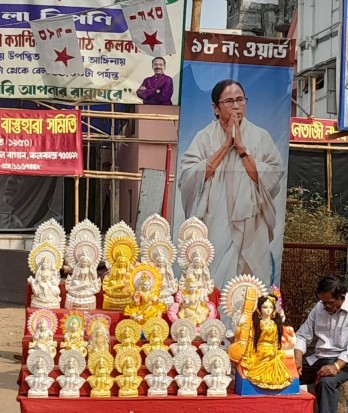
Saraswati Puja idols selling on the Kolkata street (image Nirendra Dev)
The Special Intensive Revision of electoral rolls sparks a political storm in West Bengal. The Indian Army formally objects to being dragged into the controversy. Tension escalates between the state government and constitutional authorities.
By NIRENDRA DEV
Kolkata, January 21, 2026 — The escalating controversy over the Special Intensive Revision (SIR) of electoral rolls in West Bengal has now formally reached the Indian Army, raising serious constitutional and institutional concerns.
Senior officials from the Army’s Eastern Command have approached West Bengal Governor C V Ananda Bose, objecting to Chief Minister Mamata Banerjee’s public remarks alleging that an Army officer was using Fort William, the Army’s Kolkata command headquarters, to conduct political activities linked to the SIR exercise.
According to sources at Lok Bhavan, two senior Army generals met the Governor and conveyed their strong protest. Governor Bose is understood to have taken serious note of the issue and has raised it with the Union Defence Ministry. A formal letter of objection was also submitted, though its contents were not disclosed.
The Army’s intervention follows Mamata Banerjee’s January 13 press conference at the state secretariat, Nabanna, where she alleged—without naming the officer—that a commandant at Fort William was “working on the SIR to extend support to the BJP” and was effectively running party operations from a military installation. She urged the officer to desist, claiming to possess specific information.
The remarks triggered sharp political reactions. While the BJP accused the Chief Minister of maligning the armed forces for political gain, Left parties demanded an independent inquiry to establish the truth behind the allegations.
The controversy unfolds amid heightened tension over the SIR exercise, which the Trinamool Congress has repeatedly alleged is designed to disenfranchise voters, particularly minorities and women.
However, in an affidavit filed before the Supreme Court, the Election Commission of India (ECI) defended the exercise, citing “scientifically impossible” voter mappings. The EC revealed that in West Bengal, 4,59,054 instances were found where electors were linked to more than five children, with 2,06,056 cases involving more than six children—figures it said warranted enhanced scrutiny.
The EC noted cases where over 200 electors were linked to a single parent, as well as implausible age gaps exceeding 50 years between parents and children. “Such mappings defy biological and demographic logic,” the EC submitted, adding that logical discrepancies only trigger verification notices—not deletions.
The poll body also rejected claims that the SIR disproportionately targets minorities or women, denying allegations of “algorithm-driven deletions.” It clarified that the 58 lakh voters excluded from the draft roll published on December 16, 2025, were removed due to death, duplication, migration, or non-availability during house-to-house verification—and would be given hearings.
Senior Advocate Kapil Sibal, appearing for TMC leader Derek O’Brien, argued before a Supreme Court bench led by Chief Justice Surya Kant that voters were being served notices for minor spelling differences and genealogical gaps. The EC countered that hearings are quasi-judicial and must remain insulated from political interference.
With the Army now seeking gubernatorial and central intervention, the SIR dispute has moved beyond electoral politics—touching the sensitive fault line between civilian authority and the armed forces.
West Bengal Elections: BJP Faces Bengal’s Cultural Resistance
Follow The Raisina Hills on WhatsApp, Instagram, YouTube, Facebook, and LinkedIn




About The Author