


By AMIT KUMAR
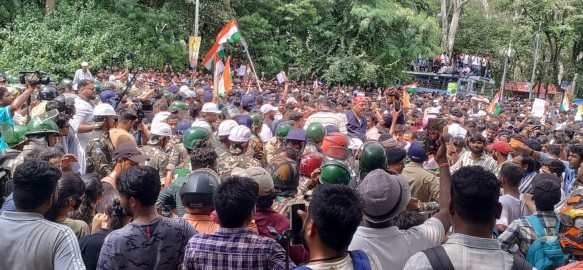
Thousands of job aspirants marched towards the Jharkhand Assembly over alleged JPSC and JSSC exam irregularities, facing barricades, water cannons and police action.
Ranchi, August 10, 2026 — What began as another student protest in Ranchi took an unmistakably Gen Z turn on Monday when protesting job aspirants arrived carrying shampoo bottles — seemingly prepared for the water cannons they expected the police to use against them.
When the water jets were deployed, several protesters reportedly used the moment to apply shampoo and bathe amid the protest. The unusual response quickly became one of the defining visuals of the agitation, turning a conventional police tactic into a symbol of defiance.
But beneath the striking images lies a serious confrontation between thousands of young job aspirants and the Jharkhand government.
Students protesting alleged irregularities in examinations conducted by the Jharkhand Public Service Commission (JPSC) and Jharkhand Staff Selection Commission (JSSC) attempted to march towards the Jharkhand Vidhan Sabha on Monday. Protesters removed barricades and advanced towards the Assembly, prompting police to deploy water cannons and, subsequently, lathi-charge the demonstrators, according to reports.
Students had been protesting alleged irregularities in JPSC and JSSC recruitment examinations for days. Their demands include action over the alleged irregularities, a CBI probe and cancellation of examinations they believe were compromised.
The Assembly gherao call brought thousands of aspirants from across Jharkhand to Ranchi.
The police action has added another layer to the confrontation. PTI quoted an injured protester, Sanjay Mahto, as saying that his head and legs were hurting and that his head was bleeding after the lathi-charge.
Is Indian Democracy Hollowing Out? Analyst Invokes Peter Mair
The competing images from Ranchi tell the story of a protest movement that is no longer easily contained by the familiar grammar of street agitation.
Barricades were erected. Students crossed them. Water cannons were deployed. Students came prepared with shampoo.
The police attempted to stop the march. Protesters continued towards the Assembly, including through field routes, according to reports and social media posts from journalists covering the protest.
That is perhaps the most important feature of the Ranchi agitation. The students are not merely protesting an examination process. They are challenging the credibility of the recruitment system on which thousands of young people have invested years of preparation and, in many cases, the hopes of their families.
For a generation whose employment prospects are already intensely competitive, an allegation that a recruitment examination was compromised carries consequences far beyond one examination date. It can mean another year, or several years, of preparation.
That helps explain the unusual resilience of the protest.
According to journalist Vedic Dwivedi, the students had been agitating for 17 days before Monday’s Assembly march. He reported that police used lathi-charge, tear gas and water cannons to prevent the protesters from advancing.
Journalist Sachin Gupta, commenting on X, highlighted the shampoo episode in a post addressed to Chief Minister Hemant Soren. The imagery was simple but powerful: students who had anticipated water cannons had decided that they would not retreat merely because the police used water to disperse them.
Another report described protesters reaching the Assembly through field routes after overcoming barricades.
This is where the Ranchi protest acquires a distinctly Gen Z character. The generation at the barricade is also the generation that understands instantly how a protest image travels. A conventional confrontation with police can remain a local news event. Students bathing under a water cannon can become a national social-media image within minutes.
The shampoo bottles therefore became more than a quirky protest prop. They represented preparedness, humour and defiance at the same time.
But the humour should not obscure the underlying issue. The central question for the Jharkhand government is whether the grievances surrounding JPSC and JSSC examinations can be addressed through a transparent process that restores confidence among candidates.
A recruitment examination is ultimately an exercise in public trust. Students prepare believing that merit, procedure and rules will determine the outcome. Once that trust is shaken, administrative assurances alone may not be sufficient.
The government’s challenge, therefore, is not simply to control a march towards the Assembly. It is to convince the protesters that the recruitment process is credible and that allegations of irregularities will be investigated fairly.
The students, meanwhile, have demonstrated that the old tools of protest control may not work in quite the same way with a new generation.
Leader of the Opposition in the Lok Sabha Rahul Gandhi condemned the use of force against the agitating students. Gandhi in a post on X said the “solutions should be found through dialogues.”
Hemant Soren Launches ‘Students’ Voice’ Campaign for Jharkhand Exam Reforms
Follow The Raisina Hills on WhatsApp, Instagram, YouTube, Facebook, and LinkedIn




