


By TRH Political Desk
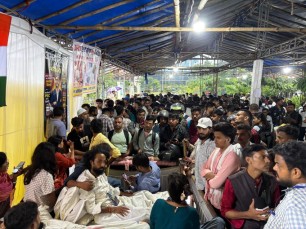
A deepening governance void coupled with weakening of parliamentary oversight seem to be hallowing out Indian democracy as the street protest fills the Opposition void, says political analyst Manish Anand
New Delhi, August 8, 2026 — A decade-old academic warning about Western democracy is finding fresh relevance in Indian politics, according to political analyst Manish Anand, host of The Raisina Hills. In a recent episode, Anand built his commentary around the late political scientist Peter Mair’s 2013 book Ruling the Void: The Hollowing of Western Democracy, arguing that its central thesis — that party-based democracy is steadily giving way to personality-driven politics — applies as much to India today as it did to Europe and the US when it was written.
The starting point: a “invincible” BJP and a reminder from history
Anand opened by noting that after the Bharatiya Janata Party’s West Bengal election win, the party appeared to have built an “unbeatable fortress,” with little visible opposition left standing. But he invoked former British Prime Minister Harold Wilson’s famous line — that a week is a long time in politics — arguing that the Congress party’s recent protest in the wake of Delhi’s Jantar Mantar demonstrated that the underlying dynamics Mair described were, in Anand’s words, “grounded in real experience” and still holding true.
Mair’s core argument: parties are being hollowed out
According to Anand, Mair’s central claim was that party-based democracy in Western countries is approaching a kind of endpoint, with political parties losing their independent relevance as individual leaders increasingly become the axis around which politics revolves.
Anand pointed to the United States as the clearest example: since Donald Trump became president, he argued, the Republican Party’s own institutional relevance has effectively been subsumed into “Trumpism,” with American politics now organised around being for or against Trump rather than around competing party platforms.
Applying the thesis to Modi’s India
Anand argued the framework maps closely onto India’s own trajectory. The Narendra Modi-led National Democratic Alliance came to power in 2014, and the BJP held an outright Lok Sabha majority through two terms; in its third term, Anand noted, the government has depended on coalition partners for stability — a shift he sees as significant.
Central to Mair’s argument, as Anand explained it, is the idea that when governance turns “managerial” in style, a void opens up that hollows out party-based democracy. Anand argued this style of governance is defined by one-way communication between government and citizens, and applied it directly to India: with Modi as an unusually powerful prime minister and the PMO wielding outsized authority, he argued, decisions made by the leadership tend to move through Parliament and Cabinet with little of the detailed debate that once characterised policymaking.
Anand suggested that Cabinet members, operating from a position of relative insecurity, are less inclined to challenge or debate decisions — reinforcing the managerial pattern Mair described.
Anand connected this managerial style to the government’s handling of recurring issues such as unemployment and paper leaks, characterising the approach as largely one that denies or dismisses these concerns rather than engaging with them.
A party reduced to a “propaganda machine”?
Anand’s sharpest claim was about the BJP’s own institutional identity. He argued that since the party’s leadership became so heavily centred on Modi, the BJP itself has increasingly functioned as a vehicle for amplifying government schemes and mobilising at election time, rather than as an independent political institution with its own internal debate and leadership space. In Anand’s framing, elections have become referenda on “Brand Modi” rather than contests between competing party visions — which he said is exactly the individual-centred democracy Mair warned about.
The European comparison
Anand extended Mair’s thesis to Europe, arguing that Britain’s Labour and Conservative parties have both seen their institutional credibility erode over the past two decades, creating space for newer forces such as Reform UK.
He suggested similar patterns of political instability tied to weakening traditional parties are visible in France and Germany, and pointed to years of comparable upheaval in Turkey, as well as Hungary’s recent change of government after a long-serving administration.
Where the “void” goes: Gen Z movements and unrest
Anand’s broader argument is that when individual-centred politics produces a managerial style of governance and weakens political parties, the resulting vacuum in the system does not stay empty — something inevitably moves in to fill it.
He pointed to Gen Z-driven protest movements in Bangladesh, Sri Lanka and Nepal as examples of that dynamic playing out, and drew a parallel to India’s own recent politics — citing the Tamil Nadu assembly election and the Congress party’s Jantar Mantar protest in Delhi as instances of the same underlying pressure.
Anand’s concluding argument was framed as a challenge to India’s political stakeholders: a managerial, individual-centred style of governance creates a void in the system, and whatever eventually fills that void is likely to bring disruption with it.
FAQ
Q: What is Peter Mair’s book “Ruling the Void” about?
A: Published posthumously in 2013, the book argues that party-based democracy in Western countries is being hollowed out as political parties lose relevance to individual, personality-driven politics.
Q: How does analyst Manish Anand apply this thesis to India?
A: Anand argues that India’s politics under Narendra Modi shows similar signs — a powerful, individual-centred leadership, a “managerial” governance style with limited internal debate, and a ruling party that increasingly functions as an extension of the government rather than an independent institution.
Q: What examples does Anand cite for the “void” being filled?
A: He points to Gen Z-led protest movements in Bangladesh, Sri Lanka and Nepal, as well as India’s Tamil Nadu assembly election and the Cockroach Janata Party’s protest at Jantar Mantar, as instances of political vacuums being filled by disruptive movements.
“We Will Write the Future With Ink”: Neha Bora Attacked in Ranchi
Follow The Raisina Hills on WhatsApp, Instagram, YouTube, Facebook, and LinkedIn




