Mumbai–Ahmedabad Bullet Train Project Accelerates with HSR
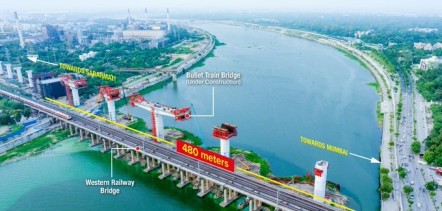
High Speed Rail Corridor Bridge over Sabarmati River in Ahmedabad (Image Railways)
Ashwini Vaishnaw Highlights ₹86,939 Crore Progress, Make in India Push and Major Civil Milestones
By TRH News Desk
New Delhi, February 12, 2026 — The Mumbai–Ahmedabad High Speed Rail Project (MAHSR) — India’s first bullet train corridor — has entered a decisive execution phase, with major civil works advancing rapidly and indigenous high-speed rail (HSR) capabilities expanding under the Make in India initiative.
Union Minister for Railways Ashwini Vaishnaw informed the Lok Sabha that ₹86,939 crore has been spent on the 508-km corridor till December 31, 2025. The project, being implemented with technical and financial assistance from Japan, traverses Gujarat, Maharashtra and Dadra & Nagar Haveli, covering 12 stations from Mumbai to Sabarmati.
Construction Milestones: Gujarat Leads, Maharashtra Gains Pace
In Gujarat, progress has been substantial: Foundations completed: 352 km; Piers constructed: 352 km; Girder casting: 342 km; Girder launching: 331 km; Track bed construction: 152 km; and OHE mast erection: 121 km
In Maharashtra: Foundations: 74 km; Piers: 65 km; Girder casting: 9 km; and Girder launching: 3 km
Foundation work is complete at 8 stations, while construction is progressing at Thane, Virar and Boisar. At Bandra Kurla Complex (BKC), excavation has reached 91% completion, with basement slab work fully completed at Level-4.
The under-sea tunnel of approximately 21 km has commenced, with 4.8 km already completed between Ghansoli and Shilphata.
Seventeen river bridges have been completed, with major bridges over the Narmada, Mahi, Tapti and Sabarmati in advanced stages.
Innovation and Indigenous Push
India has adopted the full-span launching method for the first time to place 40-metre prestressed box girders weighing nearly 1,000 metric tonnes within 16 hours — significantly reducing construction timelines.
Key innovations include: Indigenous noise barriers along elevated corridors; Advanced OHE-pantograph simulation tools developed with IIT Delhi; Indigenous Rail Turnover Prevention Device (RTPD) for derailment safety; Earthquake Early Warning System (EQEWS) with seismic dampers; and Underground station design supporting a future 90-metre building
Long-span steel truss girders, slab track materials and heavy launching machinery are now being fabricated domestically, strengthening India’s long-term HSR ecosystem.
Over 1,000 Indian engineers and skilled workers have been trained in Japanese methodologies, with a dedicated track training facility established in Surat.
Land, Safety and Sustainability
The entire 1,389.5 hectares of required land has been acquired. All statutory clearances are in place and 1,651 utilities shifted. Rehabilitation has been carried out under the Fair Compensation Act.
Stations are being designed as urban gateways reflecting local identity, with IGBC Platinum-aligned sustainability features and advanced security infrastructure.
Dedicated Freight Corridors Boost Rail Network
The Minister also highlighted the completion of the Eastern Dedicated Freight Corridor (1,337 km) and near-completion of the Western DFC (1,404 km commissioned out of 1,506 km). Currently, 406 freight trains run daily on these corridors, freeing capacity on conventional routes.
The MAHSR corridor is planned for high-frequency operations with competitive ticket pricing against rail and air travel. Integral Coach Factory, in collaboration with BEML, is developing 280 kmph high-speed train sets, building on the Vande Bharat experience.
36-Meter-Tall Bridge Rising Over Sabarmati for Bullet Train Project
Follow The Raisina Hills on WhatsApp, Instagram, YouTube, Facebook, and LinkedIn




About The Author