


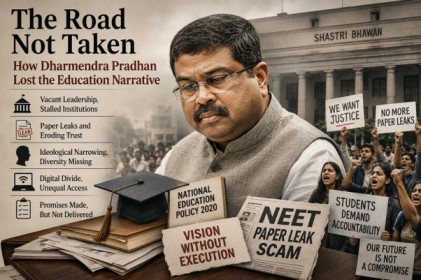


An assessment of Dharmendra Pradhan’s five-year tenure argues that the NEET paper leak controversy exposed deeper governance failures, leadership vacancies, delayed reforms and widening distrust within India’s education system.
New Delhi, July 27, 2026 — When Dharmendra Pradhan took charge of the Ministry of Education in July 2021, expectations were unusually high. Unlike many of his predecessors, he was not perceived as a stopgap political appointment. He was among the Bharatiya Janata Party’s most formidable organisational leaders, a trusted lieutenant of Prime Minister Narendra Modi and Home Minister Amit Shah, and an election strategist credited with delivering victories in politically challenging states. If anyone possessed the political capital to transform one of the government’s most complex ministries, it was Pradhan.
Five years later, his tenure ended in the most unfortunate circumstances. The immediate trigger was the sustained wave of student protests over examination irregularities and paper leaks, particularly NEET-UG. Yet, the paper leaks were merely the visible tip of a much larger iceberg. They became the pincer point of attack because several underlying frustrations had already accumulated within India’s education ecosystem. What finally brought down Pradhan was not a single controversy but his inability to address the structural ailments that had long afflicted the sector.
Ironically, many of these challenges had been identified when he first assumed office. The hope in 2021 was that Pradhan’s appointment signalled Prime Minister Modi’s intention to end what many within academic circles described as years of “backseat driving” in the functioning of the Education Ministry. The perception had grown that weak political leadership had allowed ideological gatekeepers, bureaucratic inertia and external influences to dominate decision-making.
Pradhan, with his reputation as an assertive administrator, was expected to reclaim ministerial authority and provide clear direction. The expectations were not without reason. The Modi government had inherited a vast higher education infrastructure created over previous decades. Successive governments, particularly under Human Resource Development Ministers Arjun Singh and Kapil Sibal, had significantly expanded the network of central universities, IITs, IIMs and other institutions. The challenge before Pradhan was never one of creating institutions; it was about improving governance, enhancing quality and preparing these institutions for the demands of a rapidly changing global economy.
Fast-Track Courts Won’t Fix Paper Leaks, Says Analyst — “We’ve Tried This Before, and It Failed”
At the ideological level, there was also an opportunity. For years, the BJP had argued that Indian education remained disproportionately influenced by Left-leaning academic thought. Many expected the Modi government to introduce greater intellectual diversity. Instead, critics increasingly argued that one form of ideological dominance had merely been replaced by another. Rather than broadening the intellectual spectrum, appointments often appeared confined to a narrow ideological circle.
Several appointees to key educational institutions faced allegations of administrative incompetence, financial irregularities or misuse of office. Some eventually had to be removed. This narrowed the government’s own intellectual bandwidth.
The late Arun Jaitley often spoke of expanding the ideological constituency beyond committed cadres to those “waiting to be converted.” The Education Ministry perhaps required precisely such an approach. Universities flourish through diversity of ideas, academic excellence and institutional autonomy. Instead, ideological conformity often became the defining criterion in public perception.
Administrative paralysis compounded the problem. One of the earliest concerns raised after Pradhan assumed office was the extraordinary number of central universities functioning without permanent Vice-Chancellors. Prestigious institutions such as Jawaharlal Nehru University, Delhi University, Banaras Hindu University and the University of Hyderabad, among many others, remained without permanent leadership for prolonged periods. Several newer central universities also functioned under acting arrangements.
Leadership vacancies inevitably created cascading effects. Recruitment of faculty slowed, administrative decisions were deferred, and research initiatives suffered and implementation of reforms became difficult. The launch of the National Education Policy (NEP) 2020 generated enormous optimism, but translating that vision into reality required institutions with stable leadership and empowered administrators. Without filling key positions in time, implementation naturally lagged.
Pradhan repeatedly articulated an ambitious vision. He spoke of creating a knowledge society, fostering innovation, encouraging entrepreneurship and preparing India for the Fourth Industrial Revolution. Prime Minister Modi similarly urged IITs, IISc and other premier institutions to prepare students for an era of continuous technological disruption.
The vision was inspiring, however, execution proved far more difficult. Educational reform cannot succeed merely through policy announcements. It requires an efficient human resource architecture, timely appointments, empowered institutions and constant engagement with teachers and students. Here lay perhaps the biggest weakness of Pradhan’s tenure.
The pandemic had fundamentally altered higher education. Digital learning became central to education, exposing India’s enormous digital divide. Urban students adapted relatively quickly. Students from rural areas often returned to villages where internet connectivity remained unreliable or entirely absent. Access to devices, electricity and digital infrastructure became major determinants of educational opportunity. Although the government introduced several digital initiatives, the structural inequities exposed by the pandemic remained inadequately addressed. The promise of technology could not substitute for uneven access to technology.
CJP Protests Force a Reckoning: Has Mainstream Media Failed India’s Public Interest?
Equally significant was the ministry’s relationship with students. Pradhan himself emerged from student politics. As an ABVP activist, he had led protests against paper leaks in Odisha during the 1990s. Many therefore expected him to demonstrate greater sensitivity towards student concerns. Instead, over time, the ministry increasingly appeared distant from the very constituency it was expected to serve.
By the time examination controversies erupted, student frustration had already deepened over issues ranging from recruitment delays and entrance examinations to administrative uncertainty. The paper leak controversies did not create distrust; they merely crystallised it.
Perception also played an important role. Pradhan inherited a ministry where his predecessor, Ramesh Pokhriyal Nishank, had often been criticised for excessive public visibility and attempts at micro-management. Many believed Pradhan would reverse that trend by empowering institutions and relying on professional expertise.
Instead, while he avoided the optics of constant publicity, institutional autonomy remained constrained by prolonged administrative delays and centralised decision-making. His greatest strength throughout his political career had been organisational management. As Petroleum Minister and as the BJP’s election strategist, Pradhan excelled at coordinating multiple stakeholders, resolving political disputes and executing complex electoral campaigns.
Education, however, operates differently from politics. Universities cannot be managed like election campaigns. Academic institutions demand consultation rather than command, persuasion rather than mobilisation, and intellectual credibility rather than organisational efficiency alone.
Ultimately, Dharmendra Pradhan became a victim of the gap between aspiration and implementation. His ministry produced ambitious policy documents but struggled with institutional execution. It articulated a future-ready vision but often remained trapped in present-day administrative bottlenecks. It promised innovation but could not consistently reassure students about the integrity of examinations.
When the NEET controversy erupted, it merely brought together years of accumulated dissatisfaction into one national movement. Politics often judges leaders not by the complexity of the challenges they inherit but by the confidence they inspire while addressing them. Pradhan undoubtedly possessed the political stature, administrative experience and organisational ability to leave behind a transformative legacy in Indian education.
Instead, his tenure will likely be remembered as one where extraordinary opportunities were overshadowed by unfulfilled promises. The tragedy of Dharmendra Pradhan’s innings at Shastri Bhawan is not that he faced difficult challenges. Every Education Minister does.
It is that many of the fault lines that eventually consumed his tenure had been visible from the very day he entered the ministry. The roadmap existed. The warning signs were evident. History may well conclude that what failed was not the vision but its implementation.
(This is an opinion piece. Views expressed are the author’s own, who is a Gen Z lawyer, practicing in the High Court of Delhi.)
Dharmendra Pradhan Resigns: Education Ministry Remains a ‘Hot Potato’ Under Narendra Modi
Follow The Raisina Hills on WhatsApp, Instagram, YouTube, Facebook, and LinkedIn




