


By TRH World Desk
The US-China trade war didn’t end at the summit. It moved underground. China just hit 56 American companies with export controls and procurement bans. Here’s what it means — and why lists are now the real battlefield.
New Delhi, June 27, 2026 — Tariffs get the headlines. Lists are how the real war is fought.
On June 22, Beijing made that point with surgical precision. China’s Ministry of Commerce placed 10 American industrial companies on its export control list — including rare earth miners MP Materials and USA Rare Earth, and drone makers Teal Drones and Jaia Robotics — barring Chinese suppliers from exporting any dual-use goods to them.
In a parallel move, the Ministry of Finance blocked 46 US companies, most of them major defence contractors including Lockheed Martin, Raytheon, and General Dynamics subsidiaries, from participating in Chinese government procurement. The restrictions, crucially, extend beyond China’s borders: third-country businesses routing controlled goods to the named American firms are likewise prohibited.
The immediate trigger was the Pentagon’s expansion earlier this month of its so-called 1260H list — a blacklist of companies alleged to have aided Beijing’s military — which now names 188 Chinese entities. The latest additions included household names: Alibaba, Baidu, BYD, NIO, memory chipmakers ChangXin and Yangtze Memory Technologies, and humanoid robotics maker Unitree.
China’s Ministry of Commerce called the Pentagon’s actions “malicious” and pledged to protect Chinese companies’ “legitimate and legal rights.”
But calling this a simple tit-for-tat misses the more important story.
The Architecture of a New Kind of War
What is unfolding between Washington and Beijing is not a trade war in any traditional sense. It is a regulatory war — a fight waged not with tariffs and quotas, but with blacklists, export bans, procurement exclusions, and what lawyers are now calling “blocking statute” frameworks.
China has been quietly building this toolkit for years. In April 2026, Beijing issued two sweeping new regulations — the Regulations on Countering Improper Extraterritorial Jurisdiction and the Regulations on Industrial and Supply Chain Security — that substantially expanded its retaliatory arsenal.
Both took effect immediately, with no grace period. Under these rules, a multinational bank that exits a Chinese counterparty to comply with US sanctions, or an importer that suspends sourcing to meet American forced-labour rules, may itself face Chinese prohibition orders, trade bans, asset freezes, and even personal exit restrictions on executives. The concepts are deliberately vague, giving Chinese regulators broad discretion over who gets targeted and when.
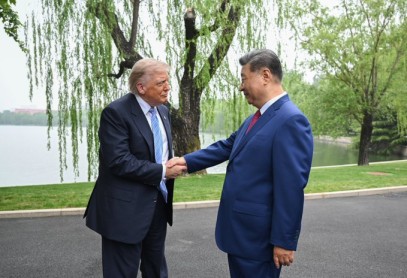
The May 2026 Trump-Xi summit in Beijing produced rhetoric about “managed trade” and “strategic stability.” It did not slow the machinery.
As one analyst told CNBC, there is “no ‘truce’ in the US-China trade war.” What the summit did was provide diplomatic cover — a way for both sides to calibrate escalation below the threshold of crisis while the underlying competition intensifies.
The Great Game 2.0: US Moves to Restrict Anthropic AI Tools, Echoing China’s Playbook
Symbolic But Not Toothless
Analysts have been quick to note the largely symbolic character of the latest Chinese measures. Most of the 10 companies on the export control list have, as The Asia Group’s Han Shen Lin observed, “little or no meaningful business exposure in China.” The procurement ban on defence contractors like Lockheed Martin is similarly more signal than substance — American weapons makers were never selling to the People’s Liberation Army.
But symbolism in geopolitics is not nothing. These designations send messages to third parties. They warn suppliers, partners, and foreign subsidiaries about the reputational and legal cost of working with targeted American firms. They force compliance departments at multinationals operating across both markets into impossible choices: follow US rules and risk Chinese retaliation, or accommodate Beijing and risk running afoul of Washington.
The Eurasia Group’s Dan Wang framed Beijing’s latest moves as a “model example” of how China will handle mild escalation while preserving the broader relationship. That is accurate — and also a sign of how institutionalized the conflict has become. Both governments now have well-rehearsed playbooks for inflicting calibrated pain without triggering a rupture.
Rare Earths: The Sharpest Edge
The inclusion of MP Materials and USA Rare Earth on China’s export control list deserves particular attention. These are not obscure drone parts suppliers. They are American companies at the heart of Washington’s stated strategy to reduce dependence on Chinese critical mineral supply chains.
MP Materials operates the Mountain Pass mine in California — the only rare earth mining and processing facility of scale in the United States. USA Rare Earth is building out domestic magnet manufacturing. Both represent the US government’s most significant investments in supply chain resilience.
By targeting them, Beijing is directly striking at the American effort to decouple from Chinese rare earth dominance — and showing it will not allow that decoupling to proceed without cost.
The Council on Foreign Relations has noted that in Trump’s second term, China’s export controls on rare earth minerals “created a global supply shortage for the materials necessary to build most technologies.” The June 22 designations suggest Beijing is prepared to turn that lever again — and more selectively — whenever Washington reaches for new restrictions.
The New Terrain
The question analysts keep circling is whether the Trump-Xi summit reset represents a genuine stabilization or a pause before the next escalation cycle. The answer, most evidence suggests, is both — and neither resolves the structural competition.
What the last six months have demonstrated is that the US-China conflict has matured past the tariff era into something more durable and more dangerous: a battle over the rules that govern global trade itself. Washington writes export control lists and investment screens; Beijing counters with blocking statutes and procurement bans. Each side is constructing legal architecture designed to compel third parties to choose — and to punish those who choose wrong.
That is not a trade war. It is economic statecraft at industrial scale. And unlike tariffs, which can be dialed up or down in a weekend phone call, regulatory weapons embed themselves into corporate compliance frameworks, supply chain decisions, and legal liability in ways that are very hard to reverse.
The next phase of US-China competition will not be fought at the negotiating table. It will be fought in the compliance offices of multinationals, in the sourcing decisions of procurement teams in Seoul and Amsterdam and São Paulo, and in the fine print of regulations most voters will never read.
The lists are the war. Everything else is commentary.
China’s Wang Yi Warns US from India: “The Law of the Jungle Is Not Sustainable”
Follow The Raisina Hills on WhatsApp, Instagram, YouTube, Facebook, and LinkedIn




