Budget 2026 Retrospective Tax: Is India Rewriting the Rules?
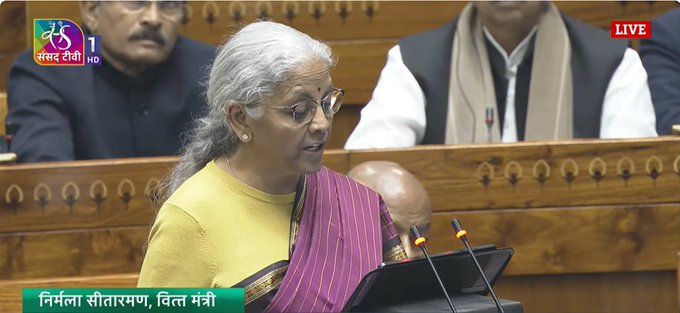
Union Minister for Finance Nirmala Sitharaman in the Lok Sabha on Sunday (Image Sansad TV)
Fine-print amendments in Union Budget 2026–27 reopen settled cases, validate invalid notices and revive investor fears of tax unpredictability
By P. SESH KUMAR
New Delhi, February 18, 2026 — India’s Union Budget 2026–27 has been applauded for its growth optimism, infrastructure push, and reformist tone. Yet quietly tucked inside its fine print lies a familiar troublemaker — retrospective tax amendments. Presented politely as “clarifications,” these backward-looking changes reopen settled matters, overturn judicial reliefs, and rewrite rules after taxpayers have already complied with the law of the day. As powerfully analysed in the recent Taxmann critique, this growing habit is not merely a technical adjustment.
It strikes at fairness, certainty, investor confidence, and the very credibility of tax governance — at a time when the government claims to be simplifying laws and improving ease of doing business. For businesses and global capital, this is not about a few sections of the Income Tax Act. It is about systemic predictability. When deadlines, procedures and final court outcomes can all be rewritten years later, risk becomes unquantifiable. Companies can plan for high tax rates. They can plan for complex compliance.
What they cannot plan for is moving legal goalposts. Retrospective power turns every completed transaction into a potential future dispute. This is why after such shocks, international investors repeatedly flagged “tax unpredictability” as one of India’s biggest policy risks — even when economic fundamentals were strong. Budget 2026 quietly revives that fear. What appears as quick revenue protection may in reality be a slow erosion of trust.
The Dangerous Temptation of Rewriting Yesterday
Every honest taxpayer plans life in real time. Businesses invest, individuals structure savings, companies sign contracts, and professionals comply — all based on the law as it exists at that moment. Retrospective taxation smashes that basic social contract. It changes the rules after the game has been played and then demands a revised score.
The Taxmann analysis shows how Budget 2026 once again travelled backward to “clarify” procedures, rescue departmental lapses, and neutralise unfavourable court rulings — all squarely in favour of the revenue. What should have been administrative reform has turned into legislative time travel. This is not an isolated episode. It has slowly become a preferred tool whenever the tax administration loses in court or discovers that its own processes were defective.
Instead of fixing the system, the past itself is rewritten.
Why Law Was Never Meant to Walk Backwards
For centuries, legal systems across the world have treated retrospective burdens with suspicion. The simple principle is that citizens should be able to arrange their affairs with confidence. Law exists to guide conduct going forward, not to punish behaviour that was lawful yesterday.
Indian courts have echoed this repeatedly, culminating in the powerful pronouncement of the Supreme Court of India (SC) that legislation should normally operate prospectively, particularly where it creates new liabilities or disturbs vested rights. The underlying logic is intuitive: a democracy cannot function if yesterday’s legal behaviour becomes today’s offence.
Retrospection may be tolerable in rare situations of public emergency or to remove genuine ambiguity for taxpayer benefit. But when it is repeatedly used to override court rulings and cure administrative failures, it stops being clarification and becomes coercion.
But this is not a new habit. It is a well-worn reflex.
Anyone who doubts this only needs to rewind to the infamous Vodafone episode.
When the courts ruled that India had no tax jurisdiction over an offshore share transfer involving Vodafone Group Plc, the government didn’t fix the law prospectively. It rewrote it retrospectively — reaching back decades to create a tax liability that did not exist when the transaction happened.
The global reaction was swift and brutal. Investors panicked. India’s tax credibility took a beating. Years of arbitration followed. And eventually, in a quiet admission of policy failure, the retrospective tax law itself had to be scrapped in 2021 — along with compensation payments.
That episode was supposed to be the burial of retrospective taxation.
Yet here we are again.
And if Vodafone represented Parliament rewriting the past, the more recent Tiger Global episode shows something even more unsettling — the judiciary itself appearing to lean toward revenue interests in cross-border taxation disputes. In the case involving Tiger Global Management, the SC took a noticeably expansive view of India’s taxing powers over offshore investment structures and indirect transfers. Where earlier jurisprudence had emphasised legal form, territorial nexus, and taxpayer certainty, the Court increasingly privileged “substance,” revenue protection, and anti-avoidance reasoning- even where the tax law at the time of transaction was far from clear.
For global investors, the signal was unmistakable: not only can Parliament retrospectively rewrite tax rules, but judicial interpretation itself may now stretch existing provisions to secure tax outcomes the legislature failed to clearly provide earlier. The chilling effect is obvious — when both lawmakers and courts tilt toward ex post revenue capture, international capital no longer knows where legal certainty begins or ends.
NFRA Enforcement Crisis: Why Audit Watchdog Is a Paper Tiger
What Budget 2026 Actually Did
Under the soothing label of “procedural clarifications,” several provisions were pushed backward in time. Time limits were recalibrated after courts had struck down delayed actions. Invalid notices were retrospectively validated despite lacking mandatory safeguards such as document identification numbers. Jurisdictional lapses were patched up years after assessments had already collapsed in litigation.
Following specific instances are particularly relevant:
- Section 92CA and Section 139 clarifying the manner of computation of sixty days for passing the order by the Transfer Pricing Officer — retrospective from 01 June 2007
- Section 144C clarifying time-limit for completion of assessment under section 144C- retrospective effect from 01 April 2009
- Section 292B -Assessments not to be invalid on ground of any mistake, defect or omission on account of computer-generated DIN, if such assessment is referenced by Computer generated DIN in any manner- retrospective effect from 01 October 2019 and
- Section 147 and 279-Clarification regarding jurisdiction to issue notice u/s 148 where income has Escaped assessment and for carrying out pre-assessment procedure u/s 148A- retrospective effect from 01 April 2021
At the same time- and this contrast is telling- provisions that soften harsh penalties or correct inequitable tax rates were made applicable only prospectively.
In effect, when the government gains, the law moves backward. When taxpayers gain, the law politely moves forward.
This asymmetry reveals the real intent far more clearly than any budget speech.
Why This Feels Fundamentally Unjust
Imagine following the law faithfully, contesting an unlawful demand in court, winning relief after years of litigation — and then receiving a fresh tax demand because Parliament decided to change yesterday.
That is not policy reform. It is legal ambush.
Retrospective amendments destroy certainty, punish compliance, fuel endless litigation, and quietly reward administrative inefficiency. Instead of improving drafting standards, strengthening officer training, and respecting judicial oversight, the state simply edits history to escape accountability.
It is the equivalent of failing an exam and then changing the answer key.
The Taxmann article makes this painfully clear: many of these amendments exist not to clarify confusion but to shield the department from its own procedural shortcuts and drafting errors.
Short-Term Revenue, Long-Term Governance Loss
Yes, the government may protect collections in the immediate years after these amendments. Some revived demands will be recovered. Some litigation will settle under pressure.
But the long-term damage is far greater.
Compliance becomes defensive.
Tax planning becomes risk-heavy.
Voluntary disclosures fall.
Enforcement costs rise.
Trust erodes.
Tax administration slowly shifts from partnership to permanent conflict.
And conflict is the most expensive way to run a revenue system
How the World Treats Retrospective Taxation
In mature tax systems, retrospective burdens are viewed almost as radioactive.
The UK avoids them except in extreme anti-abuse situations and even then limits their reach. The US applies them sparingly and typically for taxpayer relief rather than revenue extraction. Australia confines them to narrow corrective contexts after public consultation.
International tax policy bodies like the OECD consistently emphasise predictability and legal certainty as pillars of investor confidence.
India, however, keeps returning to retrospection whenever revenue is threatened.
Ironically, this happens while projecting itself globally as a stable, rule-based investment destination.
Nothing frightens long-term capital faster than a government that can rewrite yesterday.
What the Government Hopes to Gain-And What It Actually Loses
The immediate objective is obvious: protect revenue, overturn adverse judgments, and prevent tax collections from slipping.
But isn’t this is narrow, short-term thinking?
Every rupee protected today carries hidden costs- higher litigation, investor hesitation, reduced voluntary compliance, and growing distrust of tax administration. When people stop trusting the fairness of the system, enforcement becomes harder, not easier. Compliance shifts from cooperative to defensive.
A tax system thrives on legitimacy more than fear.
Retrospective law-making slowly poisons that legitimacy.
Ease of Doing Business or Ease of Changing the Past?
On global platforms and policy documents, the government speaks passionately about simplification, stability, and predictability. Yet on the ground, retrospective amendments whisper a different message: no matter what the law said when you acted, it can always be changed later.
Can we promise certainty to investors while practising surprise taxation at home?
True reform is boring, patient, and systemic- better drafting, cleaner administration, faster dispute resolution, and respect for judicial outcomes.
Time travel is simply easier.
The Way Forward: Fix Systems, Not History
We do not need more retrospective amendments. It needs stronger legislative drafting, clearer statutes, technologically sound tax administration, accountable officers, and prospective corrections when flaws are discovered.
If fraud exists, target fraud specifically.
If procedures were violated, discipline the system.
If drafting was weak, correct it for the future.
Do not rewrite the past for millions of compliant taxpayers.
A modern economy runs on trust far more than coercion.
Final Reflection
Taxes are the price of civilisation- but certainty is the foundation of compliance.
Every time the law reaches backward, it quietly tells citizens: you followed the rules, but the rules can always be changed later.
That message may raise revenue today, but it erodes confidence for decades.
If India truly wants investment, growth, and voluntary compliance, retrospective taxation must finally become the rare exception-not the routine shortcut.
(This is an opinion piece. Views expressed are author’s own.)
Follow The Raisina Hills on WhatsApp, Instagram, YouTube, Facebook, and LinkedIn




About The Author