Bhagwat’s Age Talk Signals Power Message to Modi and BJP

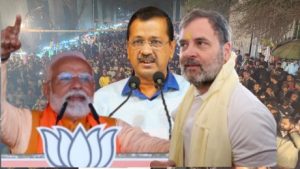
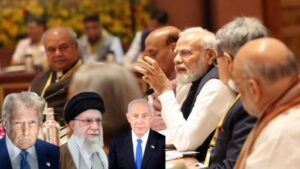
A creative image of the power play within the BJP and the RSS. (Image TRH)
RSS chief’s ‘small and big picture’ message hints at discipline, succession and the limits of personality-driven politics
By NIRENDRA DEV
New Delhi, February 9, 2026 — When RSS chief Mohan Bhagwat speaks, he rarely raises his voice—but he almost always raises the temperature. His recent remarks on age, retirement and authority are no exception. On the surface, they sound benign, even philosophical: there is no election for the RSS chief; work continues till the “last drop of blood”; retirement from work is impossible; publicity breeds arrogance; values matter more than campaigns.
But politics, especially in the Sangh Parivar, is never about the surface alone. Timing is everything. And timing is precisely what makes Bhagwat’s statement in February 2026 politically loaded.
The small picture: age is not the point
Bhagwat has crossed 75, the informal age-limit that the BJP itself institutionalised. Yet he says the Sangh has asked him to continue. He adds, pointedly, that he will step down the moment the organisation asks him to—but not before.
The immediate takeaway is clear: authority in the RSS flows upward, not downward. Positions do not confer permanence; organisational sanction does. By stressing that there has never been a “retirement situation” in RSS history, Bhagwat reminds everyone that the Sangh decides continuity, not individuals, not popularity, not electoral success.
This is the “small picture” message—discipline over celebrity, organisation over individual.
The big picture: a coded reminder to political power
The larger message, however, travels well beyond Nagpur. It inevitably lands in New Delhi.
Prime Minister Narendra Modi turns 77 in 2027. Bhagwat will be 77 as well. The 2029 Lok Sabha election will find both at 79. In a system where the BJP enforced the age norm on stalwarts like L.K. Advani and Murli Manohar Joshi, Bhagwat’s remarks revive an old, uncomfortable question: who decides when the time is up?
Is Bhagwat suggesting that no matter how towering the Prime Minister’s popularity, the final call rests with the RSS? The answer, implicit rather than explicit, appears to be yes.
This is not an ultimatum. It is a reminder of hierarchy.
Why now? The politics of timing
The statement comes just days before Bangladesh goes to polls and over a year ahead of the crucial Uttar Pradesh Assembly election of 2027. UP sends 80 MPs to Parliament and is currently ruled by Yogi Adityanath—a leader whose political ambitions are no longer whispered.
From 2027 onwards, Yogi will be under pressure to deliver a commanding mandate in UP. A strong victory would not just secure his state leadership; it would place him firmly in the national succession conversation for 2029.
Against this backdrop, Bhagwat’s words acquire another layer. By underlining organisational control and cautioning against excessive self-promotion, he appears to be preparing the ground for a post-Modi equilibrium, where leadership transitions are managed, not contested publicly.
Is this a smooth pitch for Yogi? Not explicitly. But it certainly keeps the field open.
From Nagpur to New York: The RSS Experiments with Kinder Words
The fading halo of ‘Modi Magic’
There is another subtext the RSS leadership is acutely aware of: the diminishing returns of personality-centric politics.
The “Modi Magic” that powered the BJP’s expansion in 2014 and helped it breach ideological strongholds—from Tripura to parts of the Northeast—has softened. Electoral setbacks in key Hindi heartland states in 2018, agrarian distress, joblessness, and the long-term economic aftershocks of GST and demonetisation have dented the once-unassailable aura.
Informal surveys doing the rounds in political circles suggest that if elections were held today, the BJP-led NDA might still emerge as the largest bloc—but with a reduced tally in the 270–300 range. That is a victory, but not dominance.
Within both the BJP and the RSS, this is being read as a wake-up call. Complacency is out. Course correction is in.
Values, restraint and the next generation
Bhagwat’s warning against excessive publicity—“like rainfall, adequate in timing and quantity”—is not accidental. It is a critique of overexposure, a subtle rebuke of brand politics that risks breeding arrogance.
He has said before that leadership must have the courage to own defeat and failure. That remark, recalled now, fits neatly into the current context: preparing the ecosystem for transition without rupture.
The next generation of leadership, when it emerges, may do so less through individual ambition and more by default—through organisational consensus. Names doing the rounds include Nitin Gadkari, a trusted RSS hand; Shivraj Singh Chouhan; Amit Shah; and, of course, Yogi Adityanath.
Reading the signal
Bhagwat is not issuing a countdown clock. Nor is he challenging Modi directly. What he is doing is far more characteristic of the Sangh: reasserting first principles.
No individual is bigger than the organisation. Popularity does not override structure. And continuity is earned—not claimed.
In that sense, the message is both calming and unsettling. Calming for the RSS, which prides itself on institutional permanence. Unsettling for a political culture that has grown accustomed to seeing one face dominate the national imagination.
The game, as Bhagwat seems to suggest, is changing. And the rules may soon matter more than the players.
(This is an opinion piece. Views expressed are author’s own.)
Follow The Raisina Hills on WhatsApp, Instagram, YouTube, Facebook, and LinkedIn




About The Author