1925–2025: How the RSS Rose as the Communists Receded
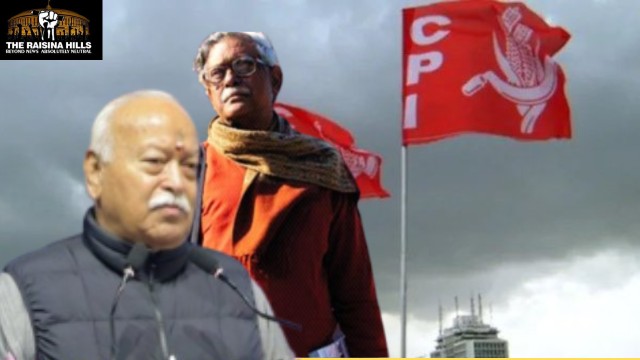
RSS chief Mohan Bhagwat and CPI 100 years. (Image X.com)
As the RSS and the Communist Party of India mark 100 years, Indian politics reveals why one ideology dominates Raisina Hill while the other searches for relevance.
By TRH Political Desk
New Delhi, December 28, 2025 — As India moves through a season of centenary celebrations, history offers a rare political symmetry. Two organisations born in the same year—1925—stand today at radically different destinations. The Rashtriya Swayamsevak Sangh (RSS) has completed a hundred years with visible confidence, power, and political dominance. The Communist Party of India (CPI), which also turned a century this December, marks the milestone amid introspection and diminishing national relevance.
The CPI was founded between December 25 and 30, 1925, in Kanpur—then Cawnpore of British India. “The city was an industrial hub, attracting Bengali and Telugu-speaking workers from Bengal and the Andhra region. It was here that Satyabhakta, driven by the idea of organising India’s labour force into a national political movement, convened a historic meeting,” recalled Nirendra Dev, a senior journalist, in an op-ed for The Raisina Hills.
But trouble began at birth. Satyabhakta argued that any communist party in India must have a national character and national priorities, he added. His opponents—many aligned with the Communist International—insisted that revolution could not be confined by borders. Inspired by the Bolshevik Revolution of 1917, they viewed communism as an international cause, not an Indian one. The ideological clash forced Satyabhakta to walk out of the very meeting he had convened.
“Ironically, his opponents adopted his core idea. The party was named the Communist Party of India—placing “India” firmly in its identity. Yet the contradiction between national politics and international ideology never truly disappeared. That fault line shaped the CPI’s destiny,” added Dev.
For decades, the Left wielded serious influence. Communists ruled West Bengal for over three decades, governed Tripura for years, formed governments in Kerala, and built strong bases in Punjab, undivided Andhra Pradesh, Bihar, and parts of Tamil Nadu. “Leaders like Jyoti Basu, Harkishan Singh Surjeet, E.M.S. Namboodiripad, Buddhadeb Bhattacharjee, and Sitaram Yechury shaped national discourse well beyond their numbers,” said Manish Anand, a senior journalist.
Yet fragmentation proved fatal. Ideological splits produced CPI(M), CPI(ML), and several Left factions—especially in Bihar, where CPI(ML) eventually replaced the CPI as the dominant Left force. “Today, the Left survives through alliances, pockets of influence, and moral authority—but not through national momentum,” added Anand.
Contrast this with the RSS. Also founded in 1925, the organisation embedded itself deeply into India’s social and cultural fabric before translating ideology into electoral power. “Where the Left debated theory, the RSS built networks. Where the communists looked outward—to Moscow and Beijing—the RSS rooted itself inward, in Indian society,” added Anand.
A century later, the verdict is stark. “One ideology commands Raisina Hill; the other searches for relevance. Two journeys began together. Only one learned how to adapt to India’s political soul,” added Anand.
Follow The Raisina Hills on WhatsApp, Instagram, YouTube, Facebook, and LinkedIn




About The Author