Xi Jinping’s Military Purge: Is China’s Leader Fighting for Survival?
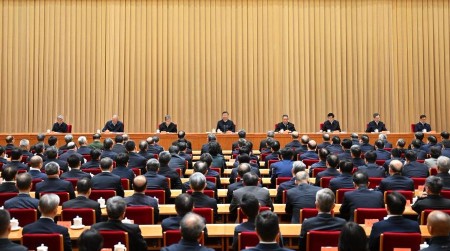
Chinese President Xi Jinping addresses Central Conference on work related to neighbouring countries (Image credit Xie Feng, X)
As China’s top generals disappear from the Central Military Commission, questions grow over power, paranoia, and the Taiwan calculus
By TRH World Desk
New Delhi, January 25, 2026 — Is China entering one of the most unstable phases of Xi Jinping’s rule?
The question is no longer whispered in closed policy rooms; it is now being asked openly across global capitals as China’s top military leadership is systematically erased from public view. Arrests, disappearances, corruption probes—layer upon layer—have left the Chinese Communist Party’s most powerful institution, the Central Military Commission (CMC), almost hollowed out.
At the centre of this storm stands Xi Jinping himself—CMC chairman, party general secretary, and president—now reportedly the only remaining member with undisputed authority. “In a system built on collective control of force, such concentration is not a sign of strength alone. It is also a signal of fear,” said Manish Anand, senior geopolitical analyst, in his monologue for the YouTube channel of The Raisina Hills.
Anand stressed that “history, after all, is not a crystal ball—but it is a warning lamp-post.”
The phrase “Night of the Long Knives” entered political vocabulary after Adolf Hitler eliminated rivals within the Nazi party and military to secure total dominance. Analysts are now cautiously invoking a modern parallel—not as equivalence, but as a structural reminder: when leaders purge those closest to the instruments of force, it is often because they feel existentially threatened.
In 2022, China’s seven-member Central Military Commission symbolised balance within power. “Today, that structure has collapsed. Both vice-chairmen—Zhang Youxia and He Weidong—once the most powerful uniformed figures in the People’s Liberation Army—have been arrested on corruption charges,” added Anand. A former defence minister—Li Shangfu—vanished before being detained. “Other senior generals with real combat exposure have either disappeared or been neutralised,” noted Anand.
Officially, Beijing insists this is about corruption. But the pattern tells a deeper story.
China has not fought a major war in decades. “Combat-experienced commanders are rare—and precisely those officers now seem to be the ones removed. In a military that Xi has aggressively modernised, loyalty increasingly appears to matter more than capability,” said Anand.
The PLA, once institutionally loyal to the Communist Party, now seems demanded to swear allegiance to one man, added Anand.
This is where politics overtakes military discipline.
Xi Jinping is in his unprecedented third term, having broken China’s long-standing two-term convention. By 2027, that term ends—and all signs suggest he is positioning himself for a fourth. “Any residual opposition, any alternative power centre within the party or military, becomes a potential threat. In that context, purges are not corrective—they are pre-emptive,” added Anand.
The Taiwan dimension sharpens the stakes. Unverified but persistent reports suggest that some of the recently purged commanders were far more aggressive on Taiwan than Xi himself—arguing that the current moment, with the United States stretched across Ukraine, the Middle East, and the Arctic, offered a strategic window. Xi, by contrast, appears cautious. “He understands that a Taiwan conflict is not a regional war—it is a direct confrontation with the United States and its Indo-Pacific allies,” added Anand.
A military defeat over Taiwan would not merely damage China’s power projection. “It could end Xi Jinping’s political career,” said Anand.
Seen through this lens, the purge looks less like preparation for war—and more like insurance against being dragged into one by over-zealous generals.
“For India, this internal Chinese turbulence carries consequences. The most aggressive PLA commanders have historically driven repeated confrontations along the Line of Actual Control—from Doklam to eastern Ladakh. Their removal could temporarily lower the temperature on the India-China border,” added Anand. A domestically preoccupied Xi is unlikely to invite another external crisis that complicates his internal consolidation.
Globally, however, the implications are more unsettling. A China where power is hyper-centralised, institutions are hollowed out, and dissent is criminalised is not a stable China—it is an opaque one. “Strategic decisions emerge from a shrinking circle. Miscalculation becomes more likely, not less,” added Anand.
Xi Jinping may believe he is securing absolute control. “Yet history suggests a paradox: the more a leader fears rivals, the more brittle his system becomes,” said Anand.
China’s future, today, is not clouded by opposition—but by over-concentration of power. And that is a risk the world cannot afford to ignore, added Anand.
(Manish Anand hosts discussions on geopolitics on the YouTube channel of The Raisina Hills)
Follow The Raisina Hills on WhatsApp, Instagram, YouTube, Facebook, and LinkedIn




About The Author