Xi Jinping’s Currency Offensive: China Signals Challenge to Dollar

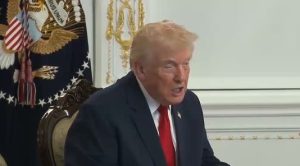
US President Donald Trump with Chinese President Xi Jinping. (Image video grab)
From Trade Power to Monetary Ambition, Beijing Moves to Rewrite the Global Financial Order
By TRH World Desk
New Delhi, February 2, 2026 —Chinese President Xi Jinping has finally said out loud what Beijing has been working toward quietly for more than a decade.
On January 31, writing in Qiushi—the Communist Party’s flagship ideological journal—China’s president called for the creation of a “powerful currency”: one that is widely used in global trade, investment, and foreign exchange markets, and that ultimately achieves reserve-currency status.
“This was not a technocratic comment. It was a political signal. And the fact that Xi himself delivered it matters far more than the words alone,” wrote former Prime Minister of the Kyrgyz Republic Djoomart Otorbaev on LinkedIn.
By the numbers, the yuan is nowhere near reserve-currency material. According to the International Monetary Fund, as of Q3 2025 the US dollar still accounts for about 57 per cent of global reserves—down from 71 per cent in 2000, but still firmly dominant. The euro holds roughly 20 per cent. The yuan ranks sixth, with a share of just 1.93 per cent.
“In global payments, the dollar continues to dominate roughly half of all transactions, while the yuan fluctuates between 3 and 5 per cent,” added Otorbaev.
He stated that “this imbalance has long defined China’s position in the global system. China is the world’s second-largest economy and its largest exporter—yet its currency remains a financial lightweight.” “Trade power has not translated into monetary power,” added Otorbaev.
So why speak now, Otorbaev wondered, answering: “Because Beijing senses a shift. The dollar’s aura of neutrality and institutional stability is no longer unquestioned.”
“The weakening of the US currency—openly celebrated by President Donald Trump as ‘great’—combined with the nomination of Kevin Warsh, a loyal Trump ally, as Federal Reserve Chair has unsettled markets,” he added.
Investors fear a politicised Federal Reserve, where macroeconomic decisions could be shaped by political pressure rather than institutional independence. “For China, this moment represents a strategic opening,” argued Otorbaev.
Xi’s message signals a transition from passive yuan internationalisation to an explicit, state-driven currency offensive. “Yet ambition does not erase constraints. The yuan’s most serious obstacle remains structural: China’s closed capital account. No global central bank will hold large volumes of a currency that cannot be freely moved during periods of crisis,” he warned.
Add underdeveloped legal protections, limited transparency in bond markets, and persistent doubts about judicial independence, and the yuan’s appeal weakens further, added Otorbaev. “Reserve currencies are built on institutions, not declarations,” he added.
Global commodities—oil, metals, grain—are still priced overwhelmingly in dollars. “Even Chinese companies prefer the dollar to hedge risk. Quietly, however, China is building parallel infrastructure,” noted Otorbaev.
He stressed that “the digital yuan is one example of Beijing’s long-term strategy to bypass existing financial rails rather than dismantle them outright.”
Xi’s rhetoric will not move markets tomorrow. But it sends a clear message to Chinese institutions and global investors alike: Beijing believes the moment has arrived.
“The dollar’s dominance may not be ending—but its invulnerability is. And China intends to probe every crack it can find,” he added.
Follow The Raisina Hills on WhatsApp, Instagram, YouTube, Facebook, and LinkedIn




About The Author