Xi Jinping Stuns Politburo: China Faces Unstable 2026 Economy
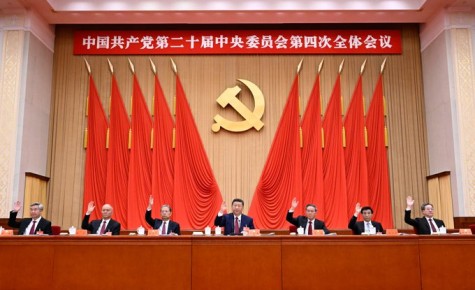
China's President Xi Jinping at Fourth Plenum in Beijing. (Image China MFA, X)
In an extraordinary December 8 Politburo meeting, Xi Jinping openly acknowledged China’s economic instability and warned of an escalating global “economic and trade war,” according to insights flagged by sinologist Frank Lehberger.
By TRH Foreign Affairs Desk
New Delhi, December 10, 2025 — Chinese President Xi Jinping has issued one of his bluntest warnings yet on the state of China’s economy, admitting that the country faces an “unstable” situation and is increasingly caught in an “international economic and trade war.”
The revelation comes from a hastily convened—and highly unusual—CCP Politburo meeting held on December 8, just ten days after the Politburo’s routine year-end session. According to Sinologist Frank Lehberger, an expert on China’s policies toward Taiwan and Tibet, the speed and urgency of the meeting signal “deepening economic anxiety” inside Zhongnanhai.
A screenshot of the December 9 People’s Daily front page—China’s most authoritative state media outlet—highlights a line acknowledging “international economic and trade struggle/war”, a phrase rarely admitted in public by Beijing’s propaganda system.
Lehberger says Xi’s unusually candid framing is significant:
- It suggests China anticipates harsher global economic headwinds in 2026,
- and sees itself increasingly confronting a coordinated pushback from the U.S., EU, Japan, India and other trading partners.
The Politburo meeting summary, published by People’s Daily, stresses that China’s outlook is “unstable, uncertain and under pressure.” Xi reportedly instructed cadres to prepare for “new contradictions” and “external shocks,” while outlining the need to enforce discipline, maintain policy control and prevent systemic risks.
The Chinese leadership also acknowledged intensifying export restrictions, sanctions, supply-chain rewirings, and foreign governments’ moves to reduce dependence on Chinese manufacturing—all factors that analysts say have sharply reduced Beijing’s manoeuvring space.
Lehberger argues that the language marks a rare moment where China’s propaganda narrative briefly aligned with its internal fears.
“It’s clear Beijing is bracing for a tougher 2026,” he said. “If the CCP calls it a ‘trade war,’ that means the situation is far worse than what China usually admits publicly.”
The Politburo’s accelerated meetings also hint at a scramble to stabilise an economy rattled by:
- a prolonged property crisis,
- record youth unemployment,
- declining foreign investment,
- sluggish consumption,
- and weakening exports.
Whether Xi’s unusually stark admission signals a strategic reset—or a hardening defensive posture—will shape global markets going into 2026.
Follow The Raisina Hills on WhatsApp, Instagram, YouTube, Facebook, and LinkedIn




About The Author