


By TRH World Desk
Xi Jinping Reshapes China’s Military Again: New PLA Promotions Signal Next Phase of CMC Overhaul
New Delhi, July 4, 2026 — A series of senior military appointments in China is increasingly being seen as the first visible step toward the next generation of the People’s Liberation Army (PLA) leadership. China’s President Xi Jinping appears to lay the groundwork for a reshaped Central Military Commission (CMC) ahead of the Communist Party’s next leadership cycle in 2027.
The latest changes, highlighted by Asia Society Policy Institute Senior Fellow Lyle Morris, suggest that Xi’s decade-long effort to tighten political control over the armed forces has entered a new phase—not one focused primarily on removing officials, but on promoting a new cohort of trusted commanders.
Two Promotions That Matter
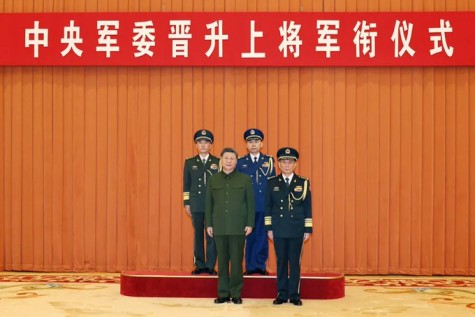
China announced the promotion of Zhang Shuguang to the rank of General, appointing him head of the CMC Discipline Inspection Commission and director of the CMC’s supervision committee, replacing veteran political officer Zhang Shengmin.
At the same time, Wang Gang was promoted to General and appointed commander of the PLA Air Force. While both appointments may appear routine, analysts say they carry far greater political significance.
Morris noted that Zhang Shengmin is expected to retire soon, potentially paving the way for Zhang Shuguang to become one of the vice chairmen of the CMC, China’s highest military decision-making body.
Wang Gang, meanwhile, is widely viewed as a likely entrant into the next CMC lineup expected to be unveiled in 2027.
If that assessment proves correct, Xi has effectively begun assembling the leadership team that will command the PLA through the next decade.
More Clues Emerge
The appointments were accompanied by another noteworthy development. Chinese Defence Minister Dong Jun and General Han Shengyan, commander of the Central Theatre Command, were photographed on Monday seated alongside senior PLA commanders during a gala celebrating the 105th anniversary of the Communist Party.
It marked the first time both officers had appeared in such a prominent military setting with the PLA’s senior leadership. Protocol often serves as an important political signal in China’s opaque system.
Their presence has stoked speculation that both Dong and Han are also being groomed for future membership of the Central Military Commission.
Morris further suggested that Yang Zhibin, appointed commander of the Eastern Theatre Command in December, could also become part of the next CMC leadership.
Taken together, the developments point to what may be the early architecture of Xi’s post-2027 military command.
Why the Central Military Commission Matters
The Central Military Commission sits at the apex of China’s military hierarchy. Unlike defence ministries in many democracies, China’s armed forces answer directly to the Communist Party through the CMC rather than to the state.
Xi Jinping serves as CMC chairman, giving him direct authority over military strategy, personnel appointments and operational planning. Membership of the commission is therefore one of the clearest indicators of who enjoys Xi’s political confidence.
Changes to the CMC are closely watched not only in Beijing but also in Washington, Tokyo, Taipei and other Indo-Pacific capitals because they offer rare insights into China’s future military leadership.
The Long Shadow of Xi’s Military Purges
The latest promotions come after one of the most sweeping anti-corruption campaigns ever conducted within the PLA. Since assuming power in 2012, Xi has repeatedly argued that corruption threatened the combat effectiveness and political loyalty of China’s armed forces.
His first major targets were former CMC vice chairmen Xu Caihou and Guo Boxiong, whose downfall shattered long-standing patronage networks within the military.
Xi subsequently reorganised the PLA’s command structure in 2015-16, replacing the old military regions with five theatre commands while overhauling procurement, logistics and command systems.
The restructuring was presented as necessary to transform the PLA into a force capable of “fighting and winning modern wars.” Yet the anti-corruption campaign did not end with institutional reform.
The Rocket Force Shake-up
The most dramatic recent purge came in 2023. China abruptly replaced nearly the entire leadership of the elite PLA Rocket Force, the branch responsible for the country’s conventional and nuclear missile arsenal.
Rocket Force commander Li Yuchao and several senior officers disappeared from public view before being removed amid corruption investigations.
The shake-up stunned observers because the Rocket Force occupies a central role in China’s military strategy, particularly regarding Taiwan and strategic deterrence.
The turbulence extended beyond the Rocket Force. Former Defence Minister Li Shangfu, appointed in March 2023, disappeared from public life within months before being removed from office.
His predecessor, Wei Fenghe, was later expelled from the Communist Party over corruption allegations.
The unprecedented removal of two consecutive defence ministers reinforced perceptions that Xi was determined to root out corruption even at the highest levels of military leadership.
Purges Reach Procurement and Equipment
The anti-corruption drive also swept through the PLA’s Equipment Development Department, responsible for weapons procurement. Numerous senior officers overseeing procurement and defence contracts were investigated or dismissed, raising questions about quality control, procurement integrity and readiness across China’s rapidly modernising military.
The cumulative effect has been a near-complete reshaping of the PLA’s senior leadership.
From Purging to Succession Planning
The latest appointments suggest Xi may now be transitioning from eliminating rivals to institutionalising a new leadership team composed of officers whose careers have advanced under his tenure.
Unlike earlier phases dominated by investigations and dismissals, recent developments point toward succession planning. The emergence of Zhang Shuguang, Wang Gang, Dong Jun, Han Shengyan and Yang Zhibin as potential future CMC members indicates that Xi is building a leadership cohort expected to implement his long-term military vision.
That vision includes transforming the PLA into a “world-class military” by 2049 while maintaining absolute Communist Party control over the armed forces.
Implications for the Indo-Pacific
Personnel decisions inside the PLA are never merely administrative. They shape China’s approach to Taiwan, the South China Sea, the East China Sea and military competition with the United States.
Several officers now being tipped for promotion command formations directly involved in potential Taiwan contingencies or oversee key strategic capabilities. As Beijing accelerates military modernisation while facing heightened geopolitical tensions, the composition of the next Central Military Commission will influence China’s defence posture well beyond its borders.
The Road to 2027
The next Party Congress in 2027 is expected to bring another major reshuffle of the Central Military Commission. If current signals hold, Xi Jinping has already begun selecting the generals who will lead China’s military into the next decade.
For outside observers, the promotions announced this week are less about individual careers than about reading the political choreography of one of the world’s most opaque institutions.
After years of relentless purges, the emphasis appears to be shifting from removing yesterday’s commanders to elevating tomorrow’s military elite.
Follow The Raisina Hills on WhatsApp, Instagram, YouTube, Facebook, and LinkedIn




